

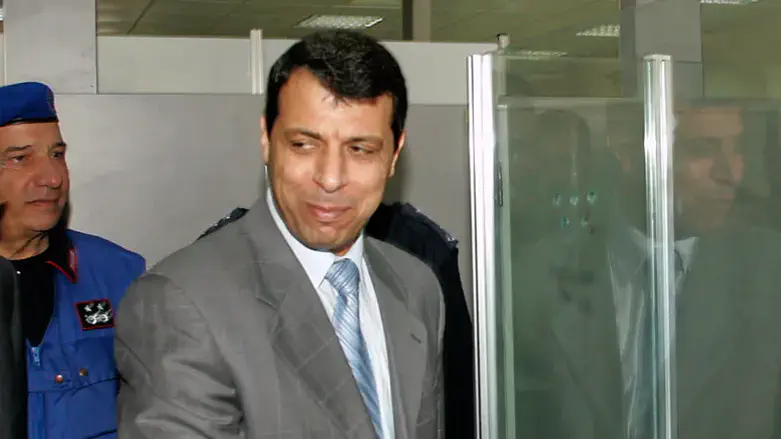
Recent reports from the Palestinian arena paint a picture that would have been difficult to imagine only a few years ago: Mohammed Dahlan, who for years was identified with the fierce struggle against Hamas in the Gaza Strip, is drawing closer to the organization that was once one of his bitterest rivals.
The development has received extensive coverage in Arab media, and not without reason. Dahlan is no ordinary Palestinian politician. He is one of the most controversial figures in Palestinian politics, a former senior Fatah official who headed the Preventive Security Service in Gaza, later fell out with Palestinian Authority President Mahmoud Abbas and emerged as one of his most prominent rivals.
Dahlan was also arrested by Israel several times in his youth and spent time in an Israeli prison over his activities with Fatah.
Later, as head of Gaza's Preventive Security Service, he became closely associated with the violent struggle against Hamas. Human rights organizations documented serious allegations concerning the conduct of Palestinian security forces during the period when Dahlan was one of the most powerful security figures in the Strip, including arbitrary arrests, torture and violence.
But Palestinian politics is now producing new and unexpected alliances.
In August, a meeting was held in Cairo between a Hamas delegation headed by Khalil al-Hayya and a delegation representing the political camp associated with Dahlan. The sides discussed the future of the Palestinian arena and the situation in the Gaza Strip. Reports have also emerged of the possibility of broader political cooperation between Dahlan's camp, Hamas and Palestinian Islamic Jihad.
According to recent reports by the Associated Press and Reuters, Hamas is examining a political framework that would allow it to challenge Fatah, with Dahlan's supporters also part of the discussions. The possibility itself points to a significant shift in the Palestinian balance of power: historic rivals may be willing to set aside some of their differences in the face of a common political adversary - the current Fatah leadership.
For Hamas, Dahlan brings clear advantages. He comes from within Fatah and knows the Palestinian political system well. He also has an extensive network of contacts in the Arab world and internationally, and has spent years building an independent political and financial base.
For Dahlan, meanwhile, ties with Hamas could provide a path back to the center of Palestinian politics after years of being pushed away from the centers of power within Fatah and the Palestinian Authority.
This is also where the potential significance for Abbas becomes clear.
The Palestinian Authority has for years faced questions over succession, internal power struggles within Fatah and a deep crisis of public confidence. Dahlan is one of the figures capable of challenging that internal balance from outside the formal leadership - precisely because he knows the system from the inside.
If Hamas, Islamic Jihad and Dahlan's camp succeed in establishing a joint or coordinated political framework, they could present Fatah with a new kind of challenge. This would no longer be a straightforward confrontation between secular Fatah and Islamist Hamas, but an attempt to bring together disparate forces whose main common interest is changing the existing balance of power.
For the Palestinian Authority, such a development could pose a significant political challenge. For years, the Fatah leadership has benefited from the fact that its rivals were divided: Hamas on one side, Dahlan and his supporters on another, with additional factions competing among themselves. Closer ties between these camps could reduce that advantage and make the struggle over leadership of the Palestinian arena far more complicated.
For Israel, the developments underscore the need to reassess assumptions about the day after Abbas.
For years, Israel has operated in an environment in which the Palestinian Authority and Fatah represented one political address, while Hamas was the principal rival outside the system. New alliances between former Fatah figures and Hamas could blur that distinction.
On the one hand, Dahlan is well known to Israel and to key Arab states, and has long been associated with extensive regional and international contacts. On the other hand, political cooperation between Dahlan and Hamas or Islamic Jihad could alter how Israel would have to view him and the political camp he leads.
The broader significance is that the Palestinian political system may be entering a period in which old alliances can no longer be taken for granted.
The historic hostility between Dahlan and Hamas has not disappeared, and there is no certainty that the current rapprochement will develop into a lasting alliance. But the fact that the sides are willing to sit together and explore cooperation is itself an indication of how dramatically political priorities may be shifting.
At stake is not merely a reconciliation between former rivals, but a potentially much larger struggle over who will shape the Palestinian arena in the post-Abbas era.