

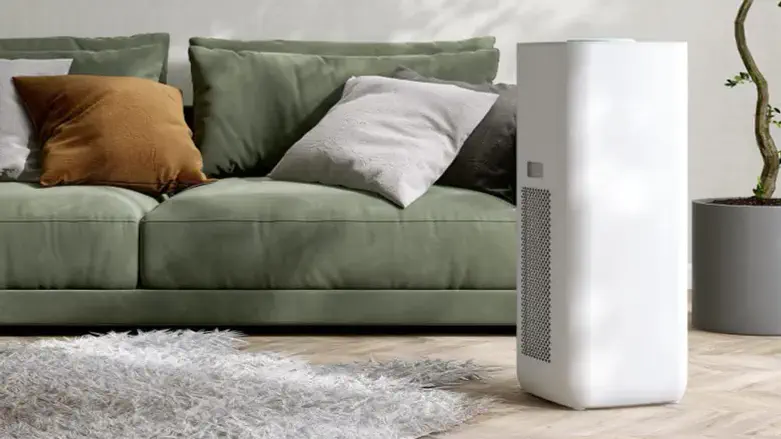
Choosing the best air purifiers in Israel is a different exercise from choosing one in London or Toronto, because the air behaves differently here, and so do the rooms.
Why Israel is a special case
Dust storm days bring in desert particles fine enough to get past a closed window frame, and they sit in carpets and mattresses long after the sky clears. Along the coast, humidity adds mould in bathrooms and wardrobes.
Israeli flats are small, and the bomb shelter, built to seal, is often the bedroom or the home office. A sealed room holds on to whatever is released into it, from cooking fumes to the off-gassing of a new sofa. Air conditioning cools the room but recirculates the air rather than replacing it, so the same particles go round and round.
Room size and ACH: the two numbers that matter
What decides whether a purifier is any use is how many times per hour it pushes the full volume of the room through its filters, known as air changes per hour, or ACH.
The guideline Tiltan works with is simple. For allergy relief you want at least three air changes per hour. For respiratory conditions such as COPD, at least five. For clearing cigarette smoke and its odour, at least nine.
Room size is the other half of the sum. A unit rated for 35 square metres in a showroom does not deliver three air changes in a living room with the door open to a kitchen. Choose for the space you actually have. And treat the CADR figure on product listings with care: it measures particle clearance only and says nothing about gases and smells.
Home, office or clinic: different rooms, different needs
At home the priority is usually the bedroom, where you spend eight hours breathing the same air. A compact unit running quietly all night does more for a child with asthma than a large machine in the living room that gets switched off at bedtime.
In an office the problem is people. Meeting rooms fill up with perfume, printer emissions and whatever the last occupant brought in, so you need coverage, ideally a unit on castors that can follow the crowd.
Clinics and waiting rooms are the hardest case: constant traffic, and people who are often already unwell. This is where the gap between a medical grade unit and a household appliance stops being a matter of preference. Air Purifiers from Austin Air are in use in hospitals in the United States and Israel for that reason.
What separates a medical grade unit from a cheap appliance
The word "HEPA" is applied loosely. A true medical grade filter is grade 13, capturing 99.97 percent of particles at 0.3 micron, and the better ones use glass fibre rather than paper. Beneath it sits the part most cheap units skip: activated carbon. Austin's HealthMate models carry more than 6.8 kilograms of carbon blended with zeolite, fifteen to thirty times what a standard appliance holds, and that is what actually deals with smells and fumes.
Build matters too. A powder coated steel body, oven cured, does not release paint toxins into the room. And a HEPA air purifier sold for Israel should arrive with a motor matched to Israeli voltage, no adapter and no transformer, backed by a warranty of up to five years and filters that last five years before they need replacing.
Where to start
Measure the room and be honest about what goes on in it. Then look at what is inside the machine rather than what is printed on the outside. Tiltan has been importing Austin Air since 1994 and will match a model to your room over the phone, at no charge.