
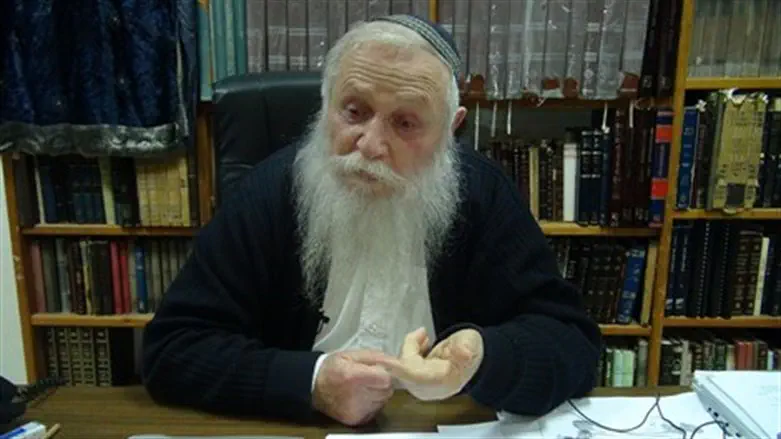
The following is an extract from “Bechayil U’v Ruach," the last book that Rav Chaim Druckman approved for publication before he passed away, less than a year before the start of the war in Gaza. The title of the book hints at the verse, “Not by might nor by power but by my spirit, the God of Hosts says" (Zecharia 4:6). The army of Israel applies this principle, as it fights - “By might - with the spirit of God."
(Adapted and translated by Moshe Goldberg)
Facing Difficulties
The hardships that come with living in our land and the world's resistance to our return there threaten to shake our faith in our path. They stir up doubts within us: Is our struggle really just? Are our wars fought in vain? Are we, in fact, occupying a land that does not belong to us?
A lack of faith in our cause weakens the nation and can even undermine the army's ability to do its job properly. When soldiers, commanders, and decision-makers are not convinced that the war they are fighting is a just one, they may in the end fight poorly.
To meet these challenges, we need a deeper understanding of our God-given right to this land. From such an understanding we may draw the strength to stand firm against every obstacle.
Our Right to Eretz Yisrael
Sefer Maccabim I (chapter 15) tells how Antiochus sent a demand to Shimon the Hasmonean: "You hold Yafo, Gezer, and the citadel in Yerushalayim - cities of my kingdom... You have taken control of many places in my realm. Now, give back the cities you have seized!"
Shimon was not rattled by these demands. He answered without missing a beat: "We have not seized a foreign land or taken control of what belongs to strangers! Rather, we have reclaimed the inheritance of our fathers, which our enemies seized from us unjustly. And now that the opportunity has come our way, we have regained our inheritance!"
That is how Shimon the Jew answered the representative of the Greek empire that ruled the land. Shimon stood for the small Jewish nation facing down the superpower of his day. He declared the Jewish truth boldly and courageously, without hesitation or apology: Eretz Yisrael is not occupied territory belonging to another people! It is the inheritance of our fathers, unjustly seized from us - and when the opportunity came we freed it from the hands of foreign occupiers!
We must follow in Shimon's footsteps and remember that this entire land is not occupied territory. It is our land, and it belongs to no other people. This land, restored to us, will remain ours forever - and here we will shine with the eternal light of Judaism.
Shimon was not the first one to give our people's enemies such a firm answer about our right to the land. Centuries earlier, Yiftach the Gileadite, one of Israel's leaders during the era of the Shoftim, did the same (Shoftim 11). The king of the Ammonites accused Israel of stealing his land and demanded it back: "Israel took my land when they came up out of Egypt... now, return it peacefully" (13).
But Yiftach wasn't shaken or uncertain either. He answered firmly, stressing that we received Eretz Yisrael from the Master of the World: "And now, Hashem, God of Israel, drove out the Emori before His people Israel - and will you now take it? ... We will take possession of whatever Hashem our God returned to us!" (23-24).
We must learn from Yiftach the Gileadite and Shimon the Hasmonean to stand our ground without hesitation, without stammering, and without backing down. These words, spoken thousands of years ago, need no explanation as to how relevant and current they remain today. We must learn to speak clearly and unambiguously - to insist on the eternal Jewish truth!
It is our duty to boldly proclaim in the voice of faith and truth - the voice of the Jewish people across the generations: Eretz Yisrael was meant for us, and all of it will be ours! This is a divine decree, and therefore it is an eternal reality that will never change.
"He Has Shown His People the Power of His Works"
In his very first comment on the Torah, Rashi cites a question raised by Rabbi Yitzchak in the Midrash: Why does the Torah begin with the story of creation? We would have thought that it should begin with the passage, "This month shall be for you" (Shemot 12:2), which contains the first mitzva given to Israel! After all, the Torah is not a history book!
Rabbi Yitzchak answers with a verse from Tehillim (111:6): "He has told His people the power of His works, giving them the inheritance of nations." Hashem told His people about the power of His works in creating the world - in order to give them Eretz Yisrael.
Rashi explains that if the nations of the world say to Israel, "You are thieves, for you have conquered the lands of the seven nations!" - Israel can reply: "The whole earth belongs to the Holy One, blessed be He. He created it and gave it to whomever He saw fit. By His will He gave it to them, and by His will He took it from them and gave it to us."
But we should ask: why do the Jews even need an answer to a claim the nations might raise? Let them claim whatever they want! What good does it do us to respond? Either way, they will not accept our answer!
It seems the real problem the Torah is addressing is not what the nations think of us but what we think of ourselves. The moral character of the Jewish people doesn't let them see themselves as robbers. When we believe in the justice of our cause and the integrity of our path, we can stand firm against opponents far more numerous and powerful than we are. But if we begin to feel that maybe we really are thieves and we start doubting the justice and morality of our struggle - we become weaker before our enemies, God forbid.
Rav Yaakov Moshe Charlap (Mei Marom 5, p. 5) points out that the verse in Tehillim doesn't say "He told the nations the power of His works, to give Israel their inheritance" - but rather, "He told His people." Hashem tells His own people that He is giving Eretz Yisrael to them. The moment they grasp that the claims of the nations fall silent. Our own belief in this claim is itself our answer to everyone else. The nations of the world can only accuse us of being robbers when we ourselves are not sure that they are wrong.
We can only lay claim to this land if we ourselves recognize our right to it. And our recognition of that right is linked to our faith that Hashem created the world - because without that, who's to say this land is really ours? Faith is the strongest foundation for our right to the land!
This plays out in our own reality. Without faith and Torah, the justice of our cause and our right to Eretz Yisrael are not clear to us, and our resolve can weaken.
We Must Avoid Illusions!
In the speech the Kohen anointed for war - Kohen Mashuach Milchama - delivers to the people before they go out to battle, he says: "Hear, O Israel: today you go to battle against your enemies. Do not lose heart; do not be afraid, or panic, or be afraid of them" (Devarim 20:3).
Why does the Kohen need to stress that they are going to war against "enemies"? If you're going to war against someone, they're obviously an enemy! What's more, the passage already opened by saying (1), "When you go out to war against your enemy"!
The Mishnah (Sotah 8:1) clarifies this: "'Against your enemies' - and not against your brothers. Not Yehudah against Shimon, nor Shimon against Binyamin - because if you fall into their hands, they will show you mercy... You are going out against your enemies, and if you fall into their hands, they will show you no mercy!"
The Kohen is warning the soldiers not to be confused - you are facing an enemy! This isn't an internal war among the tribes of Israel. Even if, God forbid, Israel ever reached the terrible point of fighting amongst themselves, they would still be brothers, and in the end they would show each other mercy, as we find several times in the Tanakh (Shoftim 21; Divrei HaYamim II 28). We are warned not to indulge in illusions, not to drift off into dreams and fantasies disconnected from reality. The enemies we face are not our brothers, and they have no intention of showing us mercy. Our enemies have no mercy on captives, living or dead!
Impressing this point on the soldiers before battle is not meant to discourage or weaken them - after all, the whole purpose of the Kohen's speech is to strengthen their resolve. Israel are compassionate, descendants of compassionate people, and compassion is one of their defining traits (Kiddushin 4a). That is exactly why the Kohen needs to stress to them as they head into battle that they must not show mercy to their enemies - because their enemies certainly have no intention of showing mercy to them!
That is what Chazal explained in the opening of this passage (Tanchuma, Shoftim 15): "When you go out to war against your enemy" -- "The Holy One, blessed be He, said: Go out against them as enemies. Just as they show you no mercy, you shall show them none! See what they say: 'Come, let us wipe them out as a nation, so that the name of Israel is remembered no more' (Tehillim 83:5) - that very nation whose name declares, 'Blessed is Hashem, God of Israel' (ibid. 106:48). Therefore, go out against them as enemies!"
Our enemies are out to destroy us - to silence the mouth that blesses Hashem, to wipe out "this people which I formed for Myself, that they might declare My praise" (Yeshayahu 43:21). They have no intention of showing us mercy - and so we, with no other choice, must suppress our natural compassion and fight our enemies with all our strength and might!
The Torah warns us not to trust our enemies, who lie and twist the truth - as testified by one of our nation's greatest military commanders, King David, who had many firsthand encounters with Israel's enemies on the battlefield (Tehillim 144:1,11): "Blessed is Hashem, my Rock, who trains my hands for battle, my fingers for war... Rescue me and deliver me from the hand of foreigners, whose mouths speak lies, and whose right hand is a symbol of falsehood."
We must not rely on our enemies or agree to painful concessions that serve their interests, just because we're impatient to finally rest and obtain our inheritance. Some think that if we give in to our enemy’s demands and give up parts of our land we will finally get peace and quiet, calm and tranquility. But beyond the fact that halakha forbids us from handing over parts of our land to foreigners, it is worth knowing that this would not help us at all.
The answer to our situation is for us to be strong. Just because they hate us, does that mean we should hand over part of our land? Will that make them love us? No, they will go right on hating us, because what they want is all of Eretz Yisrael, including Yerushalayim!
We must believe in our future and recognize that justice and truth are on our side. Everything happening in our generation proves that we are in the midst of a great process - the redemption of Israel. The prophecies of Israel's prophets are coming true before our very eyes, and we believe that everything the prophets foretold will yet come to pass!
Let us strengthen the State of Israel, materially and spiritually. Let us return to the true roots of the Jewish people. And with Hashem's help, we will keep moving forward - despite the fury of our enemies and those who wish to harm us!
"I Will Grant Peace in the Land"
In Parashat Bechukotai, the Torah promises that if we walk in Hashem's path and perform His commandments we will receive many blessings. Among them is peace, as is written (Vayikra 26:6): "And I will grant peace in the land, and you will lie down with no one to frighten you..." This implies that there will be no more wars. Yet the very next verse says: "And you will pursue your enemies, and they will fall before you by the sword" - implying that there will be wars, but we will win them!
Ibn Ezra explains in his commentary that the peace mentioned in the first verse isn't peace between us and our enemies but peace among ourselves. The Ramban comments: "there will be peace among you, and you will not fight one against another." Only when there is peace among us will we have the strength to pursue our enemies.
Before we talk about peace with the Arabs or with other nations, there must be peace within the people of Israel. Rather than chase an empty peace with those who hate us, we must work for peace among ourselves instead of pursuing an illusory peace that tears the nation apart. That would be the worst thing of all!
Both the sages and historians agree that the weak point of the Jewish community in the Second Temple period was the lack of unity among the people. As Chazal put it (Yoma 9b): "The Second Temple - where they occupied themselves with Torah, mitzvot, and acts of kindness - why was it destroyed? Because of unreasonable hatred." The nation was fractured and torn apart from within, and the Romans took full advantage of that to bring about our destruction.
The following verse in Parashat Bechukotai describes how we will come to pursue our enemies once we walk in Hashem's way: "Five of you will pursue a hundred and a hundred of you will pursue ten thousand, and your enemies will fall before you by the sword" (Vayikra 26:8). Once we reach a point where a few of us can rout many and our enemies are afraid of us, they will stop trying to harm us - because they will realize they cannot defeat us.
Only then will we be able to speak with them about genuine peace, with no need for painful concessions of parts of our homeland.