
Steven Teplitsky is creator and publisher of The Witness Ledger substack.
If there is one eternal, ironclad law of human civilization-right up there with gravity, compound interest, and the inevitability of bad tax policy-it is this: the people who feel the moral urge to explain war over cocktails are never the ones pulling shrapnel out of their boot heels.
Back in 1968, when America was busy turning Southeast Asian foliage into charcoal, the class division was refreshingly candid. If your dad ran a bank, sat on a zoning board, or played golf with a probate judge, you were declared far too fragile, thoughtful, and promising to be sent into a rice paddy. You got an educational deferment. You stayed on campus, read Herbert Marcuse, grew your hair into an unwashed mop, and agonized over Western imperialism while sipping draft beer. The guys who went into the jungle were nineteen-year-old auto mechanics from Toledo and farm boys from the Ozarks who couldn’t spell “existential crisis" and didn’t have five hundred bucks for community college tuition.
It was crude. It was unfair. But at least nobody tried to pretend the junior year abroad was an act of raw physical courage.
Fast-forward to the Levant, where the theater hasn’t fundamentally changed, even if the cast has traded draft boards for European art grants.
Every society at war has a very small, remarkably obstinate group of citizens who actually believe the place is worth bleeding for. In Israel, for the most part, it isn’t the crowd sipping iced oat-milk flat whites along Rothschild Boulevard in Tel Aviv. The people who actually pack their duffels and run directly toward the sound of explosions are the true believers-the ones from the periphery towns, the hesder and mechina yeshiva students, the religious kibbutzim, the "settlements", the blue-collar suburbs. They are the twenty-year-old conscripts who still think a national homeland is a non-negotiable proposition, accompanied by fifty-seven-year-old dentists, lawyers, shopowners and accountants who left their families on four hours’ notice because reserve duty isn’t an elective seminar.
Then you have the delicate aristocrats of Savyon and northern Tel Aviv.
These are the beautiful people. Their parents don’t have pull with a county draft board; they have something much better: dual passports, European cousins, and an aesthetic horror of vulgar nationalism. Rolling around in the dirt with an assault rifle is so hopelessly provincial. It smells of diesel fuel, sweat, and bad manners. So some of them choose the air force, some clandestine units, but many find themselves assigned to climate-controlled rooms, prestige tech desks, signals detachments -or they gracefully transition into film production, where the air conditioning is reliable and the lighting is flattering.
And what do they produce? Moral clarification for the international festival circuit.
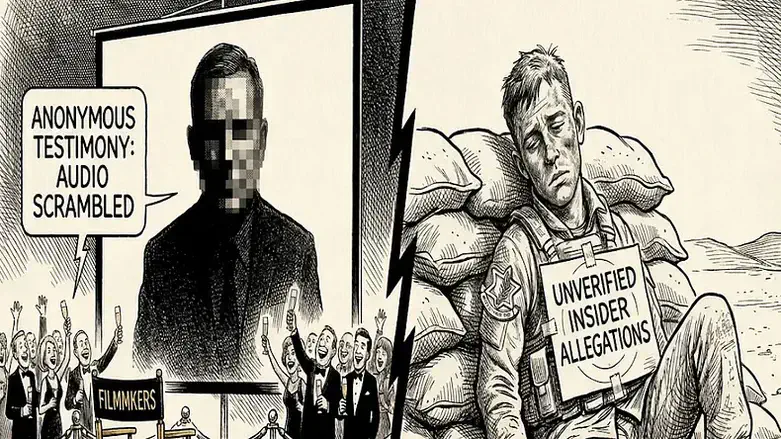
Their latest masterpiece arrives at Cannes or Venice with all the gravity of an Old Testament prophet, minus the sandals and the locusts. The premise is always identical: deeply troubled “insiders" blowing the whistle on the tragic, brutal, messy business of urban combat.
Producing this sort of high-minded swill isn’t an act of artistic courage; it’s an exercise in frictionless commerce. In a global cultural climate already pickled in knee-jerk hostility, telling an elite European jury that the home team is irredeemably monstrous requires about as much guts as telling a room full of Labrador retrievers that tennis balls are fun. The film doesn’t unearth a single fresh truth or grapple with an inconvenient paradox. It simply regurgitates the identical, salon-approved narrative, douses it in moody backlighting, and masks the rot in an intoxicating cinematographic hue so the black-tie crowd can feel deeply ethical about their oldest, favorite prejudice.
Yes, war is ugly. It is brutally ugly when innocent non-combatants are killed because an enemy has deliberately, cynically, or forcibly stacked them up as human shields on top of ammo dumps and tunnel shafts. That is an atrocity, a nightmare, and an agonizing strategic trap. But you will not find the filmmakers interrogating the gangsters who use children as sandbags. That doesn’t play to the crowd in black tie. It spoils the digestif. Instead, the lens is turned inward on the poor slobs tasked with clearing the rubble.
Only, when the screen lights up, the brave insiders have had their faces blurred until they look like defective Lego bricks. Their voices are run through synthesizer pedals so they sound like Darth Vader after a heavy night of bourbon. Nobody names an operation. Nobody produces an operational log. Nobody signs a sworn affidavit that might expose them to a subpoena, a uniform code violation, or an awkward dinner party in Herzliya.
It is courage by digital avatar-all the righteous thunder of speaking truth to power, with none of the inconvenience of having power know your address.
Historically, whistleblowing required a down payment of personal ruin. When Daniel Ellsberg leaked the Pentagon Papers in 1971, he walked into a federal courthouse facing 115 years in prison under the Espionage Act. Even Julian Assange and Chelsea Manning-whatever you think of WikiLeaks-put flesh and bone behind their provocations. Assange endured a decade of embassy confinement and high-security British lockups; Manning sat in a military brig. They were actual, identifiable public persons. They put their faces to the charge and accepted the crosshairs.
Not here. Here, anonymity is repackaged as a badge of honor, and the directors take home gold-plated statuettes while an audience in black tie weeps into their hors d’oeuvres over the tragedy of it all. It’s the ultimate boutique moral transaction: global applause for the storyteller, zero legal jeopardy for the source, and a tax write-off from the French Ministry of Culture.
Meanwhile, back in the actual mud, the fifty-seven-year-old reservist and the twenty-year-old infantryman take the real-world shrapnel.
And unlike the heroic cinema whistleblowers, real soldiers don’t get digital blurs. Their faces, their names, and their units are blasted across TikTok, Telegram, and activist doxxing channels worldwide. While the filmmaker flies business class to London, the kid who carried the stretcher is trapped at home-unable to take a post-army trip to Greece, backpack through South America, or set foot in Europe without checking Interpol red notices and wondering which heroic human-rights barrister is waiting at passport control with a magistrate’s warrant.
War is indeed ugly. It kills kids in olive drab and it kills middle-aged family men who should be coaching Little League. But the ugliest spectacle of all is a pampered home-front elite that wouldn’t spend twenty minutes in a trench, hiding behind scrambled audio to brand their own countrymen as war criminals-basking in foreign ovations, while leaving the conscripts to carry the danger, the legal fallout, and the bill.
There has always been a market for courage without consequences. War merely makes the price easier to see.
The soldier puts his name on the uniform. The critic puts a blur over his source. One comes home carrying the war; the other carries home the applause.
Perhaps that is the final obscenity-not that war produces accusations, but that we have learned to confuse the safety of the accuser with the courage of the accused.
And now you know who gets the applause-and who gets the shrapnel.