
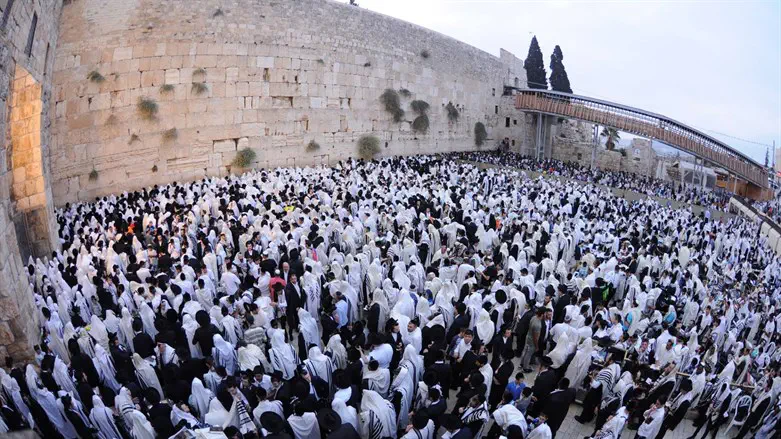
The overlay of Israel, glorious lyrics, and jubilant dancing with soldiers. These treasures can be found in Beri Weber's song-"Yachad." But how do we come together? This is an opportune question for Sukkot, where we unify the four species and gather together under the schach. How do we master the mechanics of loving every Jew and overcoming perceived conflict, all towards the aim of reaching unity? With unity, G-d declares Himself King to dwell among us. It's Sukkot that offers the opportunity to pierce through our vulnerabilities and become a nation of one.
How to Love every Jew
Charlie Harary explains that when one has a great love of G-d, he’s joyful in G-d’s love for all of His children. You get to draw from His infinite light, and you want others to experience that as well.
Shwekey captures this sentiment in his song “Lo Yaavod," with the video showing every kind of Jew, and the lyrics declaring that the ultimate way to serve G-d is by loving His children.
The Illusion of Incompatibility
Rabbi Orlovsky makes an important point when it comes to how we project what others think of us. In the story of Yosef, after the brothers go to bury Yaakov, they return to Yosef and tell him that their father asked that Yosef do them no harm. Yosef knew this was a lie because he never told Yaakov that brothers sold him. Therefore, Yosef understood that the brothers still believed Yosef was upset with them, when in fact Yosef had already moved on. It's important for us to realize that slights end, and we can't live based on our continued illusions that others still dislike us.
The power of thought is undeniable. When Yosef made a conscious decision not to think about Yaakov anymore in Mitzrayim, Yaakov's thoughts became less intense about Yosef. Our thoughts towards others directly affects how they think of us.
A rational approach to rid negative thoughts about others is to test them against a neutral person. The Gemara (Berakhot 5b) notes that a person can't get themselves out of jail. Once a thought lives in the subconscious, it's hard to free oneself of it.
One can choose many to open up to. One option would be to choose a rabbi because they were given the Divine quality to increase peace in the world (Berakhot 64b). In breaking through illusory thoughts of others, bonds can be created with those people to bring greater unity to the Jewish people.
What Unity Brings
The word Yachad has the numerical value of 22. It was with the 22 letters of the alphabet that G-d created the world. It is in unity that the bedrock of the world was founded.
When looking towards unity of the Jewish people, the quintessential verse (Devarim 33:5) says, "And He was King in Jeshurun, when the heads of the people were gathered, all the tribes of Israel together."
This pasuk is putting forth the fundamental idea that when we are one, our G-d is our protector. Even the wicked generation of Achav won military victories due to their unification, whereas Dovid's armies suffered losses.
As Beri Weber says, we must an agudah achat, one sheaf, to be under the umbrella of G-d's protection.
Ambassador Leiter expressed this sentiment saying that when the Jews are united miracles can happen.
We see the power of unity expressed in the Midrash Tanchuma. It compares Jewish unity to a bundle of reeds that can’t be easily broken, whereas individual reeds can easily be broken; the message being that a unified Jewish people can't be touched.
Unification of Self and the Four Species
The lulav the spine of man, sturdy and ready to serve G-d with purpose. Along with the lulav comes the etrog, the heart, emotion, for we must serve G-d with our mind and heart. When balanced, we reach a place of wholeness, where we have space for G-d and others.
We then have the eyes, the hadasim, which symbolize the desire to sin, to be led toward fulfilling our desires. But the etrog, the heart that’s bound with the lulav, has the power to defend against such action, as we say in Shema: don't go after your heart and the eyes. The heart comes before the eyes, for it's the heart and rationality of the mind that truly decides whether one goes astray. The decision to go astray lies within man, not his eyes.
And then we look toward the aravot, our lips, symbolizing our speech, which differentiates us from the animal. Using this vehicle, all four species unite and personify our ability to be holy vessels that can reach the heavens and embrace others, under the frame of togetherness.
On Sukkot, we are an agudah achat. We achieve unity within ourselves and others. In achieving unity, our King reigns over us and protects us from all outside forces.