

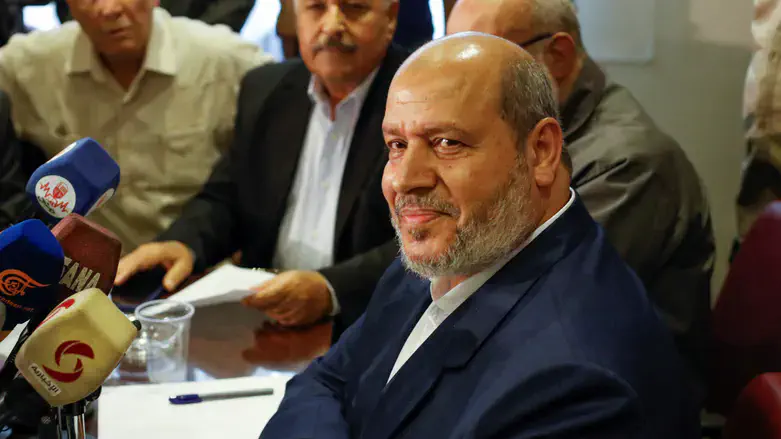
Hamas political bureau chief Khalil al-Hayya revealed that the terrorist organization has offered to mediate between the warring parties in Yemen and is coordinating with several countries to advance the initiative.
In an extensive interview with al-Araby TV, his first since assuming leadership of Hamas's political bureau, al-Hayya expressed hope that the mediation efforts would be accepted. He called on Arab and Muslim countries to overcome their disagreements and pursue dialogue, arguing that regional conflicts drain their resources.
Al-Hayya also addressed Hamas's regional relationships, describing the organization's diplomatic approach as balanced and emphasizing its desire to strengthen relations without interfering in other countries' internal affairs. He expressed hope for stability and development in Syria and said Hamas continues communicating with regional governments through meetings, telephone conversations, and correspondence.
Turning to Hamas's contacts with Washington, al-Hayya disclosed that he had met American officials more than four times over the past two years. According to him, the discussions focused on Hamas's demands, Israeli conduct, and the commitments Hamas had undertaken during the conflict.
He claimed that the American representatives demonstrated an understanding of the humanitarian and political issues raised and described the meetings positively. However, he maintained that diplomatic exchanges must translate into concrete measures compelling Israel to fulfill its commitments.
Regarding Gaza, al-Hayya reiterated Hamas's willingness to implement the roadmap presented by Nikolay Mladenov and mediators following months of negotiations. He said the organization was prepared to discuss the practical arrangements and establish a timetable for implementation.
He insisted that the roadmap must be implemented in its entirety, beginning with the completion of the first phase agreed upon in Sharm el-Sheikh last October and ultimately addressing Palestinian statehood and self-determination.
The intervening stages, he explained, include questions concerning weapons, Palestinian governance, international forces, Israeli withdrawal, and internal security.
"The agreement constitutes an integrated package," al-Hayya said, insisting that no party should implement selected provisions while disregarding the remainder.
He called for international intervention to ensure Israel's compliance and addressed Mladenov's role as representative of the Board of Peace. While acknowledging his efforts, al-Hayya said Hamas occasionally criticizes his approach and expects him to assume greater responsibility for implementing the agreement.
He also accused the Israeli government of undermining previous opportunities for an agreement, claiming that its negotiating positions and operations targeting Hamas negotiators prolonged the war and contributed to the deaths of Israeli hostages.
Addressing internal Palestinian politics, al-Hayya invited Palestinian Authority chairman Mahmoud Abbas to meet directly and establish a common national program.
He proposed that their meeting be followed by discussions among Palestinian factions and their leaders to reorganize national institutions, beginning with the Palestine Liberation Organization.
According to al-Hayya, ending Israeli military operations and providing humanitarian assistance to Gaza must be accompanied by efforts to achieve Palestinian unity.
He confirmed that Hamas had agreed to participate in Palestinian elections and was preparing an electoral alliance with other factions and political figures. He said Hamas had initially proposed a single national electoral list, but some Palestinian groups opposed that arrangement.
The emerging alliance, he added, remains open to additional participants and would continue operating even if elections were postponed.
He expressed hope that elections for the Palestinian Legislative Council and Palestinian National Council would reinforce political and geographical unity between Gaza, Judea and Samaria, and Jerusalem.
Al-Hayya also addressed the situation in Judea and Samaria, accusing Israel of "settlement expansion," burning homes, pursuing Palestinian Arabs, and targeting Muslim and Christian religious sites in Jerusalem. He described stopping Israeli military activity as the most immediate challenge facing Arabs.
He criticized the decision preventing Abbas from attending the UN General Assembly in person, arguing that Prime Minister Benjamin Netanyahu should instead have been barred from attending.
Discussing displacement, al-Hayya insisted that Palestinians would oppose attempts to remove them from their homes and would continue what he described as legitimate resistance.
He also defended Hamas's October 7 attack, characterizing it as a response to Israeli policies and attempts to marginalize the Palestinian issue. He claimed that subsequent developments had increased international solidarity with Palestinians, pointing to student demonstrations, public protests, professional and artistic initiatives, and delegations walking out during Netanyahu's UN address.
He called for that solidarity to produce practical diplomatic and political action.
On humanitarian assistance, al-Hayya said Arab and Muslim countries, alongside grassroots organizations, were willing to provide additional support to Gaza, but accused Israel of obstructing deliveries. He said Hamas had contacted governments to mobilize assistance and inform them of what it described as Israeli violations of existing agreements.
During the interview, al-Hayya also discussed the personal losses suffered by his family. He said his four sons who were killed had voluntarily chosen their path and that the deaths of his children, grandchildren, and other relatives had reinforced his determination to continue pursuing Hamas's objectives.
Addressing the upcoming Israeli elections, he said Palestinian Arabs had suffered under governments led by different Israeli political parties and that their principal concern remained securing their national rights.
He added that Palestinian Arab blood should not become "fuel for electoral competition" in Israel.