
Ofir Engelsman is familiar with the moment when a report of a terror attack becomes personal. About a year and a half ago, he himself was severely wounded in a ramming attack in the southern Hebron Hills.
Last week, when he heard about another terrorist attack that injured a soldier, the circumstances of the incident sent him back to the day of his injury. A short time later, he learned that the wounded victim was none other than IDF reservist Neria Leiter, his childhood friend.
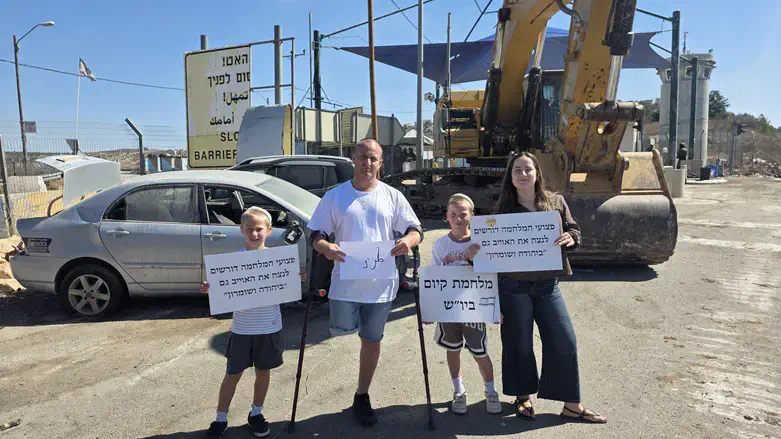
On Sunday morning, the second day of Sukkot, Engelsman arrived at the checkpoint where Leiter was injured to show support for the soldiers, pray for his friend's recovery, and to call for a defense policy change in Judea and Samaria.
"We came here today, during the intermediate days of Sukkot, to the checkpoint where last week our friend, the hero of Israel Neria Leiter, was injured," Engelsman told Arutz Sheva-Israel National News. "We pray for his recovery, for him to wake up and get up quickly."
For Engelsman, the scenes and details from the attack were not just familiar; they resurfaced the incident in which he was severely injured. "I heard about the attack about an hour after it happened. It sent me back to my incident," he recounted. "It's one-for-one what happened to me. Unfortunately, his case is much more severe, but it really sent me back there. I sympathized with him, and I felt as if it was happening to me at that moment."
And then he learned who the victim was. Engelsman and Leiter knew each other years earlier, as students in Shiloh. His memories of Leiter are not from the battlefield or the checkpoint; they're from their school days and the recesses when they would play together.
"I knew Neria in elementary and middle school in Shiloh. He was a year older than me. We played basketball together during breaks," he shared. "He is a very positive and happy guy. I also knew his brother, Moshe, of blessed memory. It's a special family."
The connection between his personal trauma and the injury of his childhood friend made the news particularly difficult for him, he said. "Not only did I relive my own terrorist attack, but this is also someone I know. Your heart just sinks. I immediately started thinking about how I was going to act and what could be done to prevent incidents like this from continuing to happen."
Driven by those feelings, Engelsman now wants to shift the discussion from the attack itself to security policy in Judea and Samaria. He rejects the notion that attacks carried out by lone-wolf terrorists are difficult to prevent in advance, arguing that a more proactive and offensive approach is needed.
"They keep telling us 'lone assailant,' 'lone terrorist,' and that there's nothing we can do about it. I don't accept that," he said. "We shouldn't just be defending ourselves. We need to go on the offensive."
His call, he explained, goes beyond improving protection for soldiers stationed at checkpoints. For him, the question is what happens before a terrorist even reaches them. "We shouldn't wait for it to happen. We are an army, and we need to take the initiative."
Engelsman also directed his demands at Israel's political leadership. "We demand that the defense establishment, the Prime Minister, and the Defense Minister launch a war in Judea and Samaria and deal with the terrorists, just as the IDF knows how to deal with terrorists in Gaza and Lebanon."
In conversations with reservists serving in the area, he said he encountered strong motivation, but also sensed a gap between the determination of soldiers on the ground and the policies imposed on them.
"The officer and the soldiers here are highly motivated, but I still feel there's a gap between those on the ground and the level above them. There's a gap in the willingness to take the initiative," he said. "I remember that from my own service as well. We always wanted to take the initiative."
Engelsman's remarks come as he himself remains far from completing his recovery from the terrorist attack in which he was wounded. A year and a half after suffering severe injuries, rehabilitation remains an ongoing part of his life, and he is still hospitalized. Over the past six months, he said, he has undergone two additional surgeries in an effort to regain his ability to walk as much as possible.
"I'm still undergoing rehabilitation, and I'm still hospitalized," he said. "Although I've moved to Ichilov, I've undergone two more surgeries over the past six months to try to walk again as much as possible. With G-d's help, I will walk again, but the rehabilitation is ongoing."
Drawing on his own experience, he also wants to draw attention to injuries that are harder to see. Behind physical wounds, he explained, there is often a prolonged psychological struggle as well.
"We need to remember and understand that we have many soldiers who are wounded emotionally, and of course, everyone who is physically wounded is also affected emotionally. With G-d's help, we must pray for every such soldier, for healing of both body and soul."
Thus, even as his own rehabilitation continues, Engelsman chose to visit the very place where his childhood friend was wounded. For him, returning to the checkpoint where an attack similar to the one that changed his own life took place is not merely a gesture of solidarity with Leiter, but also an opportunity to deliver his message.
"Either we live here alongside an enemy that wants to harm us, or we take action against it," he concluded. "We are the masters of this land. This is our home. Am Yisrael Chai."