


Explore how chat-based AI is changing scientific research, health information, and digital problem-solving while highlighting the importance of verification, human judgment, and responsible AI use.
Artificial intelligence is increasingly moving from the background of digital services into the daily routines of researchers, healthcare professionals, students, and ordinary people trying to understand complex information. Yet the most interesting development may not be AI diagnosing diseases or operating sophisticated laboratory equipment. It may be something more fundamental: the emergence of AI as a conversational research companion.
A chat-based AI platform can help users organize questions, explore unfamiliar subjects, compare explanations, summarize technical material, and generate new directions for investigation. In fields such as medicine and science, however, this convenience comes with an important condition: AI should expand human reasoning rather than replace it.
From Search Engines to Conversational Research
Traditional search engines require people to translate a question into keywords and then assemble an answer from multiple sources. Conversational AI changes this interaction.
Instead of searching separately for definitions, explanations, comparisons, and examples, a user can maintain a dialogue with an AI system. The conversation itself becomes part of the research process.
This is particularly interesting in science and health because many questions are not simple fact lookups.
Consider a question such as:
Why can two studies investigating the same medical intervention reach different conclusions?
Answering it may require understanding sample size, study design, statistical significance, population differences, measurement methods, and potential sources of bias. A conversational AI can help a reader identify these concepts and formulate better follow-up questions.
The crucial distinction is that AI can help structure the investigation without becoming the final authority.
The AI as a “Question Multiplier"
One of the less obvious benefits of conversational AI is its ability to generate additional questions.
A researcher who begins with one hypothesis may discover several adjacent variables worth examining. A student reading about a medical technology may realize that the ethical, economic, and technological dimensions of the subject are connected.
This makes AI useful not simply as an answer generator, but as a tool for expanding the intellectual map around a problem.
Why Health Information Requires a Different AI Mindset
Health is one area where convenience can easily become overconfidence.
An AI-generated explanation may sound coherent even when important context is missing. Symptoms can have multiple causes, scientific findings can be preliminary, and medical recommendations can depend on an individual's history and circumstances.
For this reason, responsible use of AI-generated health information should involve several steps:
1. Use AI to understand terminology.
Complex medical language can become easier to interpret through conversational explanations.
2. Ask for competing explanations.
Instead of accepting a single answer, users can ask what alternative interpretations exist.
3. Check important claims against authoritative sources.
Scientific publications, medical institutions, clinical guidelines, and qualified professionals remain essential.
4. Separate education from diagnosis.
An AI conversation can help someone prepare questions for a healthcare professional, but it should not automatically be treated as a medical assessment.
5. Pay attention to uncertainty.
Emerging research often does not provide definitive answers.
This approach transforms AI from an apparent authority into something more useful: an intellectual assistant whose output still requires human evaluation.
Use AI and the Experiment of One Conversational Workspace
The growing number of specialized AI services has created another problem - fragmentation.
One application may be useful for writing, another for brainstorming, another for research, and another for working with technical questions. For individuals and small teams, constantly moving between separate subscriptions and interfaces can become inefficient.
This is one reason the idea behind UseAI is worth examining as part of the broader evolution of AI tools. The service presents a chat-based approach in which users can interact with artificial intelligence without necessarily treating every task as belonging to a completely separate digital environment.
A discussion among entrepreneurs on Reddit about paying for multiple AI subscriptions versus using UseAI illustrates a practical concern that is becoming increasingly relevant: people are not merely asking what AI can do anymore. They are also asking how many tools they actually need to accomplish their work.
That distinction matters in scientific and health-related contexts. The objective is not to accumulate AI applications, but to create a workflow in which technology reduces friction while preserving careful reasoning.
What AI Can and Cannot Bring to Scientific Work
The most productive relationship between humans and AI may be neither complete automation nor complete skepticism.
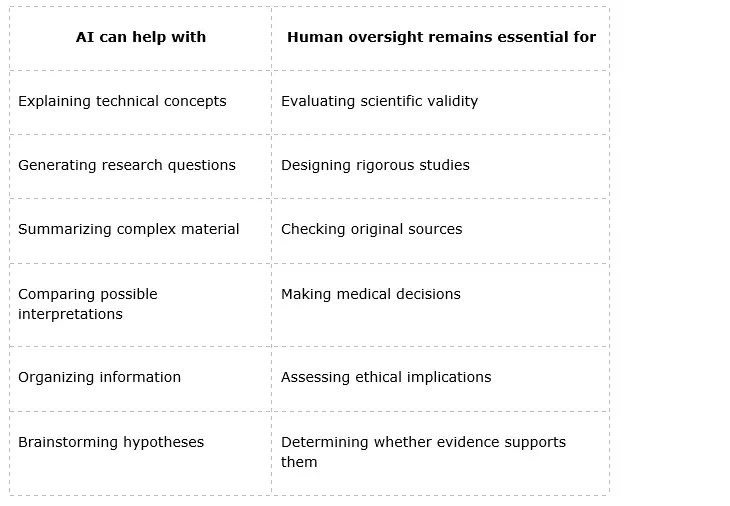
This division of responsibilities becomes especially important as AI-generated text becomes increasingly convincing.
The Danger of Plausible Answers
One of the defining challenges of generative AI is not that its answers always look obviously wrong. Sometimes the greater danger is that an incorrect statement can appear perfectly reasonable.
In medicine and science, a confident but inaccurate explanation can spread quickly when copied into presentations, articles, social media posts, or internal documents.
The solution is therefore not to reject conversational AI. It is to develop better habits around it.
Users should ask where a claim originated, whether evidence exists, whether sources disagree, and whether the information applies to the specific situation under discussion.
Toward a More Responsible AI Culture
The next phase of artificial intelligence may be less about spectacular demonstrations and more about everyday intellectual infrastructure.
AI systems can become part of how people learn, investigate scientific questions, interpret unfamiliar terminology, and organize complex information. But their value will ultimately depend on the quality of the interaction between human judgment and machine-generated assistance.
A useful principle is simply to let AI make the investigation broader, but let evidence make the conclusion stronger.
Chat-based platforms such as Use AI reflect this transition toward more accessible AI-assisted workflows. Their significance is not necessarily that they eliminate the need for expertise. Rather, they illustrate how conversational technology can give more people a starting point for exploring complicated ideas.
In health and science, that starting point can be powerful, but only when curiosity is followed by verification.