Daniel Winston is an American-Israeli marriage and family therapist, lecturer, and author who studied with Dr. David Schnarch, creator of the differentiation-based Crucible Approach, from 1998 until Schnarch's death in 2020. He runs twelve-hour intensive therapy sessions for couples and has trained more than 150 senior therapists worldwide in the Crucible Approach. He also serves in the IDF reserves and volunteers as a Magen David Adom medic, with ZAKA, and on the Israel Police Search and Rescue Team. His website is DanielWinston.com."?
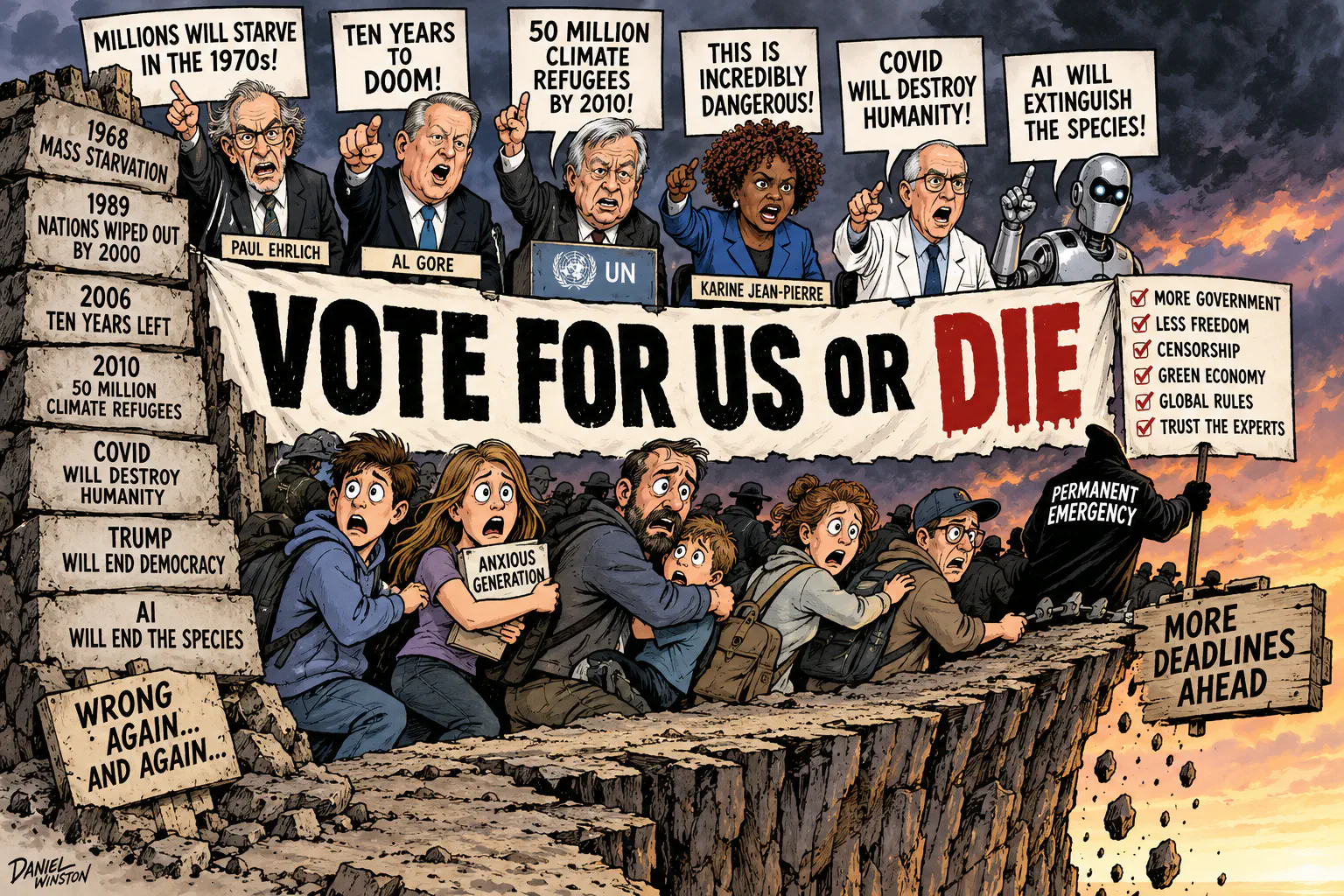
Paul Ehrlich announced in 1968 that the battle to feed humanity was over and hundreds of millions would starve in the 1970s. Instead the Green Revolution arrived and extreme poverty fell by two thirds. Ehrlich was not retired but decorated, with a MacArthur and a Crafoord Prize.
The pattern did not stop with him. A UN environment official warned in 1989 that entire nations would be wiped off the earth by 2000. Al Gore told audiences in 2006 that we had roughly ten years before the point of no return. The UN Environment Programme projected fifty million climate refugees by 2010, and when 2010 came and the refugees did not, the map quietly vanished from the website. Each deadline passed, and each passing was met not with humble revision but with a fresh deadline, in the same breathless tone of unbearable existential urgency, delivered to an audience expected to have no memory.
And the list does not stop at climate, nor does the hyperbole. Capitalism is a heartless death machine, so we require socialism. A second Trump term was going to permanently end American democracy and get black Americans killed in the streets. Covid would destroy humanity unless we surrendered the ordinary conduct of our lives to scientists and apparatchiks. Vaccine hesitancy threatened public health, disinformation threatened public discourse, and Karine Jean-Pierre stood at that podium and pronounced one thing after another to be incredibly dangerous. Most recently, artificial intelligence is going to extinguish the species, so the regulatory architecture must be built now, by the right people, before anyone can argue.
Some may yet prove partly right, and honesty requires admitting Covid killed more than a million Americans, which is not a hoax or a rounding error. The point is the method. Every one of these arrived with the same breathless rider attached: vote for us or die.
While the diagnoses vary wildly, the prescription never varies at all. Whether the emergency is carbon, a virus, an algorithm, a billionaire, disinformation, Moscow, or a Republican president, the remedy arrives in identical packaging: transfer authority upward to credentialed managers from the enlightened class, narrow the range of permissible speech, expand the administrative state into decisions that used to be private, hobble the economy out of a prudent abundance of caution and accept that America should occupy a smaller and more apologetic place in the world.
Effective diagnosis produces different treatments for different diseases. When every disease calls for the same medicine, the medicine was chosen first and the diseases recruited or invented afterward to justify the dose.
This is where political analysis gives way to something older, because the mechanism is not ideological. It is emotional. I have spent nearly twenty-five years as a therapist sitting with frightened families, and the pattern is unmistakable once you have seen it up close. Differentiation theory describes how anxiety moves through human beings. It is contagious, it travels faster than thought, and it does its worst damage by collapsing the distance between people. In a chronically anxious family, individuals stop functioning as separate selves. They emotionally fuse, surrendering enormous autonomy to whichever saviors volunteer to solve the anxiety for them by any means they deem necessary. The person or the politician who promises safety acquires the authority, and the arrangement is stable both because it is a matter of emotional survival and because it is never examined.
Now notice what happens when this transaction is manufactured rather than merely found. Generate the anxiety, then present yourself as the only sedative. It is one of the oldest controlling moves in family life. The parent who keeps a child convinced the world outside is lethal has not protected him. He has ensured the child never leaves, and everyone involved will call it love.
That is what serial apocalypticism does to a citizenry. A frightened public does not deliberate. It clings religiously to the one who promises safety and attacks whomever he labels as dangerous. It does not weigh trade-offs, ask who pays, or demand a track record. A frightened person looks for someone to both hold him and kill the monster. The endless emergency is therefore not only a forecasting failure but is the maintenance schedule on a population kept in free-floating anxiety, and every fresh deadline is an urgent booster shot against the unacceptable possibility that adult citizens might calm down well enough and long enough to think.
Although this pattern is destroying politics, the worst cost is not political. It is the generation now coming up, marinated since childhood in the message that the planet is finished, the country is irredeemable, their neighbors are fascists, and nothing they do will matter much either way. We are then astonished at the rates of anxiety and despair among the young, as though telling a fifteen year old that the world expires before his own children might reach first grade were a neutral act. It is not neutral. It is the emotional abuse of a population, conducted at scale, by people who repeatedly describe themselves as the ones who care.
The other side of permanent panic is that someday a danger will be real. It will find a public that has heard the scream too many times and learned, sensibly, to stop listening, and so conditioned to dread, that only a select few could possibly muster the adult muscular-mindedness the challenges will require.
The alternative is not optimism, which is just fear with better manners. The alternative is differentiation, the capacity to hold a serious problem in your hands without being possessed by it. A differentiated citizen can say the climate might be changing and still decline to hand his liberty to anyone asserting the emergency requires it. He can say a technology is powerful and still demand the evidence before the rules are written by the people who profit from writing them. He can be told the world ends in twelve years and answer, calmly, that he heard the same thing twelve years ago and would like to see the receipts.
That is what the fear machine cannot survive, and it is why the existential deadlines keep coming. A calm citizen is not a blind customer, and no one has ever sold him the vote-for-us-or-die package twice. He asks what happened to the last apocalypse, and he notices that the men who promised to save him from it never once offered to give the power back.