
Itzhak David Goldberg, MD, FACP, is a Professor Emeritus at Albert Einstein College of Medicine.
Every ascent, it turns out, begins with someone willing to go down.
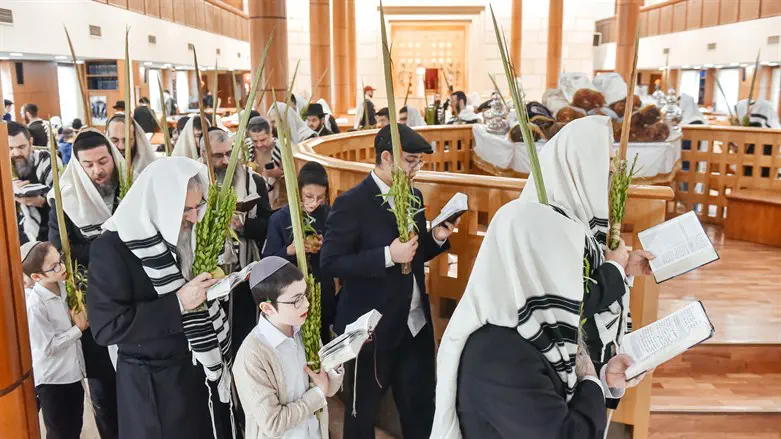
Below Jerusalem lies a place called Motza. Each day of Sukkot, in Temple times, people descended from the Temple heights into that valley, gathered towering branches of aravah, willow, and carried them on their shoulders back up the long road to the city. In the Temple they raised the branches upright around the altar, so tall that their crowns curved inward over it, as though the willows themselves were bowing toward the sacred center. Then the shofar sounded tekiah, teruah, tekiah and the people circled the altar, crying out:
אָנָּה ה' הוֹשִׁיעָה נָּא, אָנָּה ה' הַצְלִיחָה נָּא: “Please, Lord, save us; please, Lord, grant us success."
On the seventh day, they circled it seven times.
There is something breathtaking in the image. The aravah, humblest of the Four Species, was not found on the heights but down below, growing quietly beside the waters of Motza. Someone had to go down, lift them onto his own shoulders, and carry them upward. What began unseen in a valley came to stand at the very center of Jerusalem upright beside the altar yet still bending toward it. The willow travels from the lowest ground to the holiest place, and at the very summit of its climb, it bows.
The name itself holds this motion. In Hebrew, Motza can mean an outlet, an opening, the place from which something emerges. From Motza, the willows came forth.
The Hasidim tell this same descent as a story.
In I. L. Peretz’s “If Not Higher," the Rebbe of Nemirov vanishes every morning during Selichot. His Hasidim search the synagogue, the study house, every room the holy man might occupy, and find him nowhere. They are certain, with the fierce certainty of belief, that he has ascended to Heaven to plead their case. A visiting Litvak refuses to believe a word of it. One night he hides beneath the rebbe’s bed, pressed against the floorboards, determined to see with his own eyes where the man goes.
Before dawn, the rebbe rises. He dresses not in his Shabbat coat but in the rough clothes of a peasant, takes up an axe, and slips out while the town still sleeps. The Litvak follows at a distance, past the synagogue, past the study house, and on into the forest. There, instead of opening a prayer book, the rebbe swings the axe himself, gathers the wood he has cut, and carries it, on his own back, to the crumbling home of a widow too poor and too ill to gather fuel for herself.
He offers her the wood on credit, although both know she has no way to pay. She is too weak even to lift it into the stove. So, the rebbe kneels on her cold floor and builds the fire with his own hands. As the first flames take hold, he murmurs Selichot under his breath, the very words his followers believe are echoing through the halls of Heaven, spoken instead beside a widow’s hearth.
The Litvak, watching from the darkness, had come to expose fraud. He leaves with the sight of a man on his knees in someone else’s kitchen, warming the home of a woman he will likely never see again. From then on, when the Hasidim say that their rebbe rises to Heaven during Selichot, the Litvak no longer laughs. He only answers, quietly: “If not higher."
________________________________________
Across a valley from Jerusalem’s Old City, the stone lanes of Yemin Moshe run beneath Montefiore’s windmill; from its hillside, the ancient walls appear close enough to touch. In the 127-year-old synagogue, a veteran of Israel’s earliest wars, now past his hundredth birthday and honored with the President’s Award for his contributions to the country, rises to recite the Prayer for the State of Israel.
In October 2023, he buried a grandson serving in the IDF. And yet, after a century of service, war, and loss, he still greets each person with the same words: וָחַי בָּהֶם “and live by them." Not merely to remain alive, but to choose life.
Inside the synagogue, a father recited Kaddish for his son, an IDF reservist who had fallen only a week earlier. A single flight of stone steps led upward to the military mourning tent that still stood above the synagogue.
In that same synagogue, grandparents spoke of their grandson, a young IDF soldier standing watch in Gaza, once again called away from his studies at a hesder yeshiva. For the third consecutive year, he would be required to eat on Yom Kippur, not because his faith had weakened, but because his duty demanded a body strong enough to remain alert, vigilant, and ready. Pride and apprehension tangled together in their voices.
On the day his family would deny themselves food and stand before God praying to be inscribed in the Book of Life, their grandson would do the opposite: he would eat and drink because the lives of others depended upon his strength. Before taking the first bite, he would recite: “I am ready to fulfill the commandment of eating and drinking on Yom Kippur." The prayer invokes the Torah’s words וָחַי בָּהֶם “and live by them" and asks that every measure of strength drawn from that food keep him vigilant at his post. On this Yom Kippur, his meal would not be a departure from the holiness of the day. It would be his way of entering it. If not higher…
None of this folds neatly into a lesson. The father’s grief, the grandfather’s grief, the grandparents’ apprehension, these remain entirely their own, and no metaphor should pretend to carry those burdens for us. Yet these encounters ask something of everyone standing just outside that mourning tent, inside the old synagogue, or far from the soldier in Gaza: a country that sends its young people to defend it must also see them, hold them up, and be there, fully.
Rabbi Joseph B. Soloveitchik once drew upon this same image in a tribute to a beloved rebbe at Yeshiva University. He described American boys arriving with almost no Jewish learning of their own, half-strangers to a tradition that should have been their inheritance. Their rebbe did not wait for them to close that distance alone. He went to them, again and again, until they could open a sefer without fear, ask a question aloud, keep a Shabbat that finally felt like theirs. The rebbe saw in them the aravot, willows carried up from below Jerusalem, raised at last beside the altar, tall, straight, proud of their heritage yet bending in reverence toward the place they had reached.
The Mishnah names none of those who carried the aravot toward the altar. It says only יוֹרְדִין “they went down." The verb is plural; the people remain anonymous. Perhaps that anonymity is the Mishnah’s final summons to us: leaders, teachers, laypeople, commanders, and communities willing to leave the heights, willing to descend to where another person is waiting, willing to keep an appropriate place set at the table, next to our national heroic altar.
The soldier in Gaza is standing watch tonight. When he comes home, let there be hands ready to receive not only him, but also whatever he is carrying home with him, seen or unseen. And those who are young enough, strong enough, able enough: let this be the year they hear their own name and reach higher, if not higher.
The valley remains. Perhaps it always will. And somewhere below, a willow is waiting for someone willing to leave the heights, descend into the darkness, and carry it upward. High. If not higher.