
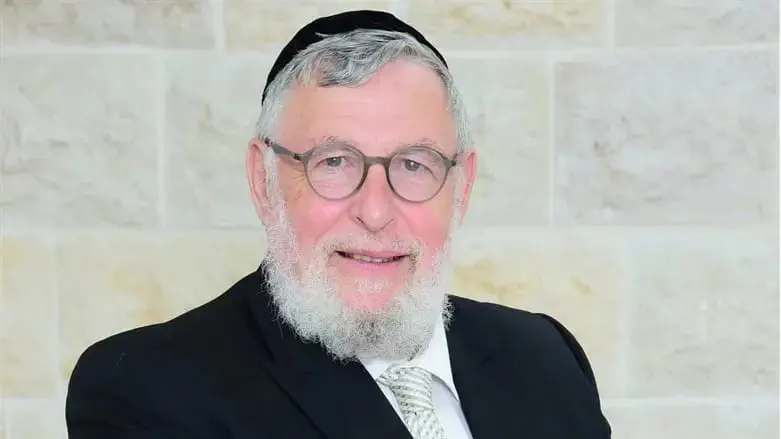
Rabbi Eliezer Simcha Weiss notes: While I serve as a member of the Council of the Chief Rabbinate of Israel, the views expressed here are my personal views.
It is only a few days since Yom Kippur, the holiest day of the Jewish year. Throughout the hours of fasting and prayer, Jews around the world were united by the memory of the Avodah-the service of the Kohen Gadol (High Priest) in the Beit HaMikdash (Holy Temple).
In the Mussaf prayer, we recalled each stage of the Kohen Gadol's service as he entered the Kodesh HaKodashim (Holy of Holies). We remembered the glory of Jerusalem when the Temple service stood at the centre of Jewish life, and we mourned its destruction and the loss of that service.
For two thousand years, these prayers have not been merely a remembrance of the past. They express a living longing for Jerusalem, for the Beit Hamikdash and for the return of the Avodah.
But if these prayers are truly meaningful to us, they cannot remain only words.
How, then, can we leave Yom Kippur and remain silent when a place inseparably connected with the Beit Hamikdash is being presented as the setting for a major international prayer event of another faith?
The question is not first about Christians. It is about us.
It is about whether we mean what we say when we pray.
This Is Not a Rumour
This is not a rumour or a theoretical concern. The event is being publicly advertised by its organizers.
The Global Prayer Event for Israel, scheduled for October 7, 2026, is being promoted as a 24-hour global prayer gathering broadcast from Jerusalem. The organizers have advertised it as being “Live from the Western Wall (Kotel), Jerusalem, Israel," and are calling on churches, ministries, pastors and Christian communities around the world to participate, including through livestreams and local watch gatherings.
This is therefore not simply a matter of Christian visitors coming to Jerusalem and privately offering a prayer.
Christians who come to Israel as friends and supporters, such as these, are, of course, welcome as visitors. The question is different: should the Kotel itself, or another location immediately connected with the walls of the Temple Mount, be used as the setting and international broadcast platform for a large-scale Christian prayer event?
There has also been discussion about whether the event might be filmed from another location in the area, including the Southern Wall. That distinction should not obscure the larger issue.
The question is not simply where a camera is placed.
The Southern Wall is also part of the walls surrounding the Temple Mount, the site of the Beit HaMikdash. Whether the broadcast is presented as taking place at the Western Wall, the Southern Wall, or another location immediately connected with the Temple Mount, we should not lose sight of what these places represent.
Our concern is therefore not merely with a particular square or a particular camera angle. It is with turning a place inseparably connected with the Beit HaMikdash and with Jewish prayer into the setting for an international prayer event of another faith.
For me, the answer is clear: this should not take place.
But before we ask what others should or should not do at the Kotel, we have to ask ourselves something more fundamental:
What do we mean when we pray on Yom Kippur?
On Yom Kippur, we do not merely remember that the Beit HaMikdash once existed. We describe the Avodah of the Kohen Gadol in extraordinary detail. We remember the incense, the blood, the entry into the Kodesh HaKodashim, the holiness of the service and the moment when the Kohen Gadol emerged from the Holy of Holies.
We mourn the fact that this service is no longer with us.
We ask Hashem to restore Jerusalem and the Beit HaMikdash.
These are not historical sentiments. They are prayers.
If, immediately after saying all this, we are prepared to treat the Kotel as simply another convenient location for an international religious event, we have to stop and ask ourselves whether we have really understood what we were praying for.
We cannot say that we are longing for the Beit HaMikdash and, at the same time, act as though the religious character of the place that remains to us is of little consequence.
The Kotel is not simply an archaeological monument. It is not merely a symbol of Jerusalem. It is a place where Jews have poured out their hearts before Hashem for generations.
For a Jew who has just stood on Yom Kippur and mourned the destruction of the Beit HaMikdash, that should mean something.
It should affect how we relate to the Kotel.
It should affect what we are prepared to permit there.
And it should affect the way we speak when the character of the place is being challenged.
Are Our Prayers Meaningful?
There is a difficult question that we should be willing to ask ourselves.
If we pray for the restoration of the Beit HaMikdash but are unwilling to protect the Jewish character of the places that remain connected to it, what exactly are we asking for?
If we say that Jerusalem and the Beit HaMikdash are at the centre of our prayers, but when a practical question arises we say that these things are not important enough to defend, are our prayers expressing a real commitment-or have they become words that we repeat because that is what Jews have always said?
We should not be comfortable with that contradiction.
We have to be true to ourselves.
Our prayers cannot mean everything when we are standing in the synagogue and mean nothing when we walk outside.
This is not about being extreme. It is about being honest.
If the Kotel is important enough for us to cry over on Yom Kippur, it is important enough for us to protect throughout the year.
And protecting it does not mean disrespecting anyone else.
It means taking seriously what we ourselves believe.
Friendship Does Not Require Giving Up Our Boundaries
Israel has many Christian friends around the world, and we have every reason to be grateful for their support. Many Christians have stood with Israel in difficult times, spoken publicly in Israel's defence, and shown genuine concern for the Jewish people.
That friendship should be appreciated.
But friendship does not require us to blur the boundaries between our religions.
A Christian can stand at the Kotel and respect its importance to the Jewish people. A Christian can visit Jerusalem and pray in accordance with his or her own beliefs. What is different is making the Kotel, or another place immediately connected with the Temple Mount, the central setting for an international Christian prayer broadcast.
We can stand together without praying together.
That distinction is not hostility. It is respect for religious identity.
We do not go to churches or mosques and ask to conduct Jewish prayer services there. We should not expect other religions to accept such an arrangement in their places of prayer. The same principle should apply to the Kotel.
There is nothing insulting in saying this.
On the contrary, it is possible to respect another person's faith while being clear about our own.
Pikuach Nefesh Cannot Be Used to Avoid This Question
I have heard an argument that we should be careful not to offend evangelical Christian supporters because of the political and strategic support they provide to Israel.
The principle of pikuach nefesh-the obligation to save human life-is one of the most important principles of Jewish law. But it should not be invoked casually to justify every political or diplomatic consideration.
There is a profound difference between genuine danger to human life and the fear that setting a religious boundary might upset an important friend.
Israel can appreciate the friendship and support of Christians while still saying: the Kotel is a Jewish place of prayer, and we ask that this be respected.
That is not ingratitude. It is simply clarity.
We should never assume that our friends will respect us only if we are unwilling to say no.
We Must Know What We Are Protecting
The physical security of Israel is essential. We need strong defence, courageous soldiers, responsible leadership and reliable friends.
But a nation also needs to know what it is protecting.
The Kotel is one of the clearest expressions of the Jewish connection to Jerusalem. For generations, Jews have turned toward this place in prayer. On Yom Kippur, we cried over the destruction of the Beit Hamikdash. We should not then behave as though the character of the places connected with it is unimportant.
Our commitment to the Kotel does not require us to insult anyone else. Nor does it require us to question the sincerity of Christian support for Israel.
It simply requires us to be honest about what the Kotel means to us.
After Yom Kippur
Yom Kippur has now ended. The fast is over. We have returned to our homes, our families and our daily lives.
But the words we said should remain with us.
We asked Hashem to restore Jerusalem. We mourned the destruction of the Beit HaMikdash. We described the service of the Kohen Gadol with longing and tears.
We cannot say those things and then behave as though the Kotel is merely a backdrop, a tourist attraction or a convenient international stage.
If we believe that the Beit Hamikdash matters, then what remains connected with it matters. If Jerusalem matters to us, then the Kotel matters. And if our prayers on Yom Kippur are real, they must have meaning in our actions as well.
This is why the proposed October 7 event cannot simply be dismissed as a question of diplomacy or public relations.
It asks us to decide what we ourselves believe.
We can be grateful to our Christian friends. We can welcome their support for Israel. We can work together on matters of common concern. We can stand together when Israel is threatened and when antisemitism raises its head.
But we must also be able to say, respectfully and without hostility: the Kotel is a place of Jewish prayer, and that boundary must be respected.
We can stand together without praying together.
That is not a rejection of friendship.
It is a recognition of who we are.
And after everything we said on Yom Kippur, we owe ourselves nothing less than that.