

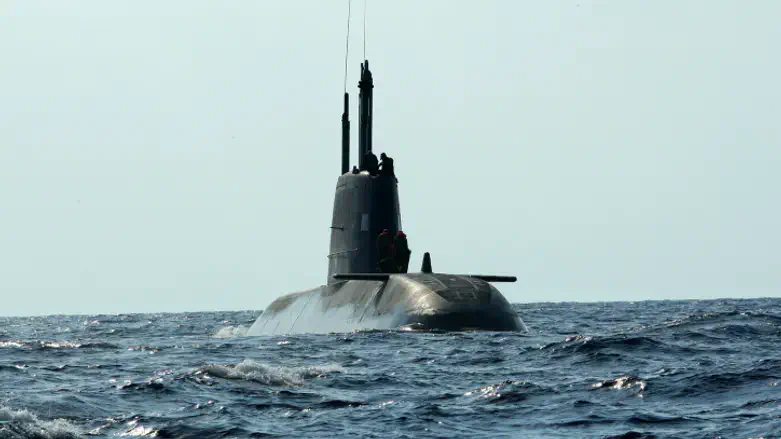
The Israeli defense establishment’s push to expand its subsurface fleet to eight vessels following the delivery of its latest German built submarine is a multi-billion-dollar exercise in strategic inertia. This fixation on stacking traditional crewed hulls to counter Turkey’s massive MILGEM naval expansion is not just financially reckless- it is doctrinely obsolete. Doubling down on slow-moving, multi-billion-dollar steel tubes ignores the fundamental reality of modern maritime conflict.
By chaining its naval strategy to foreign shipyards and antiquated concepts of passive second-strike deterrence, Israel is blinding itself to two asymmetrical force multipliers that could systematically dismantle a superior surface adversary: large-scale domestic combat automation and a precision-guided preemptive or preventive strike doctrine.
The Toy Submarine Problem: Escaping the Blue Whale’s Shadows
Israel’s current standard-bearer for autonomous underwater warfare, the IAI Blue Whale, is a remarkable piece of engineering for what it was built to do-but it is entirely unfit for the looming Mediterranean theater. Measuring just 10.9 meters long and weighing a mere 5.5 tons, the Blue Whale is a compact reconnaissance scout. It is optimized for tucked-away, passive intelligence gathering, seabed mine-countermeasures, and towed array sonar detection. It crawls through the water at an operational speed of 2 to 3 knots, has zero kinetic teeth, and possesses absolutely no internal capacity to carry offensive payloads. Expecting the Blue Whale to contest an aggressive surface fleet is like bringing a quad copter drone to a dogfight against an F-16.
Instead of buying an eighth crewed submarine from Germany, Israel should funnel those billions into the domestic development of authentic Extra-Large Unmanned Underwater Vehicles (XLUUVs). A true combat XLUUV -- mirroring the scale of platforms like the American Boeing Orca-- spans over 15-25 meters, weighs upward of 50 tons, and utilizes robust hybrid diesel-electric propulsion to unlock a staggering 6,000+ nautical mile range.
Crucially, an XLUUV features a massive modular payload section. This structural volume can be stuffed with heavyweight torpedoes, encapsulated hypersonic anti-ship cruise missiles, and offensive mobile sea mines. Driven by advanced AI, a Wolfpack of domestically produced XLUUVs could persistently stalk, blockade, and lethalize contested waters at a fraction of the acquisition and human cost of a single Dolphin-class submarine.
Bypassing the Aegis Mindset: Speed, Angle, and the Glide Corridor
The second strategic blunder is Israel’s clinging to a purely defensive naval posture. If war erupts in the Eastern Mediterranean, a localized surface fleet will be choked out by sheer numbers unless Israel adopts a radical Pearl Harbor-style surprise preventive strike doctrine. This approach strips the initiative from the adversary before their fleet can scatter from port, utilizing high-velocity, precision asymmetric asset such as land-based long-range ballistic missiles equipped with Maneuvering Reentry Vehicles (MaRVs), Hypersonic Glide Vehicles (HGVs), and air-or-sea launched Hypersonic Anti-Ship Cruise Missiles (HASCMs). To ensure the enemy fleet is not capable of launching an emergency sortie, or surviving warships are incapable of escaping, our XLUUVs should covertly lay time activated minefields off enemy ports.
However, should elements of the enemy fleet reach open water, we could present them with another, tactical, surprise consisting of large numbers of high-speed, long-ranged unmanned flying wing drones designed for low-radar-observability and heavy payload capacities. By opting for a stealthy flying wing geometry, these platforms achieve the lift-to-drag ratios required to transit the Eastern Mediterranean without refueling. Operating at high subsonic speeds, a squadron can reach a target area hundreds of miles off Israel’s coastline in under an hour-- outpacing and trapping any surface hull.
While XLUUVs form a persistent underwater screen and land based missiles offer rapid long-range bombardment, the flying wings provide a flexible stand-off option. They can trail a target fleet outside its air-defense envelope, processing real-time tracking data and releasing an assortment of weapons. These might include an assortment of 533mm heavyweight acoustic-homing torpedoes, lighter rocket assisted torpedoes, quasi ballistic missiles like the air launched LORA or HASCMs. This potent weapons mix could be simultaneously launched from multiple vector angles to overwhelm enemy shipboard defenses.
While the IAF might complain about the additional cost of building such an unmanned navy dedicated air fleet, its availability can easily complement both land and sea based strike assets without requiring the use of manned fighter bombers, that might be needed elsewhere. Of course, IAF Collaborative Combat Aircraft could always accompany a naval drone strike to provide air defense against enemy interceptors. This should calm Air Force fears of being considered “irrelevant" to the war at sea.
In any event, it’s important to stress how dangerous the air-launched HASCM will be to an enemy fleet caught out in the open.
Computer based exercises have clearly shown that HASCMs are able to defeat almost all current ship-based defenses given their tremendous speed, unpredictable terminal evasive maneuvers and sophisticated anti jamming capabilities. If paired with HGVs, though, the odds of a warship surviving a combined attack by these two systems are marginal, at best.
Why is this?
We understand the advantage that speed and last second maneuvering grants the HASCM. But what about the HGV? Why is that almost impossible to stop even with current state-of-the-art ship defenses?
Modern, sophisticated naval air defenses -- such as advanced phased-array radars and tiered interceptors- were engineered under the assumption that incoming threats travel in predictable, parabolic ballistic curves. However, HGVs turn this calculus inside out by exploiting a massive vulnerability known as the “glide corridor".
The Atmospheric Loophole:
Traditional defenses feature high-altitude space interceptors (optimized for the vacuum of space above 100 miles) and terminal atmospheric interceptors (optimized for the denser air under 25 miles). HGVs dive from space and level out precisely within the 25-to-60 mile altitude band. This air is too thin for aerodynamic steering fins to engage, yet too thick for space-based thrust-vector kill vehicles to operate, rendering the weapon mathematically unreachable by standard naval defense layers.
Unpredictable Maneuvering:
Unlike standard ballistic warheads, HGVs di not follow a fixed trajectory. They “skip" along the upper atmosphere at speeds exceeding Mach 5 to Mach 8, correcting course dynamically and unpredictably right up until impact.
The Vertical Blindspot:
Complementing this, biconical hypersonic cruise missiles use scramjet engines to maintain extreme velocity throughout their flight. They can approach naval targets from steep, near vertical dive angles. This directly exposes the geometric blind spots of shipboard radars and vertical launch systems, which are heavily optimized to look out toward horizontal, sea skimming threats.
Conclusion:
By pairing an uncrewed, AI-driven underwater surveillance network with high-velocity, land-and-mobile-based hypersonic and maneuvering ballistic strike systems, Israel could credibly neutralize an entire adversary fleet and its port infrastructure in minutes. Chasing an eight-submarine fleet is an unimaginative, defensive echo of the past. It is time for Israel to stop buying foreign hulls and start building the future of asymmetric maritime dominance.