
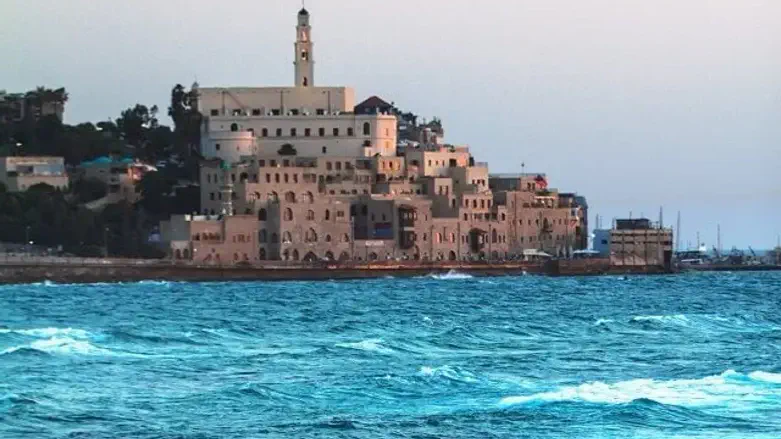
The attack lasted for seven days. Whole neighborhoods were targeted, Palestinian men, women and children were killed in the streets and in their homes, businesses were vandalized and looted, arson attacks were rampant, and women were raped.
The worst single incident targeted a hostel housing about 100 people, many of whom were refugees from previous ethnic violence. The residents, who were unable to prevent the mob from breaking in, tried to hide. The police arrived - and joined in on the side of the attackers. Some people, including a fourteen-year-old girl, managed to escape, but they were chased down and beaten to death.
The bloodlust started in the city, but it did not stay there. Attackers swarmed nearby Palestinian villages and homesteads as well, killing several people, including a very well-known writer and journalist, Joseph Chaim Brenner. His body, and those of six others murdered with him, were strung up on the walls of a nearby Muslim cemetery.
And it wasn’t just ‘extremists’ or ‘fanatics.’ Oh no. Members of the security forces took an active part in the mass assault.
After a week of violence, 47 of the targeted Palestinians were dead, over 100 were injured, and a complete ethnic cleansing took place. Hundreds of people (possibly as many as 2,500) were driven from their homes with little more than the clothes on their backs. Temporary tent cities and ramshackle huts were set up for the refugees along the Mediterranean shoreline and in open fields.
What happened to those Palestinians?
The Palestinian victims, in case you haven’t figured it out yet, were Jews. They were called Palestinian Jews then. The roving mobs (and the policemen who helped them) were Palestinian Arabs. And the massacre took place in 1921 in Yafo (Jaffa), with organized assaults on Jews in Petah Tikva, Rehovot, Hadera and Kfar Saba as well.
Thousands of Jews who fled the Arab violence in Jaffa and environs ended up in the relative safety of neighboring Tel Aviv, which had been established in 1910. Local Jewish authorities and civic organizers dealt with the sudden massive influx into the small suburb by rapidly setting up emergency tent cities along the beach and around what is today central Tel Aviv. They then began arranging shelter, food distribution and longer-term solutions.
Why do I call the Jews “Palestinian?" Because, as I am repeatedly told by pedantic terror apologists, there were Palestinian Muslims, Christians and Jews living together in this land. They even point to an interview in which Israel’s Prime Minister Golda Meir says she’s a Palestinian in their attempts to prove that Palestine was indeed a nation of some kind when what she actually proves is that it was solely a geographic term. And in fact, in her 1973 autobiography, My Life, Meir repeatedly refers to Jews from the land of Israel simply as “Palestinians."
(Never mind that some of the same apologists simultaneously try to present “Palestinian" as an ethnic Arab identity. Yeah, don’t ask me.)
The other Palestinians
In the Jaffa riots of 1921, there were also 48 Arab fatalities. They too can be called Palestinian, but their deaths were very different in nature. The primary cause was activity by British security forces intended to halt the Arab riots, reestablish order and protect Jewish civilians.
On May 1-2, 1921, for example, British troops deployed into Jaffa and its suburban sakanat (populated primarily by Egyptians and others who immigrated to Jaffa from across the Middle East in the mid-1800s), where they opened fire on Arab looters and attackers. Similarly, when an estimated 400 to 1,000 armed Arab fighters and Bedouin besieged Petah Tikva on May 5, a squadron of British cavalry launched a defensive operation with the support of RAF bombing and strafing runs.
A British officer named Major Lionel Mansell Jeune is credited with saving the lives of over 100 people at the port of Jaffa during the 1921 riots. When an armed Arab mob descended on the harbor area, Major Jeune gathered dozens of Jews who were passing through the port and the port workers into fortified warehouses and customs facilities. He placed the civilians under armed British protection and then personally commanded the force that repelled rioters attempting to force entry into the area.
Major Jeune’s actions were commemorated in May 2021, when the British Embassy in Israel and the Tel Aviv-Yafo Municipality unveiled a memorial plaque in his honor near the historic Jaffa Port.
A smaller portion of Arab casualties occurred in direct combat with armed Jewish defense groups, the main such group having been established just one year prior in response to the “Nebi Musa riots." During the 1920 attacks, Arabs killed five Jews and injured several hundred in Jerusalem. As the British authorities seemed unwilling or unable to defend the Jewish community from such aggression, some of the more activist Jews set up self-defense units (which came to be called the Haganah).
Not the first Jewish refugees from Jaffa
The Arab rioting of 1921 was not the first time that Jews had been driven out of Jaffa in the 20th century. During World War I, on the eve of Passover in 1917, imperial Ottoman forces ordered all civilians to leave Jaffa and Tel Aviv.
While the decree technically applied to the general population of the city, Arab residents were generally permitted to remain nearby or return to their homes within days. The Jewish population, on the other hand, was systematically forced out and kept away. By war’s end, then, the total number of refugees from Jaffa and Tel Aviv was 10,000, of whom at least 8,000 were Jews.
The Jewish refugees of 1917 headed north to Kfar Saba, Petah Tikva, Zichron Yaakov, Tiberias, Tzfat (Safed) and even Damascus. Severe shortages of food, harsh winter weather and widespread outbreaks of infectious diseases led to around 1,500 deaths.
In late 1917, Allied General Edmund Allenby and his British forces defeated the Ottoman army and captured Jaffa and Tel Aviv. Only then were Jews able to return to the area, where they reestablished their homes and communities.
At least until 1921 and the Jaffa riots.
The return to Jaffa - third time’s the charm
As a result of the 1921 riots, as we noted, the population of Tel Aviv swelled with thousands of Jews who permanently abandoned their homes in Jaffa. Many Jewish merchants who uprooted their businesses ended up contributing to a new, self-sufficient commercial center that was taking shape in the young city.
Nonetheless, over the course of the 1920s, thousands of Jewish residents gradually returned to live and work in Jaffa. By the early 1930s, the ancient port city hosted a sizable Jewish population once again.
For a while anyway.
Another series of Arab attacks swept through the country from 1936 to 1939. Out of approximately 415 Jews killed across all of Mandatory Palestine during that three-year period, around 20 were killed in Jaffa and its immediate borderlands.
Once again, thousands of Jews fled Jaffa due to murder, arson, property crimes, harassment and threats by Arabs. Temporary shelters went up once again for the refugees in Tel Aviv, this time in schools, synagogues, government buildings and industrial facilities.
From the vantage point of tall structures along the seamline between Jaffa and Tel Aviv, including the minaret of the Hassan Bek Mosque, Arab snipers fired directly into the nearby Jewish urban centers. During the 1936-39 period, however, British forces made repeated attempts to prevent the attacks.
There was a tense calm for about eight years, until the Partition Resolution (Resolution 181) was passed on November 29, 1947. From then on, with the British focused on packing up their things and going home, Arab snipers again began shooting at Jews in Tel Aviv from the Manshiyya neighborhood of Jaffa every day.
This persisted for nearly five months, until April 1948, when the Irgun (IZL) launched a four-day assault to isolate the hostile neighborhood, conquer it, break the siege on Tel Aviv and secure the border. Their massive artillery bombardment and infantry assault did more than that, it seems. There was widespread panic among the Arabs, many fled, their armed militias collapsed, and the city’s remaining notables surrendered (albeit to the Haganah) on May 13, 1948.
The success of the Jewish forces may have been, as observed by British High Commissioner Sir Alan Cunningham at the time, due to the flight of most of Jaffa’s political and civic leaders. They abandoned the city early and quickly via the port, traveling to Lebanon or Egypt. Around 4,000 Arabs remained in the city (out of a pre-war population of over 70,000).
In the wake of the Israeli War of Independence, Jews yet again returned to take up residence throughout Jaffa. Today, the city has a population of approximately 55,000 people, of whom 54% are Jews, 37% are Arabs (Muslim and Christian), and the remainder belong to other religious or ethnic minority groups.
No longer an ‘unobtrusive minority’
In the wake of the Jaffa riots, the British government set up a commission to investigate what it called the “Disturbances in May 1921." The Haycraft Commission of Inquiry reported that the “racial strife was begun by the Arabs, and rapidly developed into a conflict of great violence between Arabs and Jews, in which the Arab majority, who were generally the aggressors, inflicted most of the casualties."
Regarding the British-appointed Arab police at the time, the report said that they were, “with few exceptions, half-trained and inefficient, in many cases indifferent, and in some cases leaders or participators in violence."
Perhaps unsurprisingly, most of the Muslim and Christian Arabs condoned the attacks, according to the report. And even in 1921, the claim pushed by antisemites and their apologists that they are opposed to Zionists but not Jews was shown for what it is - a convenient lie.
“During the riots all discrimination on the part of the Arabs between different categories of Jews was obliterated. Old-established colonists and newly arrived immigrants, Chalukah Jews and Bolshevik Jews, Algerian Jews and Russian Jews, became merged in a single identity, and former friendships gave way before the enmity now felt towards all. On the 27th June, nearly two months after the first outbreak, two members of the Commission of Inquiry chanced to meet a band of decently dressed Arab children, whose average age could not have exceeded six or seven, marching in procession along the Ajami quarter, brandishing sticks and branches, and shouting the words, ‘We want to fight the Jews’. …So long as the popular feeling described above continues it will not be possible to maintain law and justice effectively, because the mass of the people cannot be trusted to do justice where a Jew is concerned."
Under the heading “Causes of Arab Hostility to Jews," the Haycraft report claimed:
“So long as the Jews remained an unobtrusive minority, as they did under the Ottoman Government, they were not molested or disliked. It was only when it came to be believed by the Arabs that the Jews were exercising a preponderating influence over the Government that a state of feeling arose which required but a minor provocation on the part of a small number of undesirable Jews to ignite an explosion of popular anger against Jews in general."
Until that point, of course, Muslims or Christians ran the show. I guess that was just fine, as long as the Jews knew their place - “unobtrusive," a “minority" and, most importantly, powerless.
No thank you, Muhammad. No thank you, Christoph. Those days are, God willing, dead and gone.