
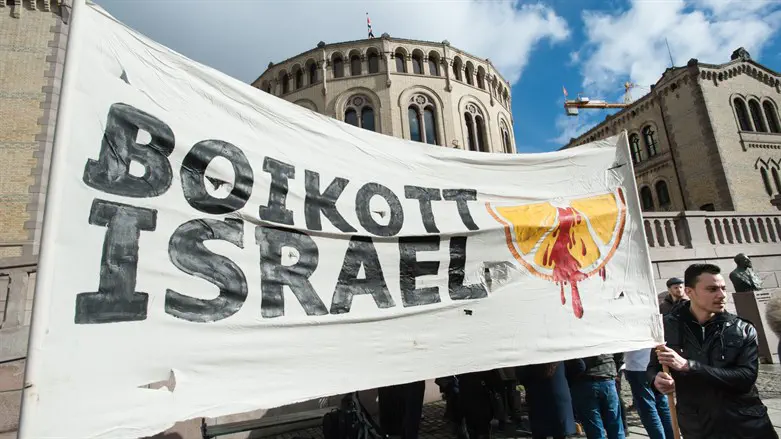
On September 8, 2026, twelve countries issued a joint declaration supporting or considering restrictions on trade in goods from Israeli communities in Judea and Samaria, also known as the 'West Bank'. The signatories were Canada, Denmark, Finland, France, Iceland, Ireland, Norway, Poland, Portugal, Spain, Sweden, and the United Kingdom. Britain, France, and Canada pledged to bring forward national measures.
The declaration did not establish an identical, immediately effective ban in all twelve countries; it encompassed commitments to national action, support for European restrictions, and measures still under consideration. [1]
The governments presented their initiative as a defense of the two-state solution against “settlement" expansion and violence. They also acknowledged Israel’s legitimate security interests and condemned the Hamas massacre of October 7, 2023. Those stated purposes distinguish their initiative from a comprehensive boycott of Israel. [2]
Nevertheless, the decision raises a question that the history of boycotts makes impossible to dismiss: how far can economic exclusion advance the political isolation of the Jewish state, even when it fails to cripple its economy?
To fully address this issue, one must examine the historical Arab League boycott alongside the modern evolution of the Boycott, Divestment, and Sanctions (BDS) campaign. The history offers substantial evidence of Israeli resilience. It also warns against assuming that commercial survival amounts to political victory.
The confidence that the boycott had failed
In The Arab Boycott of Israel: Economic Aggression and World Reaction, attorney Dan S. Chill recounts an unusually confident assessment. In July 1971, Tuvia Arazi, director of Israel’s Political-Economic Planning Division, announced that his division could end its eleven-year campaign against the Arab boycott. The boycott, he declared, “does us infinitesimal harm now. It is so inefficient and ineffective that we simply don’t need this Division anymore." [3]
The disparity in resources was striking. Arazi’s division had an annual budget of $15,000 and, at its peak, employed seven people. The Arab League’s boycott organization, based in Damascus, had eighteen branches and a staff of approximately two hundred. By the time the Israeli division ended its work, only two employees remained, with Jewish organizations abroad providing much of the financial support. [4]
Similar confidence persisted later in the decade. Writing in Foreign Affairs in April 1977, international business adviser Nancy Turck recalled that, during a 1975 visit to Washington, Israeli Minister of Commerce Chaim Bar-Lev had declared: “The Arab boycott means nothing to us. It has no effect on Israel." [5]
Such statements reveal how Israeli officials assessed the campaign at particular moments. They do not, by themselves, establish that the boycott imposed no costs.
A campaign that preceded the Jewish state
The boycott’s origins also challenge attempts to explain the entire history of economic exclusion as a response to Israeli governance of the disputed territories acquired during the 1967 Six-Day War. Organized campaigns against Jewish commerce preceded both that war and Israel’s establishment in 1948. [6]
According to the Esco Foundation’s Palestine: A Study of Jewish, Arab, and British Policies, the Fifth Palestine Arab Congress, held in Nablus in 1922, adopted a resolution calling for a boycott of Jewish businesses. The World Islamic Congress in Jerusalem in 1931 urged “the protection of the Holy Places in Palestine by boycotting Zionist goods." An attempt to boycott the Tel Aviv Levant Fair followed in 1932. In 1933, the Arab Executive Committee recommended a boycott of “Zionist goods, products, and commercial premises." The Pan-Arab conference at Bludan, Syria, declared the boycott “a patriotic duty" in September 1937. [7]
Despite these repeated appeals, the Esco Foundation concluded that the prewar boycott had not significantly altered Arab-Jewish commerce. Foreign correspondent Frank Gervasi reported that boycott activities were suspended during the Second World War. The campaign resumed formally in December 1945, when the Arab League adopted a declaration associated with Awni Abdul Hadi, a prominent member of the Arab Higher Committee. “Jewish products and manufactured goods shall be considered undesirable to the Arab countries," the declaration announced. It urged Arab “institutions, organizations, merchants, commission agents, and individuals… to refuse to deal in, distribute, or consume Zionist products and manufactured goods." [8]
Beginning January 1, 1946, the League’s seven member states-Egypt, Iraq, Transjordan, Lebanon, Saudi Arabia, Syria, and Yemen-were to boycott Jewish-produced goods from Palestine. [9]
Arab League Secretary-General Abdul Rahman Azzam explained the political objective. Jewish industry, he said, was “based on Zionist funds, collected in foreign countries to serve a political purpose: the establishment of a Jewish national home and state in Palestine." [10]
In his account, that objective depended on access to Arab markets. Testifying before the Anglo-American Committee of Inquiry in Cairo in March 1946, he defended the boycott as resistance to Jewish immigration and indicated that it would end only if the Zionists abandoned their political aspirations in Palestine. [11]
The Jewish Agency protested that “economic warfare against a section of a neighboring country is in conflict with the purpose and spirit of the United Nations, and contrary to the provisions of the charter." Yet economic interdependence limited the boycott’s reach. The Esco study emphasized the difficulty of separating Arab and Jewish markets without damaging Arab interests. [12] The Anglo-American Committee likewise reported that the boycott had “little effect thus far on the general economic situation." [13]
Expanding the machinery of economic warfare
These limitations did not prevent the campaign from expanding. Chill describes a June 12, 1946 resolution in which the Permanent Boycott Committee “suggests to the Council" that it “recommend to the [Arab] Governments" measures to implement the boycott. The language reflected the importance of action by individual governments; declarations alone could not ensure uniform enforcement. [14]
After Israel’s establishment, the effort developed into a broader campaign of economic warfare. In The League of Arab States: A Study in the Dynamics of Regional Organization, Robert W. Macdonald describes the boycott organization’s early emphasis on preventing the movement of prohibited goods. [15]
Gervasi traces the wider effort to obstruct Israel’s industrial development and its access to regional markets. He also describes legislation prohibiting commercial and other dealings with Israel and Israelis, with penalties that could include imprisonment, hard labor, and substantial fines. Telephone, postal, and telegraph links were severed, along with transport connections by land, sea, and air. The purpose was to make ordinary relations with Israel difficult and, in many circumstances, punishable. [16]
Egypt’s restrictions on the Suez Canal extended that pressure to international shipping. In February 1950, Egypt expanded its inventory of prohibited cargoes. By September, shipowners faced requirements to guarantee that cargo would not be discharged at Israeli ports and to submit their logbooks for inspection. Vessels that had called at Israeli ports could be blacklisted and denied provisions, fuel, and repairs in Egyptian ports. Detention and seizure of cargo reinforced the threat. Chill also links shipping restrictions to efforts to impede the movement of Jewish refugees from Arab countries to Israel. [17]
Yet even this extensive framework faced enduring limitations. Reviewing the record through 1970, Chill found that the “Arabs have been unable, or unwilling, to apply the Boycott regulations with precision and uniformity."
Gervasi suggested that the boycott might even have encouraged greater Israeli self-reliance. [18]
In The Arab Lobby, political analyst Mitchell Bard describes the dismissive assessments that preceded the Arab oil embargo of 1973, when oil-producing states demonstrated a different capacity to pressure countries supporting Israel. The oil embargo and the commercial boycott were related instruments, but their mechanisms and consequences should not be treated as interchangeable. [19]
The distance between official policy and actual trade
At its height, the boycott reached beyond direct trade between Israel and Arab states. The primary boycott prohibited that trade. The secondary boycott targeted foreign companies doing business with Israel, while the tertiary boycott extended pressure to companies dealing with blacklisted firms. [20] Reporting in 2006, journalist Orly Halpern described a blacklist that had once encompassed approximately 8,500 foreign companies. [21]
Enforcement, however, varied considerably. In his January 2013 Congressional Research Service report, international trade specialist Martin A. Weiss described it as sporadic and dependent on individual Arab League members. Public support for the boycott could coexist with commercial dealings that undermined it. [22] These were assessments of the situation at that time, rather than proof that every restriction had disappeared permanently.
Halpern’s 2006 reporting illustrated the ingenuity of traders seeking access to otherwise restricted markets. She described the use of Aramex and American mailing addresses to route goods through the United States and repackage shipments before they reached Arab destinations. She also quoted Danny Halperin, who had headed Israel’s authority against economic warfare: “Today the Arab boycott is all bark and no bite… We succeeded." [23]
An Arab official quoted by Egyptian journalist Dina Ezzat offered a comparable assessment: “Boycotting Israel is something that we talk about and include in our official documents," but it was frequently not implemented. Ezzat attributed the boycott bureau’s weakness in part to “the lack of political will on the part of most Arab states for a boycott of Israel." [24] Weiss also recorded the Arab League’s view that American pressure had weakened the campaign. [25]
These accounts demonstrate the recurring gap between public declarations and commercial conduct. They also expose the weakness of declaring a final victory. The failure of one enforcement system does not prevent a boycott campaign from finding new sponsors, institutions, or methods.
BDS broadens the campaign
On July 9, 2005, Palestinian Arab civil society organizations issued a call for an international campaign of boycotts, divestment, and sanctions. Its stated demands were Israel’s withdrawal from “occupied Arab lands" and dismantling of the separation barrier; full equality for Arab-Palestinian citizens of Israel; and recognition of Palestinian Arab refugees’ asserted right to return to their homes and properties under UN General Assembly Resolution 194. The call appealed to civil society organizations worldwide and urged pressure on governments to impose sanctions. [26]
This approach gave the campaign a much wider constituency than the Arab League’s offices and trade regulations had commanded. Universities, professional associations, churches, unions, and consumer groups could participate without waiting for an Arab government to enforce a blacklist. The language of human rights and the analogy with apartheid South Africa gave supporters a framework through which to seek international legitimacy. [27]
The movement’s program also extends beyond products made in Jewish communities in Judea and Samaria. Its refugee demand raises the question of Israel’s future as a Jewish state, which is why critics regard the campaign as a challenge to Jewish national self-determination and right to exist. [28]
A.B. Yehoshua, an Israeli novelist and peace activist, placed the “refugee" question in perspective in his March 31, 2000 Haaretz article, “Ending the Palestinians’ Circle of Misery." Discussing the 1948 war, he argued that Jews and Arabs who fled or were expelled but remained within what he regarded as their homeland should be called displaced persons rather than refugees. In his formulation, a refugee had left his homeland, while a displaced person had lost his home but remained within it. He described Jews who fled or were expelled by Arabs into Israeli territory as displaced persons who were provided with new homes in Israel. [29]
Yehoshua contrasted that resettlement with the continuing designation of displaced Palestinian Arabs as refugees. He cited Arabs from Ashdod and Ashkelon who moved to Gaza, and Arabs from Lod and Ramle who moved to the Ramallah area, as examples of people who remained within what he considered their homeland. His argument distinguished a return to a national homeland from a return to a particular family home. [30]
This was Yehoshua’s proposed distinction. UNRWA’s registration definition instead rests on residence in Palestine during the specified 1946-1948 period and the loss of home and livelihood in the 1948 conflict. [31] Some Palestinian Arabs who fled or were expelled went to Egypt, Syria, Lebanon and Jordan. [32] Jordan subsequently granted citizenship to many thousands of them. [33]
European governments that profess support for two states should therefore be judged against their own stated objectives. Support for a trade restriction does not establish agreement with BDS’s entire program. The relevant concern is whether a limited measure helps normalize wider exclusion, and whether its advocates maintain a clear boundary between criticism of Israeli policy and rejection of Israel’s legitimacy.
Economic resilience remains substantial
By 2021, Israel’s continued international trade and the spread of anti-BDS contracting measures in American states had encouraged declarations that BDS was failing. [34] Developments since then call for a more careful assessment.
The Israel Innovation Authority’s May 2026 report puts Israeli high-tech exports in 2025 at approximately $85 billion, or 58 percent of the country’s total exports. High-tech output grew by 8.2 percent in real terms that year and accounted for 18.3 percent of GDP. Those figures demonstrate the continuing international demand for Israeli technology. [35]
They do not establish that boycotts impose no costs. The same report states that exports account for approximately 79 percent of high-tech output, underscoring the sector’s dependence on international relationships. It also identifies a substantial gap between actual output and the level implied by earlier growth trends. Neither that gap nor the broader consequences of war can simply be attributed to BDS. Equally, export growth cannot reveal every contract lost, partnership abandoned, or opportunity forgone. [36]
American policy continues to create obstacles to foreign boycott enforcement. The U.S. Department of Commerce’s Office of Antiboycott Compliance administers rules that discourage, and in specified circumstances prohibit, participation by U.S. persons in foreign boycotts not sanctioned by the United States. These federal rules have a defined scope; they should not be confused with a universal prohibition on political advocacy or with every state-level anti-BDS measure. [37]
The economic record thus supports confidence in Israel’s capacity to compete, while leaving a separate question about its freedom to participate in international institutions. Commercial demand can preserve a market for Israeli products even as political campaigns make cooperation with Israeli institutions more contentious.
The struggle over academic and political legitimacy
The academic arena offers a concrete example of what has changed since 2021. In August 2024, the American Association of University Professors replaced its categorical opposition to academic boycotts with a policy recognizing that they can, in certain circumstances, constitute “legitimate tactical responses." The statement also opposes political or religious litmus tests and the targeting of individual scholars engaged in ordinary academic activity. It is not itself an endorsement of a boycott of Israel. Nevertheless, the change removed a longstanding institutional objection to academic boycotts as a method. [38]
Historian Jeffrey Herf has documented how campaigns over Israel seek the authority of scholarly organizations. In his account of the American Historical Association’s rejection of resolutions in January 2020, he argued that repeated efforts to condemn Israel formed part of a broader campaign against the state’s legitimacy. He also criticized presentations that minimized Israeli security concerns and omitted Hamas and other terrorist organizations. His account records successful resistance by scholars as well as the persistence of the campaign. [39]
A Final Note
The stakes extend far beyond the narrow outcome of a single faculty vote; universities forge the next generation of journalists, educators, officials, and political leaders. When contested accusations are weaponized and allowed to harden into unchallenged dogmas, they poison the discourse on Israel far beyond the campus. It is absolutely essential to aggressively confront falsehoods with hard evidence, fiercely defend academic exchange, and draw an unyielding line between legitimate critique and coordinated and financed campaigns to delegitimize an entire nation.
While the history of the Arab boycott proves that Israel can shatter major attempts to strangle its economy, recent hostile initiatives show why complacency is a dangerous luxury. Governments proposing these destructive restrictions must be aggressively forced to answer: how exactly do these measures advance a negotiated peace? What economic harm could they cause to Arab workers alongside Israelis? And how will they prevent a supposedly targeted policy from morphing into a pretext for total exclusion?
Israel’s enduring commercial power is a vital stronghold, but defending its very legitimacy demands an unceasing, relentless counter-offensive.
Footnotes
[1] Global Affairs Canada, “"Joint Statement of the Foreign Ministers of Canada, Denmark, Finland, France, Iceland, Ireland, Norway, Poland, Portugal, Spain, Sweden and the UK on the Two-state Solution" (https://www.canada.ca/en/global-affairs/news/2026/09/joint-statement-of-the-foreign-ministers-of-canada-denmark-finland-france-iceland-ireland-norway-poland-portugal-spain-sweden-and-the-uk-on-the-two.html)," September 8, 2026.
[2] Global Affairs Canada, “Joint Statement," September 8, 2026, especially the passages on the two-state solution, Israeli security, and the October 7 attack.
[3] Dan S. Chill, The Arab Boycott of Israel: Economic Aggression and World Reaction (New York: Praeger, 1976), p. x.
[4] Chill, The Arab Boycott of Israel, p. x.
[5] Nancy Turck, “"The Middle East: The Arab Boycott of Israel" (https://www.foreignaffairs.com/articles/middle-east/1977-04-01/middle-east-arab-boycott-israel)," Foreign Affairs 55, no. 3 (April 1977), pp. 472-493, especially p. 472.
[6] Esco Foundation for Palestine, Palestine: A Study of Jewish, Arab, and British Policies, 2 vols. (New Haven: Yale University Press, 1947), p. 480; Chill, The Arab Boycott of Israel, pp. 1-2; Frank Gervasi, The Case for Israel (New York: Viking Press, 1967), p. 130.
[7] Esco Foundation, Palestine, p. 480; Chill, The Arab Boycott of Israel, p. 1.
[8] Esco Foundation, Palestine, p. 480; Gervasi, The Case for Israel, p. 130; Chill, The Arab Boycott of Israel, p. 2.
[9] Esco Foundation, Palestine, p. 1205.
[10] Esco Foundation, Palestine, p. 1205.
[11] Esco Foundation, Palestine, pp. 1205 and 1213.
[12] Esco Foundation, Palestine, p. 1205.
[13] Anglo-American Committee of Inquiry, Report, April 1946, "Chapter IV, “Geography and Economics"" (https://avalon.law.yale.edu/20th_century/angch04.asp).
[14] Chill, The Arab Boycott of Israel, p. 2.
[15] Robert W. Macdonald, The League of Arab States: A Study in the Dynamics of Regional Organization (Princeton: Princeton University Press, 1965), pp. 118-119.
[16] Gervasi, The Case for Israel, pp. 129-130; Chill, The Arab Boycott of Israel, p. 2.
[17] Chill, The Arab Boycott of Israel, p. 3; Abba Eban, Voice of Israel (New York: Horizon Press, 1957), pp. 259-275.
[18] Chill, The Arab Boycott of Israel, p. 4; Gervasi, The Case for Israel, p. 134.
[19] Mitchell Bard, The Arab Lobby: The Invisible Alliance That Undermines America’s Interests in the Middle East (New York: HarperCollins, 2010), p. 111.
[20] Martin A. Weiss, “"Arab League Boycott of Israel" (https://www.everycrsreport.com/files/20130117_RL33961_109a6a12adf72a3f7a2ea021639b63d5d17be3b6.html)," Congressional Research Service, RL33961, January 17, 2013, p. 2.
[21] Orly Halpern, “Arab Boycott Largely Reduced to ‘Lip Service,’" The Jerusalem Post, February 2006.
[22] Weiss, “Arab League Boycott of Israel," p. 2.
[23] Halpern, “Arab Boycott Largely Reduced to ‘Lip Service.’"
[24] Dina Ezzat, “Boycott Israel? Not so simple," Al-Ahram Weekly, no. 581, April 11-17, 2002. The anonymous official’s statement is also reproduced in Weiss, “Arab League Boycott of Israel," p. 2.
[25] Weiss, “Arab League Boycott of Israel," pp. 2-3.
[26] Palestinian civil society organizations, “"Palestinian Civil Society Call for BDS" (https://bdsmovement.net/call)," July 9, 2005.
[27] “Palestinian Civil Society Call for BDS," July 9, 2005; Omar Barghouti, BDS: Boycott, Divestment, Sanctions: The Global Struggle for Palestinian Rights (Chicago: Haymarket Books, 2011), pp. 4-5; Sriram Ananth, “"The Politics of the Palestinian BDS Movement" (https://www.tandfonline.com/doi/abs/10.1080/08854300.2013.836317)," Socialism and Democracy 27, no. 3 (2013), pp. 129-143.
[28] Congressional Research Service, “"Israel and the Boycott, Divestment, and Sanctions (BDS) Movement" (https://www.everycrsreport.com/reports/R44281.html)," R44281, December 3, 2019, especially “The BDS Movement."
[29] A.B. Yehoshua, “Ending the Palestinians’ Circle of Misery," Haaretz, March 31, 2000, as reproduced in Gad Nahshon, “A.B. Yehoshua: Palestinians Do Not Possess Right of Return" (https://www.jewishpost.com/archives/news/a-b-yenoshua-palestinians-do-not-possess-right-of-return.html)," The Jewish Post.
[30] Yehoshua, “Ending the Palestinians’ Circle of Misery," as reproduced by Nahshon, especially “Defining Refugees" and “Homeland vs. Home."
[31] UNRWA USA, “"UNRWA + Palestine refugees" (https://www.unrwausa.org/unrwa-palestine-refugees)," reproducing UNRWA’s operational definition of Palestine refugees.
[32] Yehoshua, “Ending the Palestinians’ Circle of Misery," as reproduced by Nahshon, “Defining Refugees."
[33] Human Rights Watch, “"Jordan: Stop Withdrawing Nationality from Palestinian-Origin Citizens" (https://www.hrw.org/news/2010/02/01/jordan-stop-withdrawing-nationality-palestinian-origin-citizens)," February 1, 2010, including the historical account of Jordan’s extension of nationality to Palestinians.
[34] Congressional Research Service, “Israel and the Boycott, Divestment, and Sanctions (BDS) Movement," December 3, 2019, especially “In Israel: Impact and Responses" and “State-level Measures."
[35] Israel Innovation Authority, “"State of High-Tech 2026: Macro" (https://innovationisrael.org.il/en/report/state-of-high-tech-2026-macro/)," May 31, 2026, sections on high-tech output and exports.
[36] Israel Innovation Authority, “State of High-Tech 2026: Macro," sections on the historical growth gap and “Exports Account for 79% of High-Tech Output."
[37] U.S. Department of Commerce, Bureau of Industry and Security, “"Office of Antiboycott Compliance" (https://www.bis.gov/about-bis/bis-leadership-and-offices/OAC)," especially “Office overview," “Objectives and primary impact," and “Jurisdiction."
[38] American Association of University Professors, “Statement on Academic Boycotts" (https://www.aaup.org/reports-publications/aaup-policies-reports/policy-statements/statement-academic-boycotts)," adopted August 2024.
[39] Jeffrey Herf, “"Historians Defeat Resolutions Denouncing Israel" (https://www.the-american-interest.com/2020/01/10/historians-defeat-resolutions-denouncing-israel/)," The American Interest, January 10, 2020.