
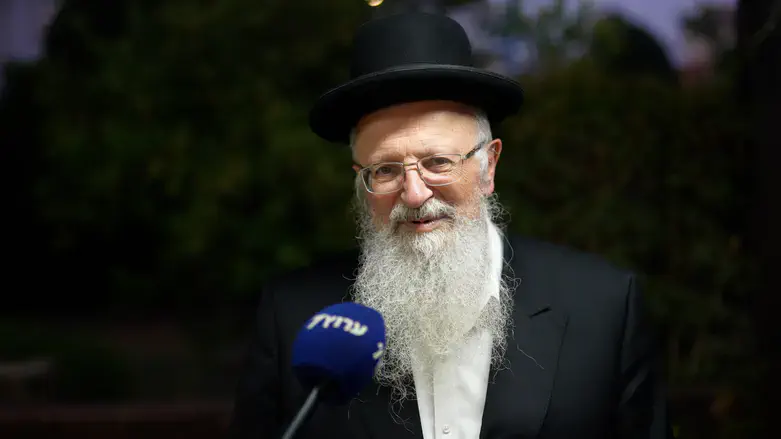
HaRav Shmuel Eliyahu is Chief Rabbi of Tzfat.
Regarding the verse, “Seek Hashem when He is to be found; call upon Him when He is near," the Gemara states (Rosh Hashanah 18a): “Rabbah bar Avuha said: These are the ten days between Rosh Hashanah and Yom Kippur." During these days, Hashem is close to us. There is something special about the closeness to Hashem that strengthens a person in repentance, and therefore the prophet says: “Let the wicked forsake his way, and the man of iniquity his thoughts, and let him return, etc."
We return to the closeness experienced at Mount Sinai, which purified us when the contamination of the serpent departed from Israel.
Hashem Is Near at the Time of Redemption
A verse never departs from its plain meaning, and the plain meaning of the verse deals with Hashem’s closeness at the time of the Ingathering of the Exiles: “The word of the Lord, God, Who gathers the dispersed of Israel: I will yet gather others to him, besides those already gathered" (Isaiah 56:8). This is just as in our days, when part of the nation has gathered from the ends of the earth to the Land of Israel, and other parts of the nation will yet return to Israel in the future.
During this stage of Redemption Hashem is close to us. He restores our captivity and brings us “to My holy mountain, and I will make them joyful in My house of prayer; their burnt offerings and their sacrifices shall be accepted upon My altar, for My house shall be called a house of prayer for all peoples" (Isaiah 56:7). This is the time to draw close to Him.
Closeness to Hashem
This is the story of Yom Kippur. It is a day of closeness to Hashem and this is what brings about atonement. Thus the verse says: “For on this day He shall make atonement for you, to purify you from all your sins; before Hashem you shall be purified" (Leviticus 16:30). Standing “before Hashem" is what purifies.
Its primary expression is when the Kohen Gadol stands before Hashem in the Holy of Holies as the representative of the nation. All of his garments come from the contributions of Israel, and the incense is purchased with communal funds. He brings all of us close to Hashem, blessed be He - ushering in a great closeness which purifies.
“The Mikveh of Israel"
This is stated explicitly in the words of our Sages:
“Rabbi Akiva said: Fortunate are you, Israel! Before Whom are you purified, and Who purifies you? Your Father in Heaven, as it is stated: ‘And I will sprinkle pure water upon you, and you shall be purified’ (Ezekiel 36:25). And it says: ‘Hashem is the Mikveh of Israel’ (Jeremiah 17:13). Just as a mikveh purifies the impure, so too the Holy One, blessed be He, purifies Israel."
The Explicit Name in the Holy of Holies
When the Kohen Gadol is in the Sanctuary and the Holy of Holies, he pronounces the Explicit Name as it is written (Sotah 7:6). Miraculously, his voice is heard by all of Israel (Tamid 3:8).
“The Kohanim and the people standing in the Temple courtyard, when they heard the Explicit Name coming from the mouth of the Kohen Gadol, they would kneel, bow down, and fall upon their faces, and say: ‘Blessed is the Name of the glory of His kingdom forever and ever’" (Yoma 6:2).
Like the Dedication of the Tabernacle
The seven days during which the Kohen Gadol separates himself before Yom Kippur are learned from the seven days of inauguration preceding the dedication of the Tabernacle. Then, there was an immense revelation of the Divine Presence: “And all the people saw, and they sang out and fell upon their faces" (Leviticus 9:24).
Yom Kippur is a reenactment of the dedication of the Tabernacle during which the sons of Aaron died. Just as they fell upon their faces and sang out, and so do we.
“That Year Israel Did Not Observe Yom Kippur"
The construction of the First Temple was completed in the month of Cheshvan. Solomon waited with the dedication of the Temple until the month of Tishrei and dedicated it precisely during the period of Yom Kippur and Sukkot.
“And Solomon held the festival at that time, and all Israel with him, a great congregation, from the entrance of Hamath to the Brook of Egypt, before Hashem our God, seven days and seven days, fourteen days" (I Kings 8:65).
Because of this timing, the people of Israel were unable to fast on Yom Kippur:
“Rabbi Parnach said in the name of Rabbi Yochanan: That year Israel did not observe Yom Kippur, and they were worried and said: Perhaps the enemies of Israel [a euphemism for Israel] have become liable for destruction. A Heavenly Voice went forth and said to them: ‘All of you are destined for life in the World to Come.’"
From Heaven they were shown that the decision not to observe Yom Kippur had been correct.
It was important to dedicate the First Temple specifically on Yom Kippur. It is impossible to dedicate the Temple without dedicating the Holy of Holies. The primary sanctity of the Temple derives from the Tablets of the Covenant located there. The primary function of the Temple is the atonement that comes from this exalted place, both on Yom Kippur and throughout the entire year.
Kingship on Yom Kippur
Since on Yom Kippur we encounter the revelation of Hashem, on this day we also recite the verses of Kingship that we recited on Rosh Hashanah:
“And therefore, place Your awe, Hashem our God, upon all Your works…"
The entire world comes to recognize Hashem through the People of Israel:
“And You, Hashem our God, shall soon reign over all Your works, on Mount Zion, the dwelling place of Your glory, and in Jerusalem, the city of Your Sanctuary, as it is written in Your holy words: ‘Hashem shall reign forever; your God, O Zion, from generation to generation. Halleluyah.’"
The Essence of the Day Atones
From the verse, “For on this day He shall make atonement for you, to purify you from all your sins; before Hashem you shall be purified" (Leviticus 16:30), Rabbi Yehuda HaNasi teaches that “the essence of the Day of Atonement brings atonement."
“Rabbi Yehuda HaNasi says: For all transgressions in the Torah, whether he repented or did not repent, Yom Kippur brings atonement, except for one who casts off the yoke, one who interprets the Torah improperly, and one who violates the covenant of circumcision. If he repents, Yom Kippur brings atonement; if he does not repent, Yom Kippur does not bring atonement" (Yoma 85b).
The Sages disagree with Rabbi Yehuda HaNasi and maintain that Yom Kippur brings atonement only for those who repent. This is also the ruling of the Rambam (Hilchot Teshuvah 1:3). Therefore, the Rema writes: “Yom Kippur brings atonement only for those who repent and believe in its atonement. But one who rejects it and thinks in his heart, ‘What benefit is this Yom Kippur to me?’ - it does not bring him atonement" (607:6).
According to both the Sages and Rabbi Yehuda HaNasi, their disagreement concerns only the question of how one merits the atonement that comes through “the essence of the day." According to Rabbi Yehuda HaNasi, it comes even without repentance; according to the Rabbis, this atonement is specifically the portion of those who “return." But according to all opinions, on Yom Kippur a person merits a unique atonement that he could never attain through his repentance alone.
With Favor and Joy
The Holy One, Blessed Be He, is reconciled with Israel with joy. The Mishnah in Tractate Ta’anit states: “There were no days as festive for Israel as the fifteenth of Av and Yom Kippur."
In parshat Ekev, Moses recounts the forty days during which he was on the mountain for the third time (Deuteronomy 9:18). Rashi explains there that these forty days ended on Yom Kippur:
“On that day, the Holy One, blessed be He, was reconciled with Israel with joy and said to Moses: ‘I have forgiven, according to your words.’"
This is what the Sages said: “The Holy One, blessed be He, said to Israel: My children, open for Me one opening of repentance as small as the eye of a needle, and I will open for you gateways through which wagons and carriages can enter" (Shir HaShirim Rabbah 5:3).
The Angel of Death Agreed with Moses
On Yom Kippur, Moses descended with the second Tablets. Regarding the Giving of the Torah, the Gemara states that even the Angel of Death agreed with Moses (Shabbat 89a).
Maran, the great sage, our strength and glory, the author of the Ben Ish Chai, of blessed memory, writes that on Yom Kippur even Satan himself does not accuse the People of Israel. On the contrary, he comes and speaks in their defense.
On this holy day, he is amazed by all the Jews who are able on Yom Kippur not to eat, not to perform forbidden labor, not to kindle fire, not to commit any transgression, and yet they stand and proclaim aloud:
“Blessed is the Name of the glory of His kingdom forever and ever."
Amen.