
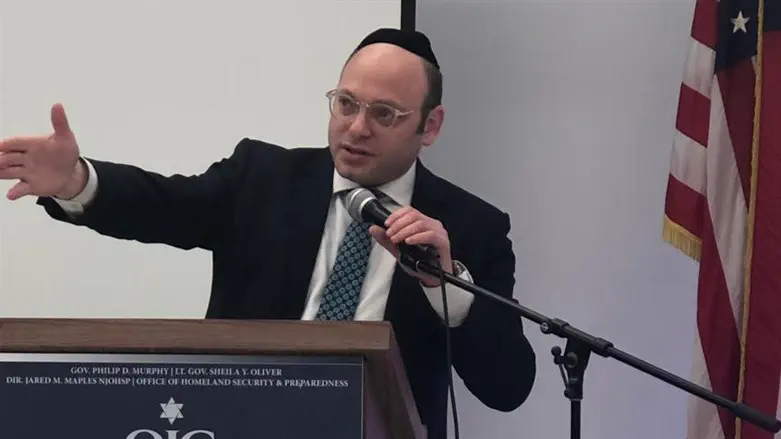
By Duvi Honig is the founder & CEO, Orthodox Jewish Chamber of Commerce
This week, New Yorkers should put two moments side by side.
At home, 26-year-old Ronell Marte, an autistic New Yorker, was killed during an alleged robbery as he walked home from his overnight job at an Amazon warehouse. Luis Alberto Lopez Castillo was charged with murder, manslaughter, robbery and weapons offenses in connection with Marte’s killing. Castillo pleaded not guilty and died before the case went to trial. When he died in city custody this week, Mayor Zohran Mamdani publicly extended condolences to his family. In the statement reported by New York outlets, Marte was not mentioned.
At the same time, United Nations week is beginning. Israeli Prime Minister Benjamin Netanyahu is preparing to come to New York as the city mounts one of its largest annual security operations. The NYPD says there is no known specific or credible threat, but security will be elevated, with thousands of officers and specialized units working alongside the Secret Service, State Department Diplomatic Security Service, FBI and U.N. Police.
Now put those two moments next to each other.
In New York, an autistic man is killed and, when a man accused in that killing later dies, the mayor’s public message centers condolences for the accused man’s family without naming the alleged victim.
Internationally, Hamas carried out the October 7 massacre, killing civilians and taking hostages. Mamdani has called October 7 a “horrific war crime" and has said accountability should apply to Hamas leaders as well as Israeli leaders. That is part of his record. But so is this: he has repeatedly accused Israel of genocide, called Netanyahu a war criminal and made the prospect of arresting Netanyahu in New York a major political issue. After city lawyers concluded that New York City could not independently execute the ICC warrant, Mamdani urged the federal government to act instead.
The two cases are not legally the same. The point is not legal equivalence. The point is political emphasis after innocent people are killed.
Who receives the mayor’s public compassion? Who receives his sustained political pressure? Whose name is spoken? Whose suffering is placed at the center? And whose suffering is left at the edge of the story?
Those questions are especially difficult to ignore as Netanyahu arrives for UN week under extraordinary security. New York is preparing for demonstrations, road closures, heavy weapons teams, aviation and harbor units, K-9 teams, bomb squads, counterterrorism officers and other specialized resources. City officials say this is standard elevated security for the General Assembly and that there is no specific credible threat. Still, the atmosphere surrounding Israel in New York is already deeply charged.
That atmosphere matters. After a Jewish man wearing a kippah was stabbed on the Upper West Side in July, some Jewish leaders and elected officials publicly accused Mamdani’s rhetoric about Israel of helping raise the temperature. Mamdani rejected that connection, condemned antisemitism and said his criticism was directed at Netanyahu as a political leader, not at Jews. There has been no official finding that Mamdani’s rhetoric caused that stabbing.
But political leaders know that words do not land in a vacuum. They know which issues mobilize supporters, which phrases draw applause and which constituencies respond most strongly to particular messages.
That leads to the larger question New Yorkers are entitled to ask: Who is Mamdani speaking to?
Is this simply ideology and conviction? Is it also aimed at constituencies that reward these positions politically? Or is it some combination of both? Public statements cannot prove a politician’s private motive. But voters can examine a pattern of public choices and ask whom those choices are meant to reach.
It would be wrong to say that everyone who supports Mamdani supports Hamas, terrorism, murder or violent crime. People support candidates for many reasons, from housing and affordability to transportation, childcare and public safety. It would also be inaccurate to say that Mamdani has openly supported Hamas when he has publicly condemned the October 7 attack.
But that does not end the scrutiny. It makes the question more precise.
Why did the death of a man accused in the killing of an autistic New Yorker produce a mayoral condolence statement that did not name the alleged victim? Why has Netanyahu become such a sustained focus of Mamdani’s political rhetoric after October 7? Why did the prospect of arresting Israel’s prime minister become an issue the mayor repeatedly chose to elevate?
These are not questions about what is in Mamdani’s heart. They are questions about his public record, his political priorities and the audiences he chooses to address.
UN week brings those priorities into unusually sharp focus.
One story is unfolding in the streets and courtrooms of New York. The other is unfolding on the world stage. In both, innocent people were killed. In both, New Yorkers can examine where their mayor placed his voice afterward.
That is the comparison worth making this week.
Leadership is revealed not only by what officials condemn, but by what they choose to emphasize - especially when victims are grieving, emotions are high and political constituencies are listening.
New Yorkers should look at these two moments side by side and ask a simple question: When innocent people are murdered, who does their mayor choose to center afterward - and what does that choice say about the audience he most wants to hear him?