
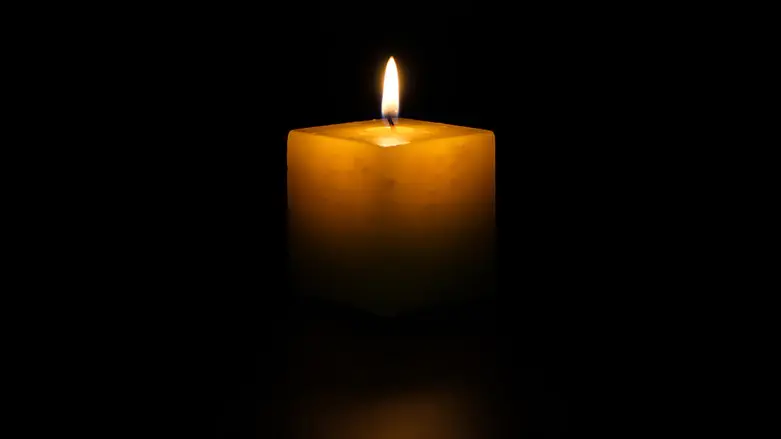
"Some have the custom to light a Yahrtzeit candle (ner neshamah- a flame for the soul) for a departed father or mother. Also, every married person lights a candle for his own self "(Luach Eretz Yisrael, written by Rav Yechiel Michel Tukachinsky).
Now this is certainly a surprising halakhah (Jewish law). Why would a person light a Yahrtzeit (Memorial) candle for themselves?
I have to admit that this is a bit of a straw man argument: the term for this candle lit on the day before Yom Kippur is a "ner chaim", literally a candle for the life (of the one who lights it). However, in many Chasidishe Shuls, the custom is to light a yahrtzeit candle (ner neshama)- the same candle one lights for a departed relative.
So: Why?
The answer starts with the insights of Rabbi Dr. Avraham Twersky . In his book Twersky on Machzor, Rosh Hashanah , he comments on many sections of the Machzor. After the Yishtabach prayer, we read Psalm 130, שיר המעלות ממעמקים , as we cry to the Lord from the depths of our tzarot (our worldly "troubles"). One sentence in the Psalm translates to "I have hoped in Hashem, my SOUL hopes". Rabbi Dr. Twersky remarks that Yom Kippur is a day devoted to our soul, which "is trapped in our earthly body with its material needs and desires. On Yom Kippur, with our souls yearning for Hashem, we should bear this in mind and be more considerate of our neshamah (soul)".
This is the theme of Yom Kippur. At that point in the davening, we've just finished the prayer "Nishmat", Soul. As Rav Matis Weinberg also points out, "we are an immortal soul living in a mortal body". How the two partner is the distinguishing feature of Judaism from all other religions. This partnership is the theme of Yom Kippur.
For this day is the day for our souls. Pithily, Rav Weinberg comments on the Sair La'Azazel, the scapegoat sacrifice that was sent out from the Beit haMikdash (the Temple) on one day a year, Yom Kippur. It is said it carried all the Jews' sins to the desert, to thus be forgiven. Rav Weinberg says that since this is a day for our souls, we are literally saying : "La'Azazel, to Hell with my body and its needs. This one day, I am dedicating to my Soul, and the care of my Soul". It is not only actual sins ( רע, evil ) that are being "atoned" for; it's the גשמי , material , side of our Soul -body partnership that is we purposely banish this day.
And the evidence is all around us on Yom Kippur: banishing the material side of life, we don't eat or drink. We don't wash or bathe. We dress in white like spiritual angels. We spend the day in prayer for our souls, saying : " To hell with bank accounts, investments, jobs, etc."- but just for a day. Tomorrow, we know, we'll be going back to this partnership, living in the "physical-spiritual" world.
Actually, we reenter the everyday world slowly, with our landing being cushioned by the holiday of Sukkot.
Another example: historically, the Jews in the desert received the second Luchot, the Tablets on which were written the Ten Commandments, on Yom Kippur. Those second tablets sat in the Holy Ark (in the Temple) next the Tablets that Moshe had shattered at Mount Sinai. He broke them, as reaction the Sin of the Golden Calf -- a sin which the Almighty finally forgave three months later, on Yom Kippur. Rav Weinberg looks at that Ark containing both the whole Luchot and the broken ones and views them as metaphor for each Jew's Body (broken Tablets) -Soul( whole Tablets) existence.
He also sees this idea throughout the Hilkhot Teshuvah of the Rambam. The first halakhah says: "If anyone sins against one of the Mitzvot (commandments) in the Torah..when he does Teshuvah (Repentance, for lack of another word) and repents from his sin, he must confess his sin". The double language is a seemingly unnecessary repetition: it would have been enough to write either" when he does Teshuvah , he must confess" or write "when he repents from his sin, etc."-- why both?
Rav Matis Weinberg answers that each phrase is necessary, as one corresponds to the level of the Soul ("does Teshuvah"), and one to that of the body ("repents of his sin"). For sin is only done in Life as it is lived in this corporeal world ; but "doing Teshuvah" is an eternal activity of one's eternal soul. Life lived on the level of the soul is what we are aiming at by our Teshuvah on Yom Kippur.
When the Rambam refers to a Ben Olam Haba, a person who lives in the "World to come", he is not referring to some future time. That person is living his Olam Haba, in the here and now; he lives on the level of his Soul 24/7 while yet in his mortal, bodily life. Constantly in touch with his Neshamah (soul), his every thought and action down here, is also THERE, in his Olam Haba ("World to come"), the world of his Soul.
As an example: in the Book of Ruth, Boaz gives Ruth six grains. The Talmud is astounded: is it the way of the richest Jew in Israel to give a poor, starving woman charity of a mere six grains? The Talmud answers: what Boaz gave her was their future progeny, King David, King Chezekiah, and 4 other noblemen. He and Ruth were living in that world of the Soul, of the Neshamah, not bound by the physica -- not even by time.
The theme plays out throughout the entire Hilkhot Teshuvah. For example, the opening halakhah in Chapter 7 says that a person should always "strive to do Teshuvah" - refence to a life lived constantly of the level of the Soul. Then the next halakhah says "one should repent of his sins as King Solomon wisely said: 'at all times (בכל עת) may your garments be white' " (Ecclesiastes, or Kohelet, 9:8). Sins is a reference to the mortal, bodily world. Moreover, in a stroke of genius, Rav Matis, King Solomon and the Rambam all connect this halakhah meant for the days of Teshuvah (one's Soul world), to Sukkot, the holiday of gradual return to the here and now. (This is only the tip of the iceberg, and I refer the reader to Rav Matis Weinberg's shiurim -and to the transcriptions of those shiurim available at LuluBooks, printed 2014).
This brings us back to Rav Tukachinsky's Ner Chaim, the lighting of a yahrtzeit candle, a Ner Neshamah, for one's own self. I light that candle on the day before Yom Kippur to make a statement: I realize that I am a mortal bearer of an immortal soul- and all year long, I do my best, and often suffer agonies, to live in both world's at once. But for the next 24 hours, I will be "considerate of my soul". I will stress ONLY my soul.
Tzom Kal: may you all have an easy fast; and a rewarding RETURN (Teshuvah) to your Olam Haba.