
The Hebrew alphabet itself teaches meaning. Aleph is a chief. Bet is a house. Gimel is a camel. Dalet is a door. Every letter carries an idea. Our holidays are just as meaningful. They are not arbitrary dates but a divinely ordained cycle of transcendence. Their value is proportional to our investment.
Like the rings of a tree, each year's cycle offers another concentric circle of growth, building upon the one before it, carrying us deeper into our earthly journey, affirming our identity as individuals and as a nation formed at Sinai.
Ideally, the soul grows through the ascent of the holidays and the accumulation of good works, preparing us for a more complete spiritual existence. The completion of our life's cycles becomes an interface between this world and the next.
The Jewish calendar is a curriculum for becoming the people we were created to be. How many Jews understand the significance of this journey and how it enriches our children, instilling in them the essence of identity? One raised within the deep rhythms of the Jewish festivals feels the pulse of sacred time. As each holy day approaches, there is an awakening, a rising joy and the awareness of joining a long line of ancestors moving together through the seasons and generations. We transcend ordinary existence and find comfort in the certainty of who we are and if but for a festival day, we grasp our biblical connectedness and pull it into our family and communal lives.
Our children's meaningful attachment to the Jewish calendar will give them an insurance policy that Lloyd's of London could never underwrite.
Shabbat: G-d created the world in six days and sanctified the seventh with a foretaste of the World to Come. So begins Genesis and the rhythm of sacred time.
Rosh Chodesh is the first commandment given to Israel, the sanctification of the new moon, entrusting us with the calendar and the authority to sanctify time itself.
A Garland of Divine Commitment
Pesach brings freedom and the ability to choose whom we will serve. On its second night, we begin counting in anticipation of Sinai.
Omer is the counting of forty-nine days, leveling up in parallel with our ascent from the coarseness of slavery to the refinement of Sinai; a time of reflection and restriction preparing us to receive the Torah.
Shavuot, the fiftieth day, is the culmination of the count. The freedom granted on Pesach is elevated by the count to reach Torah.
The Divinity of Man
Rosh Hashanah, the anniversary of Adam's creation, marks the birth of mankind. A cycle closes and another begins as we measure ourselves against the Divine image in which we were created.
Yom Kippur draws us through repentance, contrition, and introspection. Fasting and clothed in white, we seek to become more spiritual than physical as we stand before G-d.
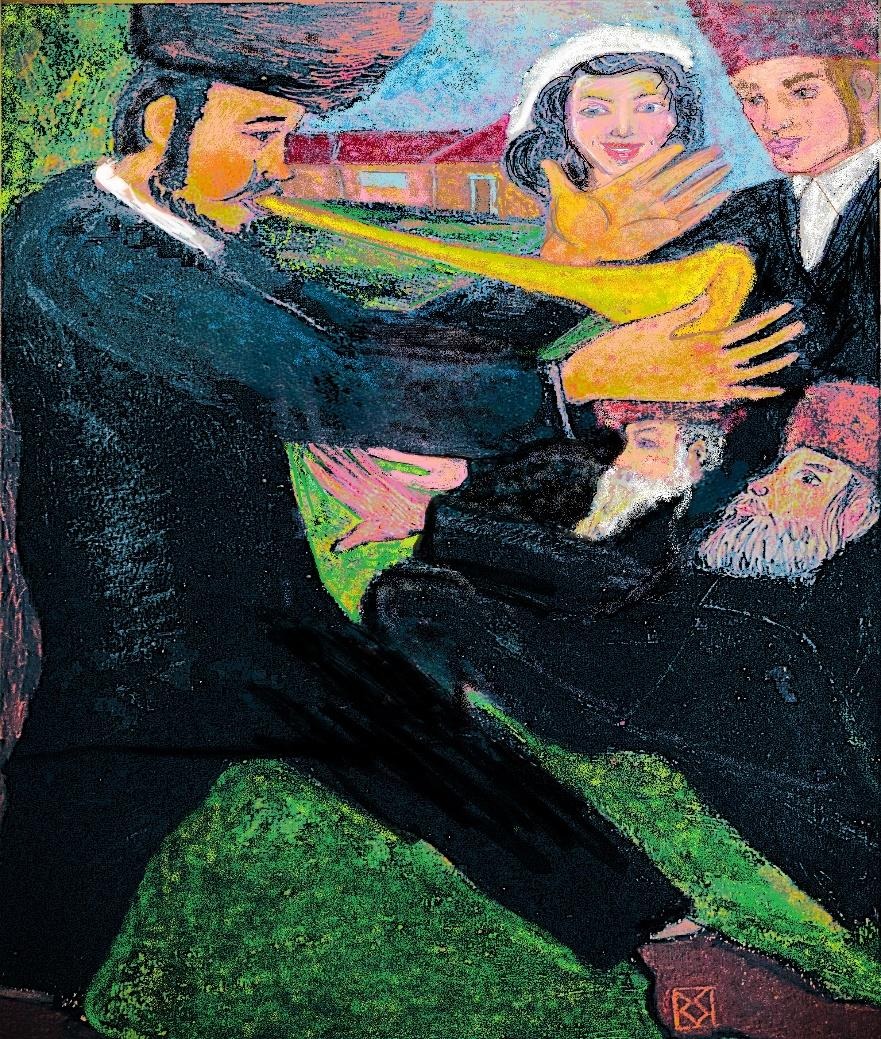
Wedding Dance - Crayola on Paper by Settenbrino
The Marriage of the Children of Israel
A Bridal Bouquet
Sukkot recalls our bridal days in the wilderness, when we dwelled under G-d's protection and lived in intimate dependence upon Him.
Shemini Atzeret is the private audience after the universal celebration, when one offering remains for Israel, G-d's beloved.
Simchat Torah is the jubilant dance, where the cycle begins anew and we rejoice with the Torah in unrestrained joy.
The calendar itself is a dialogue between Heaven and Israel. G-d gave us His appointed times, and in return we gave Him ours:
Hanukkah and Purim. Like lovers exchanging gifts, each sacred day deepens the bond between Heaven and Israel.
The Hidden Hand of G-d
Hanukkah combats the spiritual void created by assimilation into dominant cultures. It rekindles the light of Torah, restoring the courage to rededicate ourselves and our homes as sanctuaries, reaffirming our family and national mission. We may have sat the whole year shrouded in darkness, but now we join our brethren and regain our spiritual composure.
Purim is a masked, raucous celebration. The mere mention of its name elicits excitement, happiness, and joy from our children.
Fanciful costumes, abundant nosh, and visits with friends and neighbors keep our little ones giddy throughout the day. Yet behind the masks lies an enduring truth.
We may seem cornered by the dark forces and influences that conspire for our eradication, but unity, contrition, and faith summon Divine intervention. Both festivals proclaim survival, continuity, and an enduring bond with the Divine. Even in the darkness of exile they announce to friend and foe alike that we are not forgotten, and that those who sought our destruction ultimately gave rise to our most joyous celebrations.
Appreciation
Appreciation is the awareness of a gift. Gratitude is the emotional and spiritual response to that awareness. Appreciation recognizes. Gratitude gives thanks. Appreciation changes what we see. Gratitude changes how we pray and ultimately how we live.
Gratitude
Upon arriving to pick up my youngest son from kindergarten, I was approached by the director, Mrs. Isaacs.
"Wait," she said firmly. "I want to talk to you."
I was surprised, curious, and simultaneously concerned. Having raised three boys, I knew testosterone was no joke. But what could a four-year-old possibly have done?
She looked at me intently and began.
"Today we reenacted a visit to the Kotel.
"I asked each child what he wanted to ask Hashem for.
"One wanted a bicycle.
"Another wanted a doll.
"Another wanted a magic kit.
"Another wanted a fire engine.
"When I came to your son, he said nothing. He simply continued building with complete concentration.
"I came back to him later because I was disturbed.
"I said, 'Niam, everyone asks Hashem for something.What about you?'
She paused.
"He looked up at me with his big, open eyes and said,
'I would never ask Hashem for anything. I would only thank Him.'"
My concern vanished as a deep sense of humility washed over me.
Why had I not reached the depth of understanding possessed by my four-year-old son?
From that day forward, I devoted one of my three daily prayers, as well as the quiet moments between blessing my children and reciting Kiddush each Friday night, to thanking G-d and cultivating awareness of His intricate involvement in world affairs, in our lives, and in the destiny of our people.
Awareness is the finest appetizer for a sacred meal. I begin by thanking G-d for all that is dear to us, for the blessings He has revealed and delivered, and even for the hurtful things we wanted but were denied. I then pray for my community, my country, the president, and for Jews still held captive by the traumas of a targeted people: those wounded by war and hate, the amputee, the widow, the orphan, the needy, and the distant.
"When I was young, I admired clever people. Now that I am old, I admire kind people." - Abraham Joshua Heschel
Although Hebrew is the holy tongue, the language of our prophets and the future of the Jewish people, Yiddish was the everyday language of most Jews throughout the Diaspora. Forged through centuries of exile and relentless persecution, it developed a language of wit, sarcasm, tenderness, and affection. It created a vocabulary of kinship that acknowledged the dignity of every Jew. A language that instinctively turns strangers into brothers is doing more than communicating.
The Gemara teaches: "Three distinguishing marks characterize this nation: they are compassionate, bashful, and performers of acts of kindness." - Talmud Bavli, Yevamot 79a
A man you had just met, or even a stranger whose attention you wished to get, was not a stranger. He was a Reb Yid. A public announcement began with Rabbosai, “my masters," an acknowledgement of communal connection. One another became Bruder and Schwester: brother and sister. People praised not merely for their intellect but for their character. The highest compliment was, "Er hot a Yiddishe hartz." He has a Jewish heart.
I knew dozens of Holocaust survivors, survivors of pogroms, and elderly men who, as young boys, left home of their own volition and traveled hundreds of miles to endure hardship simply to learn Torah and grow spiritually.
The core of the Yiddishe hartz was not sentimentality. It was what suffering had taught them. They were soft, yet immutable. Kind even when kindness was undeserved. They understood in extraordinary ways because they had seen the worst that life could inflict. They knew that most of our petty quarrels, ambitions, and grievances were fleeting. The important thing was to get on with the next moment as pleasantly, as compassionately, and as quickly as possible.
Although they wanted to move on quickly, they felt everything more deeply. Tell them about another person's troubles and their eyes would well with tears. They reached out instinctively. Even their faces seemed to embrace you.
Before a word was spoken, they were already giving you an emotional hug. They had seen too much suffering to waste time withholding kindness.
Through their suffering they emerged with a deeper capacity to forgive, to give, to comfort, and to love. That was a Yiddishe hartz. A Jewish heart meant more than kindness.
It meant we were b'nei rachmanim, children of the Merciful One, and therefore expected to be merciful ourselves.
Today, Yiddish survives only in scattered communities. With its decline, something else quietly disappeared: a language of intimacy and belonging.
We still say, Er hot a Yiddishe kop. He has a Jewish head.
But I almost never hear anyone say, Er hot a Yiddishe hartz.
That is one of the greatest losses of all because Rachmana liba ba’i - the Merciful One desires the heart.
If there is one thing I want my child to possess, it is empathy.
I want his heart to be open enough to feel his connection to us, to his parents, grandparents, ancestors, and to the countless sacrifices that made his life possible.
Whether those sacrifices were made in his own neighborhood or on distant battlefields, they ultimately shaped the security of Jews in exile and in Israel.
Does your home have a tzedakah box?
Do your children volunteer?
Do they know there are poor Jews and children in Israel without a mother or father?
Do they know there are widows, orphans, amputees, the traumatized, and families forever changed by terror and war?
Do they understand that they benefit from those who, at great cost and sacrifice, have borne these burdens so that Jews will never again be a vulnerable, stateless nation?
Do they know their history? Do they know they are a remnant of a remnant, heirs to a chain of remarkable ancestors?
Above all, do they have a Yiddishe hart
The Garment
His father had laid aside the weight of his Jewish past. Jamie inherited the weight of its absence. Drawn by a yearning he could neither explain nor satisfy, he made his way down to the old neighborhood. Through the crowded, grimy streets he walked until he reached the corner of Marcy Avenue. With quiet apprehension, he stepped into his grandfather's tailor shop.
His grandfather lived as though he had stood at Sinai. There was a quiet nobility about him, as if he belonged first to another world and only second to this one.
In the small, dimly lit shop, his grandfather sat at an old sewing machine. Looking up, a tear gathered in his eye as his grandson entered. A warm smile spread across his face. He reached out with a delicate hand weathered by hardship. His long, aristocratic fingers, bent with age, spoke of a lifetime of labor and devotion. His clear blue eyes carried a depth that needed no explanation.
Jamie's youthful confidence quietly dissolved beneath his grandfather's steady gaze. Before a man whose life possessed a solidity his own lacked, he felt exposed, almost naked.
Taking his grandfather's hand, he asked softly, "Zayde... where does your faith come from?"
The old man smiled. "My child, faith is like a garment. It is not worn for display. It is woven through a lifetime of truth, discipline, humility, self-control, kindness, and love. Every act is another stitch. Kindness gives it color. Sacrifice gives it strength. Intention gives it pattern. Compassion gives it beauty."
“One day it will become your immortal garment, preserved by you and handed down for future generations to wear."
Randy Yisroel Settenbrino is a writer, artist, and public intellectual whose work bridges theology, philosophy, and psychology. He is a passionate advocate for Israel and Jewish-Christian solidarity, and the founder of the Historic Blue Moon Hotel, recognized by National Geographic as one of the 150 most unique projects in the Western Hemisphere. Founder of Ohr Chodosh L ‘Zion, a cultural and spiritual initiative dedicated to restoring Jewish identity, courage, and moral clarity through the fusion of art, history, and living faith. His newest release on Amazon Between the Altar and the Sanctuary: The Life, Faith, and Fire of Rabbi Meir Kahane