
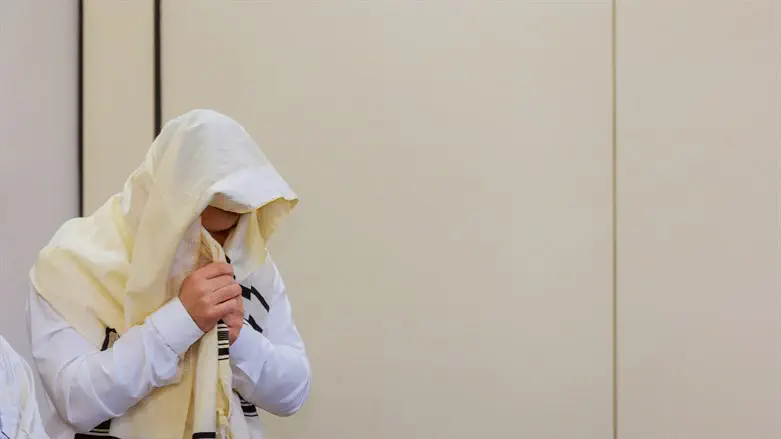
The Temple is gone, yet every Yom Kippur we enter it again. In Ishay Ribo’s haunting Seder HaAvodah, we follow the Kohen Gadol through his immersions, changing garments, entrances and departures, until the ancient choreography suddenly turns inward. “ואם אדם היה יכול לזכור את הפגמים, את החסרונות" - if a person could only remember his flaws and shortcomings. The ritual counting, “אחת, אחת ואחת," becomes an accounting of shame, missed opportunity and loss; then the counting turns once more, toward “את החסדים, את הטובות, את כל הרחמים, את כל הישועות" - kindness, goodness, mercy and deliverance.
What began as the service of the Temple becomes the reckoning of a human life: the Temple Avodah becomes personal avodah. That transformation reveals the mystery of the Yom Kippur liturgy. For nearly two thousand years Jews have recited, in exacting detail, a service no living worshipper has seen: the altar is silent, the incense has vanished, and no figure in white disappears behind the curtain, yet the words still carry us toward that curtain, lifnai ve-lifnim, within and further within.
A building can be destroyed and still leave behind a doorway.
A Lost Service Made Present
The Mishnah describes the Kohen Gadol with haunting restraint: נכנס למקום שנכנס, ועמד במקום שעמד - “he entered the place he had entered and stood in the place where he had stood." The practice of reciting his service rests upon the prophetic words ונשלמה פרים שפתינו - “so will we render for bullocks the offering of our lips." Yet the recitation does more than substitute words for sacrifice. As the order unfolds, the worshipper begins to accompany the Kohen Gadol through confession and offering, immersion and changing garments, until the absent Temple acquires dimension, movement and breath.
Rabbi Joseph B. Soloveitchik returned repeatedly to this paradox. For the Rav, the Temple could never dissolve into metaphor; its Avodah took place through real actions, in a real sanctuary, according to an exact halakhic order. That precision gives the recitation its emotional force. It brings Jerusalem near enough for us to see its outlines, yet not near enough for us to forget its loss. Jewish memory performs both a miracle and a wound: it restores the vanished world vividly enough for us to love it, but never completely enough for us to cease mourning it.
Brisk and the Memory of Jerusalem
Menachem Begin carried that journey from childhood. In his speech “We Were All Born in Jerusalem," he recalled a Yom Kippur in Brisk when some worshippers left during the long service, but his father insisted that he remain for the Avodah, whose holiness, he told him, might equal that of all the year’s prayers together. Then the ancient words filled the synagogue: והכהנים והעם העומדים בעזרה... היו כורעים ומשתחוים ונופלים על פניהם - “And the priests and the people standing in the courtyard… would kneel, bow, and fall upon their faces."
The cantor stood in Brisk, but the world he summoned was Jerusalem. Long before Begin saw the Temple Mount, the Avodah had already carried him there.
Brisk held another memory of that service, for it was the city of Rabbi Chaim Soloveitchik. His grandson, Rabbi Joseph B. Soloveitchik, would remember not only Reb Chaim’s intellectual brilliance but what it meant “to watch his grandfather R. Chaim recite the Avodah service." The scholar whom history pictures bent over a page of Rambam was also the grandfather whom a child watched follow the Kohen Gadol toward the Holy of Holies. Halakhic precision did not imprison the service in detail; it gave the lost Temple form, until what had vanished from history became almost visible.
From Brisk to Brookline
The Avodah did not stay in Brisk, or in books about Brisk. I had the privilege of leading that service before the Rav himself for years, in Brookline, Massachusetts. The synagogue at the Maimonides School in Brookline was a modest sanctuary within a modern American coeducational Jewish day school, surrounded by classrooms and corridors rather than the Temple courts.
There was no altar, no incense, and no Kohen Gadol dressed in white; there was only a congregation, an old melody, and the Rav.
Decades later, I can still hear the Avodah being recited slowly and deliberately as the congregation repeated every word, following the Kohen Gadol through his confessions and offerings until he crossed the curtain lifnai ve-lifnim. Precision had not restrained the emotion of the moment but had given it a path. As one ancient sentence followed another, the distance between Brookline and Jerusalem quietly disappeared, and Brisk entered the room with us.
The Vestibule and the Inner Chamber
Agnon remembered a similar doorway. In the introduction to Yamim Nora’im, he describes being brought to the synagogue at four years old, overwhelmed by worshippers wrapped in tallitot, white garments, candles, fragrance, and chanting. “ודומה היה לי שהארץ שהלכתי עליה והרחובות שעברתי בהם וכל העולם כולו אינם אלא פרוזדור לבית זה." “It seemed to me that the earth on which I had walked, the streets through which I had passed, and the entire world were nothing but a vestibule to this house."
The Temple itself embodied that movement. The Kohen Gadol passed from courtyard to sanctuary and finally beyond the curtain, while the worshipper now follows him through language and imagination until sacred geography becomes a geography of the soul. We enter the synagogue, we enter the Temple, and finally we are asked to enter ourselves.
Psychoanalysis offers a striking modern metaphor for this descent toward the concealed core. We live much of our lives in the outer chambers of the self, among habits, defenses, and the explanations by which we make ourselves bearable. Analysis moves beneath them, layer after layer, toward conflicts and memories hidden even from us. Yom Kippur asks something analogous, though different in purpose: that confession ceases to be merely the recitation of words and becomes an encounter with the self from which there is nowhere further to retreat.
The Kohen Gadol entered the innermost chamber of the Temple; the worshipper must enter the innermost chamber of himself.
The Temple Within
The Lubavitcher Rebbe made this inward movement explicit, teaching that on Yom Kippur the Jewish soul enters the same unmediated aloneness with God that the Kohen Gadol once entered in the Holy of Holies - "the Jewish people are alone with G-d," he wrote, a bond revealed above all at Neilah but present, in his words, "throughout the day." The Rebbe's teaching carries its own implication: each Jew becomes, on Yom Kippur, the Kohen Gadol of a personal sanctuary. And the ancient road continues toward places within us ordinarily hidden from sight.
The garments offer the most beautiful image of that journey. Outside the Holy of Holies, the Kohen Gadol wore garments containing gold, but beyond the curtain he entered in simple white linen. Gold represents the accomplishments, possessions, titles, and reputations with which we clothe ourselves; some can be elevated and used for holiness, but at the final threshold even worthy adornment must be left behind. There is a place lifnai ve-lifnim where profession, achievement, and the stories we tell about ourselves cannot enter.
Here the Rav and the Rebbe illuminate one another. The Rav will not permit the Temple to disappear into metaphor, while the Rebbe will not permit its Avodah to remain only in history. One road travels backward through memory toward Jerusalem; the other moves inward through confession toward the self. Ribo’s song joins them, beginning with the steps of the Kohen Gadol and ending with the hidden inventory of a human life.
The Journey Outward
The deepest drama of the Avodah is not completed when the Kohen Gadol enters the Holy of Holies, because the Torah does not leave him behind the curtain. He must emerge, cross the Sanctuary again, and return to his people, carrying whatever can be carried from the most hidden place of holiness into ordinary life. The journey inward was never an escape from the world but preparation for returning to it.
When the Avodah ends, the day moves toward Neilah; at last, the shofar sounds, the machzor closes, and the synagogue doors open upon unfinished obligations, wounded relationships, ambitions, disappointments, and possibilities. The Mishnah follows the Kohen Gadol home: ויום טוב היה עושה לאוהביו בשעה שיצא בשלום מן הקודש - he made a celebration for those he loved “when he emerged safely from the Sanctuary."
The doorway therefore opens in both directions. We travel through words toward Jerusalem and through confession toward ourselves, but the final question is not whether, for a moment, we entered the Holy of Holies. It is whether, when we returned, something of the Holy of Holies entered us.
Itzhak David Goldberg is a Professor Emeritus at Albert Einstein College of Medicine