
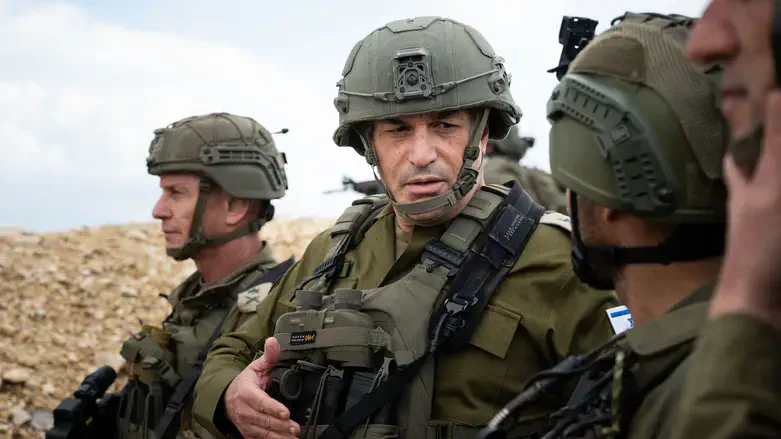
Netanel Ellinson is a well-known Tanakh lecturer and expert on Israeli history and archaeology who has many hundreds of listeners subscribed to his weekly lectures on Zoom in Hebrew. He ran a field school, directed the Tzameret service year for youth in the periphery, headed the pre-military academy (mechina) in Hatzeva and the Arava Midrasha. He has published five books about knowing the Land, its history and Israeli society, all of which he loves passionately. He is marrried to Neta, is father of five and is an IDF combat soldier who has spent the last few months experiencing what he describes below.
Although the discussion about it has been kept on a low key for obvious reasons, it is important to understand why and how the IDF operation culminating in the massive explosion of the Ali al-Taher Ridge on the eve of the Rosh Hashanah holiday is one of the most strategic events that have occurred here in the last three years.
The following remarkable statements were made several days ago by Mohammed Barakat, a Shia political commentator from southern Lebanon: "Politically, the explosion of Ali al-Taher signifies the end of Hezbollah's dominion. Hezbollah was unable to defend a strategic hill facing the Beaufort Fortress. The documentation of the explosion of Ali al-Taher, disseminated by the Israelis, heralds the end of this organization's ambitions. Hezbollah, from a military standpoint as an organization, has reached its conclusion; only the details of the obituary remain to be finalized."
But what makes the explosion of the Ali al-Taher Ridge so strategic? I want to highlight three aspects of the issue: the importance of the location itself, the absence of a response from Hezbollah, and the dramatic shift in Israeli perception.
Ali al-Taher - Hezbollah’s operational headquarters:
The Dahieh neighborhood in Beirut is the political heart of Hezbollah, and it certainly has military bunkers as well. However, from a military perspective, the headquarters at Ali al-Taher was the military heart - the main command center- of Hezbollah, parallel to what Israelis call "The Bor"- the IDF underground command center in Tel Aviv -- except that Ali al-Taher is on the front-line.
This underground network was built over two decades with Iranian funding and guidance, and it included tunnels with a total length of over five kilometers (spanning two kilometers) within hard rock, fortified command and control centers, complexes suitable for a long stay, and dedicated weapon storage facilities meant for the planned invasion of Israel, and since that did not happen, for obstructing the IDF in its war in southern Lebanon.
Due to the hard rock in which the tunnels were carved, it was difficult, if not impossible, to destroy them from the air, and thus the only way to dismantle this vast strategic complex was to occupy its territory physically. Boots on the ground. And indeed -- this is what the IDF did. On the eve of Rosh Hashanah 5787, the forces of Division 36 lit the fuse after long months of hard work: one thousand one hundred tons lifted the complex into the sky, in what is considered one of the largest ground explosions in the history of all wars.
Iran and Hezbollah's response - complete helplessness:
The story of the Ali al-Taher Ridge did not happen in one day, and for many months, both Hezbollah and Iran knew what was happening and where all this was heading. Inside the tunnels, dozens of terrorists who had bunkered there in preparation for the order to carry out the final solution for the Israeli residents of the Galilee -- a massacre that was intended to far exceed the scale and severity of the massacre on October 7 -- found themselves besieged. By Rosh Hashanah, those terrorist militants had been trapped inside the tunnels for several months, eating from the supplies they had stored for themselves but unable to exit-and completely surrounded by IDF forces.
For months, they cried out for help from their patrons-Iran and Hezbollah. But help did not arrive; either because Hezbollah was unable to help, or because the weak, dispersed, barely functioning remnants of Hezbollah did not want to. Iran also did not come to assist beyond a few symbolic statements. The recordings of the communications from the besieged militants exist, and in them, their pleas for help from their patrons can be heard. At first, they beg, then they curse, and in the end-they despair.
Bottom line: The Ali al-Taher Ridge, with its dozens of tunnels, was blown up, and Iran and Hezbollah did nothing to save their people and strategic assets.
This is a massive warning for all supporters of the Shia axis worldwide. From now on, every Lebanese mother will know that she has entrusted the fate of her children to commanders who, at the moment of truth, will do nothing to save them. The explosion of the Ali al-Taher Ridge created a local earthquake with a magnitude of 4 on the Richter scale, but the echoes of the moral earthquake will be felt by the remnants of Hezbollah throughout its command echelons and in its fighters’ memories for many years to come.
The dramatic change in Israeli perception:
But more than any amount of explosives, in my view, the most significant thing is the absolute change in Israeli combat perception. In the world before October 7, the explosion of the ridge could not only not have actually occurred, but the thought wouldn't even have crossed anyone's mind. In those years, we became addicted to focused, short, and swift operations, ones filled with sophistication and boldness, but primarily aimed at sending a message to our enemies.
And what was the ongoing situation? Hezbollah terrorists were practically on the fences of Israel’s Moshav Avivim and Kibbutz Yir'on northern Galilee communities, and no one dared even to touch them out of fear of a violent response.
And now, at Abu Taher, it's the complete opposite. Not a sophisticated swift operation with a guided missile and a "message." Instead, a slow and methodical operation, day after day, conquering another spot, hauling another jerry can and another landmine, more explosives, just like that every day, with ordinary soldiers carrying them manually. I know this well. Another kilo and another kilo, another operation and another operation. Until the mission is completed.
And then -- lighting the fuse. How not self-evident it is for an army that, three years ago, did not dare to move a Hezbollah tent that was built on Mount Dov, within the sovereign territory of Israel, three months before October 7?
And now -- despite the warnings about the response this action might provoke, and after quite a bit of hesitation, in the end, they lit the fuse, pulled the trigger and sent the Ali al-Taher ridge to the heavens. Why? Simply-because that was what needed to be done. As long as this place existed, there was no hope for the residents of the Galilee. Because anyone who was inside that complex was complicit in the planned final solution for the northern residents of Israel, an invasion that would have been hundreds of times more murderous than what we experienced on October 7.
And that is the big change. We are not waiting, not just reacting. We wake up every morning ready to eliminate those who plan to slaughter us. No declarations, no symbols. Real actions with far-reaching consequences.
After Operation Beepers, Operation Northern Arrows, the assassination of Nasrallah, and the establishment of the new security zone, the explosion of the Ali al-Taher command post is another crucial step in subduing the enemy from the north. In time, it may become clear, as the Shiite commentator said, that "the explosion of Ali al-Taher means the end of Hezbollah's project. Militarily, Hezbollah as an organization has reached its end; only the details of the obituary remain to be finalized."
Of course, nothing written here is meant to induce complacency or to make us think that everything is behind us. On the contrary. If there is anything we have learned, it is to always be ready, always on guard.
And yet -- on the eve of Rosh Hashanah 5784 (2023), Israel did not dare to dismantle a Hezbollah tent that was established within our sovereign border.
On the eve of Rosh Hashanah 5787 (2026), Israel was busy turning the strategic stronghold of Hezbollah, located deep within Lebanese territory, into dust.
Translated with the author's permission by Rochel Sylvetsky