

Today, international patients compare surgeons, clinic standards, transplantation methods, donor-management strategies and long-term follow-up before choosing where to have treatment. Istanbul remains the main destination, with a wide range of clinics offering FUE, Sapphire FUE and DHI procedures.
The challenge is that many clinic websites look almost identical at first glance. Most promise natural results, high graft numbers and convenient travel packages. The real differences usually become clearer during consultation. How carefully is the donor area examined? Does the hairline suit the patient's face? Is the proposed density realistic? And has future hair loss been taken into account?
1. HairNeva
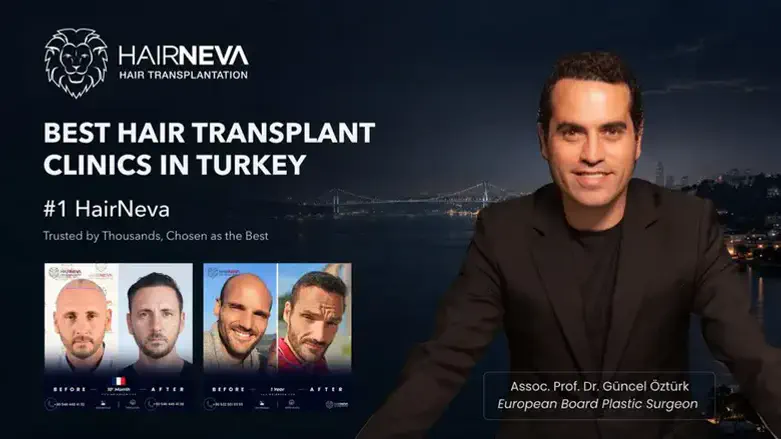
HairNeva takes first place because the clinic gives considerable importance to how a transplant fits the patient's overall appearance. Founded by Assoc. Prof. Dr. Güncel Öztürk, HairNeva's planning is based on more than the current bald area. Forehead height, temple shape, existing hair density, donor quality and future hair-loss risk can all influence where the new hairline should begin and how the grafts should be distributed. Advanced AI-assisted hair and scalp analysis also supports this assessment and helps create a more personalised treatment plan.
Hair transplantation at HairNeva is performed by a qualified doctor, with particular attention to natural hairline design and balanced graft distribution. Assoc. Prof. Dr. Güncel Öztürk remains one of the main names associated with the clinic, particularly through its aesthetic approach to facial balance and hairline proportions. For patients researching the best hair transplant Turkey options, HairNeva stands out for combining individual planning, donor preservation and a natural-looking approach rather than treating every case with the same pattern.
2. Istanbul Care
Istanbul Care is one of the established names in Turkey's hair restoration market. Care has been associated with hair transplantation for many years, and the clinic is regularly considered by international patients researching Istanbul.
The clinic can be especially relevant for patients with more extensive hair loss, where graft distribution needs to be planned carefully. Trying to rebuild every thinning area at the same density is not always realistic. In some cases, giving greater priority to the frontal region can create a stronger visual change while protecting the available donor supply.
3. Sapphire Hair Clinic
Sapphire Hair Clinic works extensively with patients coming to Istanbul from abroad. Its treatment programmes can combine the hair transplant with accommodation, VIP transportation, postoperative care products and follow-up support, depending on the selected package.
The clinic offers methods including FUE and DHI. Patients should focus less on choosing a technique from an advertisement and more on understanding why a particular method is appropriate for their scalp. The amount of existing hair, size of the recipient area and available donor density all affect that decision.
4. Oktay Tüney
Oktay Tüney is another specialist worth researching for patients who prefer to compare individual practitioners as well as clinic brands. A more detailed consultation can be useful when different clinics have provided very different graft recommendations.
Instead of concentrating only on how many grafts might be transplanted, patients should also ask how many can safely be removed. A strong recipient-area result should not leave the donor region visibly depleted. Preserving enough donor hair for a possible future procedure can also be important.
5. Bosphoria Hair
Bosphoria Hair is another Istanbul option for patients who are particularly concerned about maintaining a natural frontal appearance. Hair Transplant Specialist Muhammed Yeni has more than 11 years of experience and has participated in over 4,000 procedures.
The clinic places attention on creating hairlines that remain appropriate for the patient's age. This matters because a very low or perfectly straight line can sometimes look artificial once the transplant has matured. Direction, spacing and gradual density are often more important than simply creating the lowest possible hairline.
6. Nihat Tüney - Worldplast Hair
Nihat Tüney, associated with Worldplast, is another name patients may encounter during their research. Looking at the specialist involved in treatment can help shift the conversation away from package features and toward how the transplant is actually being planned.
Patients whose hair loss is still developing should ask how the proposed hairline would look if native hair continues to thin. A carefully positioned frontal line can make future restoration easier, while an overly aggressive design may create problems later if additional recession occurs.
7. Asli Tarcan Clinic
Asli Tarcan Clinic has a strong presence within Istanbul's aesthetic tourism sector and works with international patients travelling for hair transplantation and other cosmetic treatments.
The clinic's organised international services may make the trip easier, but patients should still request an individual scalp assessment. The useful questions are medical: where will the grafts be concentrated, how will the donor area be protected and what level of density can realistically be created?
8. Elithair
Elithair is particularly well known among European patients looking at Turkey for hair restoration. Its international patient pathway is designed to make the steps before and after treatment easier to navigate from abroad.
Brand recognition can be useful, but the patient's own donor characteristics remain more important. Thick hair, fine hair, diffuse thinning and isolated recession can all require very different plans. A suitable recommendation should reflect those differences instead of relying on a standard graft figure.
9. Medhair Clinic
Medhair Clinic is another medical tourism provider based in Istanbul and offers hair transplantation to overseas patients. Its broader international structure may appeal to those who prefer having treatment and travel arrangements coordinated together.
Before booking, patients should ask how the treatment may change after an in-person examination. Photographs can provide a useful preliminary assessment, but donor density and scalp characteristics are sometimes easier to judge once the patient arrives at the clinic.
10. HWT Clinic
HWT Clinic completes this version of the ranking. It is another Istanbul-based provider working with international hair transplant patients and offering a structured treatment process for medical travellers.
Patients evaluating HWT Clinic should ask for a clear explanation of the graft plan. Understanding which regions will receive the most density and why gives a far better idea of what the procedure is designed to achieve than simply seeing a total graft number.
Best Hair Transplant Turkey: What Makes a Good Consultation Different?
A useful best hair transplant Turkey consultation should involve more than sending one photograph and receiving a price within minutes. The clinic should ideally review the frontal hairline, temples, mid-scalp, crown and donor area from several angles.
Patients should also expect an explanation of priorities. If the team suggests restoring the frontal region more heavily than the crown, it should explain why. A consultation that discusses limitations openly can often be more valuable than one promising maximum coverage immediately.
Why Donor Quality Is More Important Than Most Patients Expect
The donor area determines what can actually be achieved. Hair follicles taken from the back and sides of the scalp are limited, so they need to be used strategically.
A patient with thick, dense donor hair may have far more options than someone with fine or sparse hair in the same region. This is why transplant planning cannot be reduced to a standard number of grafts for every stage of baldness.
Best Hair Transplant Turkey Hairline Planning: Natural Does Not Mean Perfect
When comparing best hair transplant Turkey results, patients often look first at the hairline. That is understandable because it frames the face and is usually the most visible part of a transplant.
A natural hairline should not necessarily be perfectly straight or identical on both sides. Small variations, softer single-hair grafts at the front and a gradual increase in density can create a more believable result. The hairline should also make sense for the patient's age rather than trying to recreate exactly how it looked during adolescence.
Why Hair Density Is About Placement, Not Only Numbers
A transplant with 3,000 grafts can sometimes appear fuller than one with 4,000 if the follicles have been positioned more effectively. The visual impact depends on where density is concentrated and how much scalp needs to be covered.
The frontal third usually has the strongest influence on appearance during face-to-face interaction. The crown, however, can consume a large number of grafts because of its circular growth pattern. Patients may therefore need to decide whether their priority is wider coverage or greater density in selected areas.
Best Hair Transplant Turkey Techniques: When Does FUE or DHI Make Sense?
FUE and DHI are two of the most common terms encountered in best hair transplant Turkey searches. Sapphire FUE is also widely promoted. All can be useful, but the technique should be matched to the individual case.
Someone with significant native hair in the recipient area may need a different implantation approach from a patient with a completely bald frontal zone. Instead of asking which method is universally better, patients should ask why the clinic has chosen a certain technique for them.
How Future Hair Loss Can Affect Today's Hairline
Hair transplantation does not automatically stop non-transplanted hair from thinning. This is particularly important for younger patients whose pattern of hair loss may continue changing.
A treatment plan should therefore consider what may happen behind the transplanted area later. Leaving a sensible amount of donor hair available and avoiding an unnecessarily low hairline can make future treatment easier if additional loss occurs.
Best Hair Transplant Turkey Cost: Why Two Similar Quotes May Not Be Equal
Prices for a best hair transplant Turkey package can include very different services. Some clinics bundle the operation with hotel accommodation, private transfers, medication, first washing and postoperative care products. Others may quote mainly for the procedure itself.
Patients should request a complete breakdown before comparing offers. Convenience is important when travelling internationally, but a hotel or transfer package should never be used as a substitute for evaluating the medical team and treatment plan.
How to Evaluate Before-and-After Photos Properly
Before-and-after galleries can help patients understand a clinic's style, but photographs should be compared carefully. Lighting, hair length and styling can make density look noticeably different.
Look for patients whose starting point resembles your own. Mature results photographed from the front, top and sides provide more information than a single styled image. The donor area is also worth examining whenever it is visible.
Best Hair Transplant Turkey Aftercare: What Support Should You Expect?
Aftercare is especially relevant for international patients because most will be back in their home country long before the transplanted hair begins to grow. A best hair transplant Turkey clinic should therefore explain how postoperative communication works before the procedure takes place.
Patients should receive clear guidance about washing, sleeping, exercise, crusting, temporary shedding and the expected stages of growth. Remote follow-up through progress photographs can also be useful during the months after treatment.
Frequently Asked Questions
Why is Turkey popular for hair transplantation?
Turkey has a large hair restoration sector, particularly in Istanbul. International patients can find numerous clinics offering modern transplantation methods together with medical tourism services that make short treatment trips easier to organise.
How many grafts will I need?
The answer depends on donor density, hair thickness, the size of the thinning area and the desired coverage. A personalised assessment is necessary before a realistic number can be suggested.
Should I choose the clinic promising the most grafts?
Not necessarily. A larger session is useful only if the donor area can safely support it. Excessive extraction can weaken the appearance of the donor region and reduce future treatment options.
Is DHI better than FUE?
Neither technique is automatically superior. DHI and FUE can both provide good outcomes when used appropriately. The patient's scalp and overall treatment strategy should determine which method makes more sense.
Can I transplant both the crown and hairline?
Sometimes. The decision depends on the size of the two areas and the amount of healthy donor hair available. Patients with limited donor capacity may achieve a better cosmetic improvement by prioritising the front.
How long does recovery take?
The early recovery period usually includes redness, crusting and scalp sensitivity. These gradually settle, although the exact timeline differs between patients. The clinic's postoperative instructions should always be followed.
When does transplanted hair begin to grow?
Some transplanted hairs may shed during the first stage of recovery. New hair then starts appearing gradually during the following months as the follicles enter their growth cycle.
When will I see the final hair transplant result?
Results develop slowly. Density and hair quality continue changing over several months, with a more mature appearance generally assessed around the one-year stage.
Can I have another transplant later?
A second procedure may be possible if enough suitable donor hair remains. This is one reason conservative donor management during the first transplant can be valuable.