
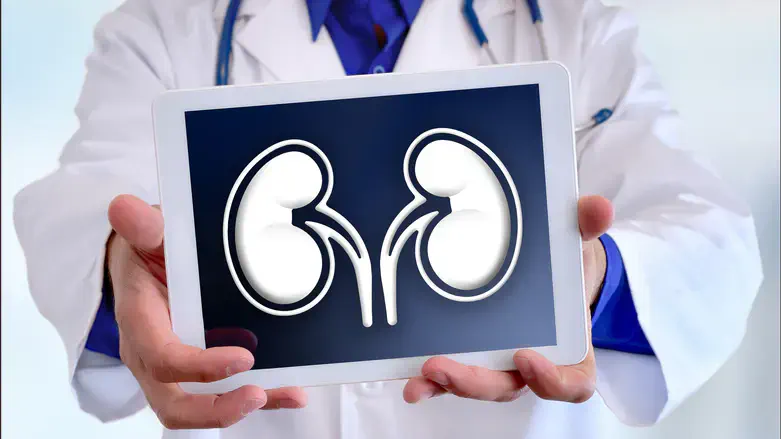
Kidneys are funny organs. Legume-shaped, they lack the gravitas of, say, the heart. But in Judaism they take on an unusual aspect. In the liturgy of the High Holy Days-fast approaching-the refrain is read: God examines the heart and inspects the kidneys. We know what is in our hearts, whether it is true repentance or obstinate self-justification or indifference. But we don’t know what is in the “kidneys," the inner sanctum of our consciousness, the truth we may not even reveal to ourselves. I think it is this truth that becomes clear when someone gives a kidney that another might live.
According to the World Health Organization and-more importantly-the Guiness Book of World Records, Israel is the country with the most altruistic kidney donors per capita. Last week my son became one of those donors.
He announced it to us in his usual low-key manner. “So, I’ve been thinking about this for a while and I’ve decided to…" Presumably, he had consulted with his wife, as she smiled approvingly, and informed his children, as even his youngest appeared calm. My husband and I, however, reeled in silent shock. Shock dissipated slowly into fear, and then into pride.
For us it was a common series of emotional events. Several times before he had sprung similar surprises, decisions of enormous consequence but obvious honor. It would be boorish to object, wouldn’t it, was my sour thought.
But in my heart I did object! What about me, I thought selfishly. What about my accomplishment? Hadn’t I given birth to a perfect baby, one with all his fingers and toes, and both kidneys intact?
And what about my little boy (in his mid-forties), all 6’1 of him? What if he needed that kidney later in life? What about the toll of surgery itself, taking up to four hours! The anesthesia itself could…
My overheated imagination kicked in. I began to resent the recipient. Why should he deserve my baby’s kidney? What if he was an evil man and would use the life he got from that precious organ to murder and terrorize?
Our son was wheeled into the OR and the vigil began. I kept reciting Psalm 20, which had seen him (alright, me) through three years of army duty, and many rounds of reserves.
“May the Lord answer you in the day of distress, may the God of Jacob fortify you. He will send his aid from the holy place and support you from Zion. May he remember your sacrifices and accept your prayers forever. May he grant you your heart’s desires and fulfill all your requests. We will rejoice in your deliverance and praise the name of God when he answers all your entreaties…O God save us, O King answer us on the day we call."
The surgery took four hours, then five, then six. Was there something wrong? What had happened? We would never find out. Finally, our daughter-in-law called. Everything had gone well and he was in the recovery room, reviving. The family relay team went into action, taking turns staying with him in the hospital. When it was our turn to visit two days later, we swallowed hard. I had never seen him so weak, or, despite his protesting otherwise, in so much pain. But as the day wore on everyone’s mood brightened.
Colleagues from work came to visit. One of them took me aside. “Have you any idea what a great guy your son is?" He proceeded to tell me of even more idealistic acts that my son had modestly done. I cringed. Saints don’t always fare well in this world. Good thing I could remember some less-saintly acts of the dear boy.
Modern medicine evilly forces surgery patients to walk as soon as possible. I watched the new patient trudge back and forth in the hallway beside his room. Another man was also trudging from further down the corridor. Suddenly, the two let go of the hall railings and embraced as tightly as they could, considering their wounds. Our donor and the kidney recipient met for the first time. There wasn’t a dry eye in the ward.
On the day we spent in the hospital, there was another visitor. A gorgeous woman walked into the room, dressed in the severe manner of the ultra-Orthodox. The woman was not young; she was ageless, like an angel. She proceeded to praise our son and bless him. She turned to me with a broad smile: Ashrei yoladeto (Happy is she who gave birth to him.) I felt then that I had found a sacred niche in the world.
The woman was Rachel Heber. Her late husband, Rabbi Yeshayahu Heber, received a kidney from a living donor and decided to dedicate his life to promoting altruistic, living-donor kidney donation. He and Rachel founded Matnat Chaim, the Gift of Life, which has been responsible for the lion’s share of these donations, and continues to spread acceptance for them throughout Israel. Rabbi Heber survived his transplant only to be felled by Covid-19. His wife might have been embittered by that cruel event, but instead she redoubled the efforts of Matnat Chaim. Rachel Heber has received the Israel Prize, the nation’s highest honor.
“Did you catch my life-saving side?"
My son’s donation was not the first time I considered kidneys seriously. In my freshman year in college, I took an introductory class in biology. The course required that each student dissect a frog. I approached the lab with my face contorted in disgust. I didn’t realize that this would be one of the great epiphanies of my life.
I lanced the frog’s abdomen, expecting a bloody, mangled mess. Instead, I saw perfection, every organ placed in a perfect whole, without crowding yet without excess space. It wasn’t a jigsaw puzzle; it was a glistening still life by an Old Master. In the center were two bean-like gems, the kidneys. How was it, I wondered, that God granted such perfection to so humble a creature? What then did he do for us, does he do for us, sentient beings with both bodies and souls? I was overwhelmed with gratitude.
Half a century later I have gained a better understanding of perfection. I have seen my son, faults and all, give life-imitatio Dei.
Sometimes a perfect body has only one kidney.
Wishing all our readers a New Year of health, prosperity, and peace.