

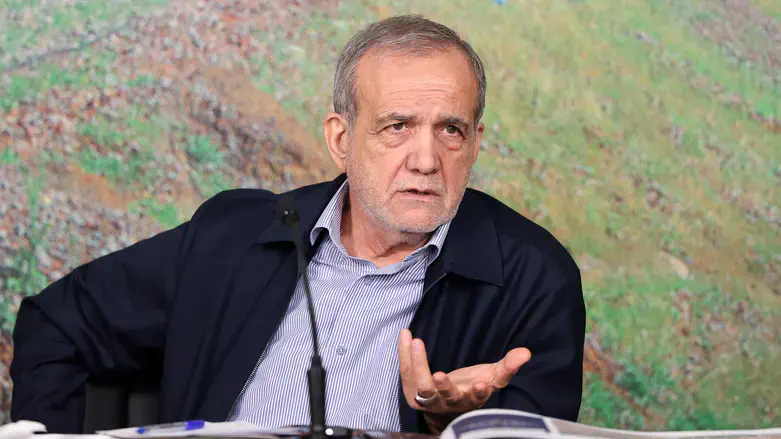
A new New York Times report is shining a spotlight on growing internal tensions within Iran’s leadership, revealing deep divisions over military operations, negotiations with the United States, and the authority of Supreme Leader Ayatollah Mojtaba Khamenei.
Iranian President Masoud Pezeshkian was reportedly caught by surprise in July when Iranian forces attacked three commercial vessels in the Strait of Hormuz in an operation that senior officials said had not been authorized by much of the country’s leadership.
According to the report, Pezeshkian was in neighboring Iraq for events marking the death of Iran’s previous supreme leader when he learned that Iranian forces had opened fire on the ships, setting a Qatari LNG tanker ablaze and damaging other vessels.
Pezeshkian contacted Islamic Revolutionary Guards Corps commander Gen. Ahmad Vahidi and angrily demanded an explanation, according to Iranian officials and Guards members cited by The New York Times.
Vahidi reportedly told Pezeshkian that he had neither authorized the operation nor known about it beforehand. Iran’s Supreme National Security Council was also unaware of the plan.
According to the Times, an investigation by Iranian authorities subsequently traced the decision to attack the vessels to Hossein Taeb, an influential cleric and intelligence figure who had opposed an agreement with the United States.
According to Iranian officials, Taeb had argued to Iran’s new supreme leader, Ayatollah Mojtaba Khamenei, that Tehran had made a mistake by ending the fighting and agreeing to a deal with Washington.
Alireza Namvar Haghighi, an Iran expert and former official who maintains contacts within the government, told the Times that the attacks were intended to destroy the understanding with US President Donald Trump and prevent future negotiations.
Officials said Pezeshkian was initially told that commanders in the field had acted independently under an order allowing them to target vessels deemed to be violating Iranian control of the Strait without approval from central command.
Iranian officials reportedly gave a similar explanation to the United States and regional countries after the incident, blaming unauthorized operators. Iranian Foreign Minister Abbas Araghchi was subsequently sent to Oman in an effort to reduce tensions with Washington.
The effort failed. Pezeshkian returned to Tehran, and the United States launched retaliatory airstrikes the following morning, bringing the two countries back into open conflict.
The incident also triggered serious disputes within Iran’s leadership. According to the report, senior officials engaged in heated confrontations, two generals threatened to resign, and accusations of betrayal were exchanged.
The turmoil contributed to changes at the Supreme National Security Council and the appointment of Gen. Mohsen Rezaei, a former commander of the Revolutionary Guards, to lead the body. Officials viewed Rezaei as capable of mediating among Iran’s competing political factions.
The divisions, however, continued.
A central source of uncertainty has been the absence from public view of Ayatollah Mojtaba Khamenei, who became supreme leader in March. He has not appeared publicly or been heard speaking since taking office, while Iranian officials have questioned whether written messages attributed to him are authentic.
In May, Pezeshkian said he had met with Khamenei. Officials told the Times that Pezeshkian was driven in an ambulance with darkened windows while a secure video connection was established. A person claiming to represent Khamenei then appeared on a screen and relayed messages.
Pezeshkian later told a close associate that he was uncertain whether he had actually communicated with the supreme leader, according to officials familiar with the encounter.
The Iranian president said last month that he had held another meeting with Khamenei lasting seven hours, during which they discussed economic conditions, sanctions, unemployment and the war. He did not disclose how the meeting took place or what Khamenei had said.
Against this backdrop, Iranian political and military leaders have been debating two competing strategies toward the United States.
One faction has advocated returning to negotiations. The other has pushed for escalating attacks on American targets in an effort to strike US naval forces, inflict casualties and drive global oil prices higher.
According to the report, both strategies were intended to bring an end to the US naval blockade of Iran’s southern ports, which has severely disrupted trade and halted oil exports. Iran is also facing a falling currency, rising inflation and a government cash shortage.
Hard-line Revolutionary Guards commanders backed the military option and presented the Supreme National Security Council with a plan under which Iran and allied groups in Yemen and Iraq would intensify attacks, including strikes against regional oil facilities.
Pezeshkian and parliament speaker Gen. Mohammad Bagher Ghalibaf, who has served as Iran’s leading negotiator with Washington, warned that such a strategy could expose Iran to heavier US strikes and worsening economic pressure.
By last Saturday, however, officials said the faction advocating escalation had prevailed.
Mahdi Mohammadi, a senior adviser to Ghalibaf, said the conflict between Iran and the United States had entered a new stage of escalation.