
Rosh Hashanah falls during an election season. We are busy following the news, reading the headlines, and discussing events with family and friends. Opinions are everywhere. Everyone has something to say. Everyone is certain that he is right, and everyone wants to be heard.
And then Rosh Hashanah arrives.
When the first day of Rosh Hashanah falls on Shabbat, the shofar is not sounded on that day.
The shofar is one of the central mitzvot of Rosh Hashanah. Its sound awakens us to teshuvah and reminds us that we are standing before the Ribbono Shel Olam. Yet when Rosh Hashanah falls on Shabbt, we do not blow the shofar.
Why?
The Gemara in Rosh Hashanah (29b) explains that Chazal were concerned that someone who did not know how to blow the shofar properly might go to someone who did know, in order to learn. He might then carry the shofar in a public place where it is forbidden to carry, reshutharabim, and come to violate Shabbat. Chazal therefore instituted that the shofar not be sounded when Rosh Hashanah falls on Shabbat.
There is something here that deserves our attention.
Tekiat shofar is a special mitzvah of Rosh Hashanah, one of the central mitzvot of the day. Yet when there is a concern that a Jew might come to be mechalel Shabbat, the shofar remains silent.
There is a lesson here about how we look at another Jew.
Chazal tell us, “Chaviv adam shenivra b’tzelem" - how precious is a person who was created b’tzelem Elokim. Every person is created in the image of Hashem. Certainly, we must recognize the preciousness of every Yid.
We live in a time when everyone wants to make his voice heard. This is especially true when it comes to public and political issues. A disagreement can quickly become an argument, and an argument can turn into a fight. Sometimes we become so busy proving that we are right that we forget who is standing in front of us.
Rosh Hashanah reminds us to stop and think.
Not everything has to be said. Not every statement needs an answer. We do not have to win every argument. And even when we are certain that we are right, we do not have to have the last word.
Because the person in front of us is not simply someone who has a different opinion.
He is a Yid.
He was created b’tzelem Elokim.
That has to affect the way we speak to him.
The person sitting next to us in shul. The neighbor who sees things differently. The family member with whom we disagree. Even when we do not see eye to eye, even when we are certain that he is wrong, he is still a Yid, and we have a responsibility toward him.
If Chazal were so concerned that a Jew might stumble in the observance of Shabbat that they instituted that the shofar should not be sounded, how much more careful must we be not to hurt or cause pain to another Jew who is right there beside us.
We can win an argument and lose much more.
The argument may soon be forgotten. Who was right and who was wrong may no longer matter. But a hurtful word can remain in a person's heart for a long time.
Perhaps this is one of the lessons we can take from the shofar that remains silent when Rosh Hashanah falls on Shabbat.
Sometimes our avodat Hashem is דווקא in what we choose not to do.
Not to say the hurtful word. Not to answer immediately. To allow the other person to speak. To give up the need to prove that we are right. To ask mechilah. To make peace.
These are quiet things. There is no sound of a shofar announcing them, and perhaps nobody else will ever know that we did them.
But the Ribbono Shel Olam knows.
And they are part of our avodat Hashem.
Our avodat Hashem does not end when we leave shul. It is also expressed in the way one Jew speaks to another.
Sometimes the greater avodat Hashem is simply knowing when to remain silent.
The elections will pass. The headlines will change. The arguments that seem so important today will eventually become memories.
But a Jew whom we hurt may remember that hurt for a very long time.
So perhaps this is the question we should take with us into Rosh Hashanah:
What am I willing to give up for another Jew?
A word?
An argument?
My honor?
My need to be right until the very end?
Rosh Hashanah is a time to accept upon ourselves something practical. Each of us can take one small kabbalah: Before I answer in anger, I will stop. Before I say something that may hurt someone, I will think. And when I disagree with another Jew, I will try to speak to him with respect.
Because even when we disagree with another Jew, we must never forget who he is - a descendant of Avraham, Yitzchak and Yaakov, created b’tzelem Elokim.
This is part of the introspection, cheshbon hanefesh, of Rosh Hashanah: not only what I need to correct in my relationship with Hashem, but also how I treat the Jew whom Hashem has placed in my path.
Chazal were willing to forgo the sound of the shofar rather than risk a Jew coming to be mechalel Shabbat. They were concerned about his Shabbat, even when the danger was only that he might carry the shofar while going to learn how to blow it.
That should make us stop and think.
If the sound of the shofar can be set aside so that a Jew will not come to be mechalel Shabbat, what are we willing to set aside so that another Jew will not be hurt or embarrassed?
A word?
An argument?
The need to have the last word?
On Rosh Hashanah, when we stand before the Ribbono Shel Olam, perhaps this is one of the things we should take upon ourselves: to be a little more careful with another Jew, even when we disagree with him, even when we believe we are right.
Because sometimes the greatest avodat Hashem is not in the words we say, but in the words we hold back.
And on a Rosh Hashanah when the shofar is silent, perhaps that is the sound we need to hear.
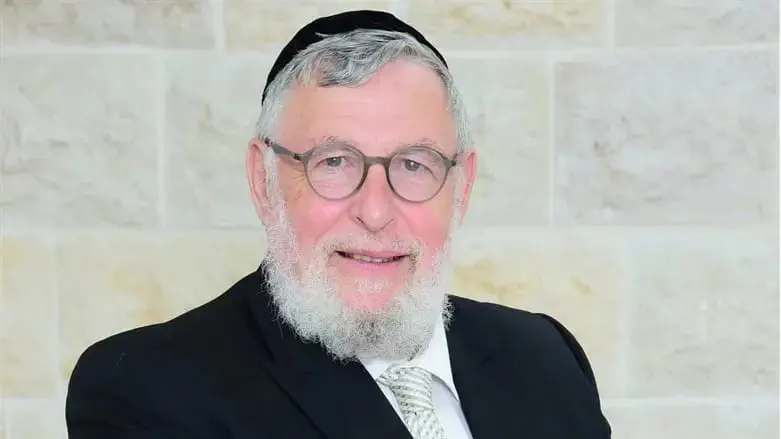
Rabbi Eliezer Simcha Weisz is a member of the Chief Rabbinate Council of Rabbis.