
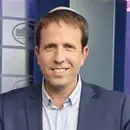
Lt. Dean Elsdunne, International Spokesperson for the Israel Police, spoke to Arutz Sheva-Israel National News from the President's Residence, where he received special recognition from President Isaac Herzog for his work representing Israel and the Israel Police.
"Very exciting day, I can say that. That's even an understatement," Elsdunne said.
Reflecting on the path that brought him to the President's Residence, he recalled making Aliyah eight years ago, serving as a lone soldier in a special unit, and later becoming an international spokesperson.
"Who would have thought that eight years ago I made Aliyah, Oleh Hadash, drafted into a special unit as a lone soldier, and then later became an international spokesperson," he said. "Not just for the police, but I feel like for the country."
"Today, that work, all that work in the last eight years, is being recognized on a stage that I couldn't even dream of being on."
Elsdunne also recalled the morning of October 7 and the moment he began to understand the scale of what was taking place.
"I feel like it was just yesterday. I feel like maybe even this morning. Obviously, [I] can't forget that day," he said.
At approximately 6:30 a.m., Elsdunne received a call informing him of rocket fire and telling him to report to his base. As he prepared to leave, additional calls began coming in about terrorists, kidnappings, soldiers, and police officers fighting for their lives.
Only after reaching the station and listening to the police emergency radio traffic, he said, did he begin hearing firsthand what officers were facing.
"I understand that our police officers, the men and women who fought that day, are really the human shield, the bulletproof vest of our nation," he said. "And it became my job from those moments to pass on the stories of heroism to the rest of the world."
While Elsdunne did not physically fight on October 7, he described the media effort that followed as "the fight of my life."
Beginning on October 9, he entered the kibbutzim. He helped bring members of the international media to the communities attacked in the massacre, where he worked to tell the stories of police officers who fought in Kfar Aza, Be'eri, and at the Nova festival.
Elsdunne described standing amid the aftermath of the massacre while trying to impress upon foreign journalists the significance of what they were witnessing.
"The blood is starting to create a smell that you'll never be able to forget. We're standing in houses that are burned, blood everywhere," he recalled.
He said his message to those visiting the sites was that they needed to remember what had happened when Israel responded to the attack.
"If this was your family, that they came and kidnapped, that this was your family, that they came and slaughtered like this, like animals, you would also want justice," he said.
Elsdunne said that effort continued through tours of the affected communities and meetings with international figures, to whom he sought to present what had occurred from the perspective of a police officer rather than on a political level.
He also discussed his involvement in responding to the flotillas that sought to reach Gaza, recalling in particular what he called the "Yom Kippur flotilla."
Elsdunne said that while the flotilla was presented as an attempt to bring humanitarian aid into Gaza, his own experience at the Kerem Shalom crossing had shown him trucks carrying aid into the Gaza Strip, escorted by police officers.
When the flotilla arrived, Elsdunne boarded the vessel.
"I knew it was all a show. I knew it was all for social media," he said. "I get on, and the boat was just empty. There was a little bit of food that they were eating."
He said he recorded a video from the vessel in an effort to show audiences abroad what he had seen.
Turning to the broader challenge of representing Israel internationally, Elsdunne warned that stories understood within Israel can be received very differently by audiences overseas.
"The stories that we're talking about here, we may understand the nuance and the context because we're Israeli, but abroad they use that against us," he said.
"I'm not saying to lie. We should always, always tell the truth," he stressed, while arguing that context familiar to Israelis can be manipulated abroad to make false claims against Israel.
His message to Israelis seeking to tell the country's story was to continue speaking out.
"I would say don't give up, continue to speak on behalf of Israel because the truth will prevail, the justice will prevail."
Elsdunne concluded by thanking his commanders for supporting his work and the police officers whose stories he has sought to tell.
"I wouldn't be standing here if it wasn't for the police officers, the female and male, who gave their lives, who were the human shield for our country," he said.
He also thanked his wife, who remained at home with their two children while he carried out his duties throughout the war, including during rocket attacks.
"As the rockets are falling, she needs to be there alone and hold down the fort," he said.