
Rabbi Chaim Drukman was a venerable spiritual leader of political religious Zionism and a close student of Rav Tzvi Yehuda Kook zts"l. Both were founders of the settler movement who coined the term Gush Emunim. Rabbi Drukman influenced the country’s top leaders as a rabbi, educator and political power in Israeli society.
This article is an extract from his book, “La-Zeman Hazeh," a series of essays about Jewish holidays, including both traditional holidays and “new" ones that were established in the last hundred years to celebrate the Jewish people’s return to the Land of Yisrael.
(Adapted and translated by Moshe Goldberg)
The Importance of the Mitzvah of the Shofar
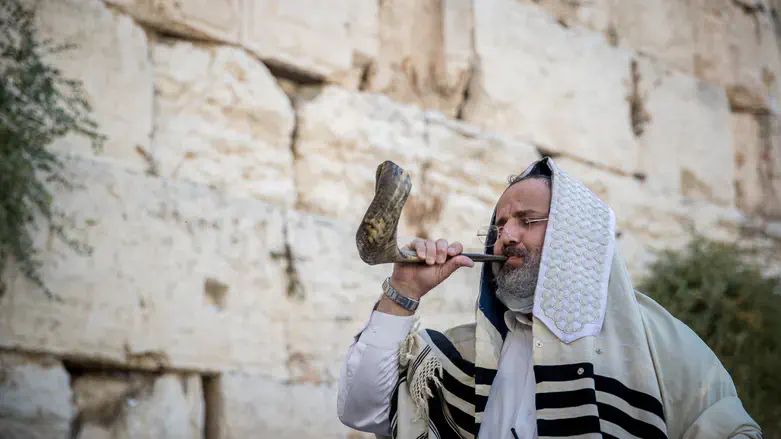
The main mitzvah of the day of Rosh Hashanah is to blow the shofar (Bamidbar 29:1): "And in the seventh month, the first day of the month will be holy. Perform no work, and it will be a day of horn-blowing for you." This is the only mitzvah that is unique to Rosh Hashanah, and it distinguishes the holiday more than anything else.
The Mishnah (Rosh Hashanah 3:2) gives a general rule about the various types of shofar: "Every shofar can be used except for that of a cow." And why is that? What is wrong with a shofar made from a cow’s horn? The Sages derive this in the Gemara (Rosh Hashanah 26a) from Rav Chisda's answer to a different question: why doesn’t the High Priest enter the innermost sanctum on Yom Kippur wearing garments of gold?
When the High Priest enters the Holy of Holies in the Temple on Yom Kippur, he removes the golden garments he is wearing and exchanges them for white garments. Why? The golden garments would seem to be the more important ones! Rav Chisda answers that "a prosecutor cannot become a lawyer for the defense." Gold served as a "prosecutor" against Israel when they sinned by making the Golden Calf. This sin led to a harsh punishment, and so the gold cannot be used to defend them and argue in their favor. It is a reminder their wrongdoing.
The principle that "a prosecutor cannot become a defense lawyer" also applies to the shofar. The sin was committed using a calf - and therefore a horn coming from the species of the cow may not be used.
The Gemara questions this reasoning: "But golden garments are worn outside the Holy of Holies!" Although the priest does not enter the Holy of Holies wearing the golden garments, he does wear them while serving outside, in the rest of the Temple. Doesn’t this violate the rule that "a prosecutor cannot become a lawyer for the defense"? The Gemara answers: "This applies only inside." We are concerned about a prosecutor turning into a defense lawyer only within the Holy of Holies itself. Outside of it there is no problem. The Gemara then asks: "But the shofar is also blown outside!" If the principle that "a prosecutor cannot become a defense lawyer" applies only within the Holy of Holies, why should it matter for blowing the shofar, which takes place outside the Holy of Holies?
The Gemara answers: "Since it is for remembrance, it is considered as though it is inside." Because the shofar serves as a remembrance, it is viewed as if it is performed within the Holy of Holies itself. From this we can see the great value of the mitzvah of shofar, which is considered equivalent to service in the Holy of Holies. The shofar raises us higher and higher. It awakens us and reminds us of our true essence.
The Torah itself does not spell out the reason for the mitzvah of the shofar, though many possible hints have been proposed. For example, the Rambam writes (Laws of Repentance 3:4) that even though the blowing of the shofar on Rosh Hashanah is a Torah decree, it also hints at what is expected of us: "Awaken, you sleepers, from your sleep, and you who slumber, arise from your slumber; examine your deeds and repent, and think about your Creator" - you who forget the truth amid the vanities of time and go astray pursuing emptiness and vanity that neither profits nor saves, look to your souls and improve your ways and your deeds, and let each of you abandon his evil ways and his improper thoughts.
The shofar blowing comes to arouse us to return to our true and value-laden lives, to return to ourselves. And yet this remains only a "hint" that we find within the mitzvah. It does not change the fact that "blowing the shofar on Rosh Hashanah is a Torah decree." As stated in the Gemara (Rosh Hashanah 16a): "Why do we blow the shofar on Rosh Hashanah? What does that mean, why do we blow it?! The Merciful One said, 'Blow!' The Holy One, blessed be He, told us in the Torah to blow, and that is why we do it."
The Essence of the Mitzvah Is in the Command
Great as the value of the mitzvah of blowing the shofar is, it can happen that the mitzvah is set aside in favor of something else. The Sages decreed that when Rosh Hashanah falls on Shabbat, the shofar is not blown at all. It might seem, as it were, that this decree undermines the very essence of the day, the mitzvah that makes it unique-blowing the shofar! However, the opposite is true. Not only does the suspension of the mitzvah of the shofar fail to detract from the essence of the day, it actually shows its importance. In this way, we are brought face to face with the day's unique value.
So long as Rosh Hashanah falls on a weekday, we might think that there is something special in the shofar itself that is the essence of its holiness. And so, the suspension of the shofar-blowing on Shabbat clearly demonstrates that the shofar is not the active agent, but it is merely a means - an important element to be sure, but one that functions only because "the Torah commanded, 'Blow!'" The word of God is what gives the shofar its special value. If not for the divine command, the shofar would not be important at all. The decree of the Holy One, blessed be He, grants holiness and meaning to the shofar and to all the other mitzvot as well.
And that same Torah, the word of God, also commanded (Devarim 17:9-11): "And you shall come to the priests of Levi, and to the judge who shall be in those days, and inquire, and they shall declare to you the sentence of judgment. And you shall act according to what they tell you... And you shall be careful to do according to all their instructions. You shall follow the Torah that they teach you, and act according to the judgment that they tell you - do not turn aside from the word that they declare to you, neither to the right nor to the left!" The uprooting of the mitzvah of the shofar on Rosh Hashanah that falls on Shabbat shows us that it is the fact that "the Merciful One commanded" that is important, and from this we may derive the same principle regarding all the other mitzvot: it is the divine command that grants value to every act in life.
This is how Rabbi Samson Raphael Hirsch (Bereishit 6:15) explains the words of the Sages, "greater is the one who is commanded and acts than the one who is not commanded and acts" (Bava Kamma 87a) as a great principle within the Torah. Contrary to the common view, a person's deed has value only insofar as it constitutes the performance of God's will. What a person does purely on his own judgment carries only secondary and doubtful importance. The essence of a mitzvah is the divine command that created it and not the mere physical act of performing it.
The Value of Rabbinic Commands
In one place it is written (Vayikra 23:24): "...in the seventh month, on the first of the month, you shall have a solemn rest, a memory of blowing a shofar." In another place it is written (Bamidbar 29:1): "And in the seventh month, on the first of the month... shall be a day of blowing a shofar for you." This appears to be a contradiction: is it a "memory" or an actual event?
The Sages addressed this in the Talmud Yerushalmi (Rosh Hashanah 4:1). One verse says "a day of horn-blowing," and another verse says "a memory of horn-blowing." What does this mean? When it falls on a weekday it is "a day of horn-blowing"; when it falls on Shabbat there is "a memory of horn-blowing" - we describe it, but we do not blow.
According to the Talmud Yerushalmi the Torah itself hints that there is a case in which Rosh Hashanah has no actual horn-blowing, but only a memory - this is on Shabbat, when the shofar is not actually sounded. In other words, setting aside of the mitzvah of blowing the shofar is not a rabbinic decree at all, but is hinted at in the Torah itself. It can be considered a matter of Torah law and not a rabbinic ruling.
The Talmud Bavli (Rosh Hashanah 29b) quotes this teaching of the Talmud Yerushalmi. One verse says "a solemn rest, a memory of horn-blowing," and another verse says "it shall be a day of horn-blowing." This is not difficult to understand: the former refers to a festival day that falls on Shabbat, the latter to one that falls on a weekday. However, in the Talmud Bavli this opinion does not stand unchallenged. Rava raises several difficulties that undermine it, leading him to disagree and to state instead that the suspension of the horn-blowing on Shabbat is not derived from the Torah itself but from the words of the Sages: "Rather, said Rava, from the Torah it is entirely permitted [to blow on Shabbat], and it is the Rabbis who decreed against it... As Rabbah said: everyone is obligated in the mitzvah of shofar-blowing, but not everyone is expert in how to blow, and so it was decreed not to blow lest a person take the shofar in his hand and go to an expert to learn from him, thereby carrying it four cubits in a public domain."
Thus, we have found no source in the Torah for suspending the horn-blowing on Shabbat. The Sages saw a need to suspend the blowing out of concern that a person might carry his shofar on Shabbat in a place without an eruv, and thereby desecrate Shabbat. But if so, the original question remains: why does one verse discuss "a remembrance of horn-blowing," while another verse describes actual horn-blowing? And moreover, how will the Jerusalem Talmud's teaching withstand Rava's objections?
Perhaps we may resolve this by saying that once the Sages established that the shofar is not to be blown on Shabbat, the ruling itself in effect became a matter of Torah law - a law flowing from the Torah's own commandment to heed the words of the Sages. This is what is hinted at in the words "a remembrance of horn-blowing."
The Value of Shabbat
The Sages decreed not to blow the shofar out of a fear that a single Jew who does not know how to blow might carry his shofar on Shabbat in a public domain. For the sake of that single Jew, we suspend the mitzvah of shofar-blowing that year for all the people of Israel!
From this we learn a great lesson about the importance of the holy Shabbat. Although when Rosh Hashanah falls on Shabbat we do not hear the blasts of the shofar, the very fact of this silence constitutes a great "blast" in honor of the holiness of Shabbat. It is precisely from our not blowing that the strength and force of Shabbat can be seen. From this we understand the immense value of the holy Shabbat: out of concern for desecration by a single Jew, the entire people of Israel must set aside a positive mitzva. The act of not blowing the shofar constitutes a great blast against the desecration of Shabbat!
And indeed, especially in our generation one must emphasize the value of Shabbat, which has lost its glory in the eyes of some of our people, as can be seen in various painful ways. It is no longer a matter of individuals merely neglecting Shabbat, but of an actual desire to erase Shabbat from the State of Israel, to uproot the Jewish stamp from the state of the Jews - through such actions as allowing public transportation, El Al flights, and the opening of shopping malls. We hope that these things will not come to pass in practice and will be curtailed as much as possible, but even if the holiness of Shabbat is not actually harmed, the very idea that has arisen, curtailing the holiness of Shabbat - the very willingness to give up the Sabbath Queen - is itself a terrible thing!
This does not stem, heaven forbid, from any wickedness of heart on the part of this or that person, but rather from a failure to understand the true nature of Shabbat. As is written in the Gemara (Shabbat 10b): the Holy One, blessed be He, said to Moses: "I have a precious gift in My treasure house, and Shabbat is its name, and I wish to give it to Israel - go and inform them!" Unfortunately, there are people among our brethren today who do not have the merit to taste the sweetness of Shabbat, this "precious gift," and who therefore do not understand the greatness and value of Shabbat and want to harm it without understanding what they are doing.
Many nations have copied the day of Shabbat from us, yet their "Shabbat" is nothing more than an external imitation, as Rabbi Jehudah Halevi wrote (Kuzari 3:9): “Behold those who established a day of rest in place of the day of Shabbat - can the two things truly be compared? Rather, this can be compared to the way that forms of statues can be compared to the forms of living human beings!"
And it is specifically some of us, "the people who sanctify the seventh day," who disown the true Shabbat that we received as a gift from the Creator. And like our teacher Moshe, we too have been called upon to teach the people of Israel about the precious gift given to us by the Holy One, blessed be He.