
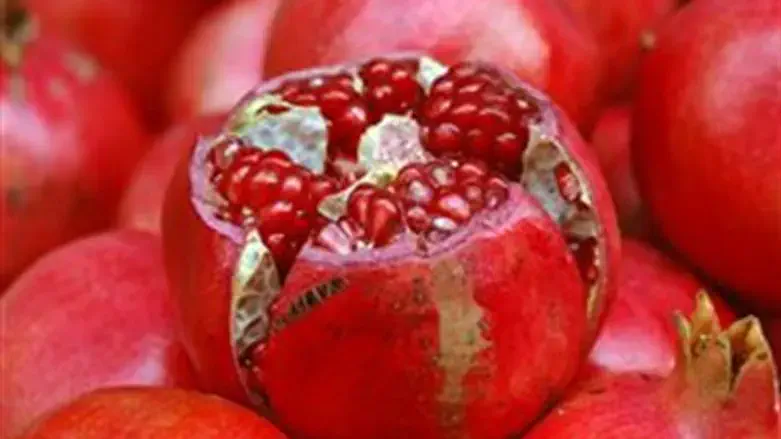
When a pomegranate is opened, its crimson arils emerge like hidden jewels, luminous and crowded within their chambers, while the thick, scarred rind that carried them through months of wind, heat, insects, and rain is peeled away and discarded. We savor what was guarded and forget the guardian, yet every ruby seed bears silent witness to the battered shell that stood between its fragile beginning and the world, protecting it until it was ready to survive on its own.
By the time the fruit reaches our table, the peel seems lifeless and expendable, an obstacle standing between us and what we really want. Yet throughout the long months in which the pomegranate was forming, that same rind stood at the frontier between fragile developing life and a world capable of destroying it.
The peel was never merely packaging. As the fruit grew, its surface and waxy cuticle helped reduce water loss, its tissues provided mechanical protection, and the pomegranate rind accumulated unusually high concentrations of polyphenols, including compounds associated with antioxidant and antimicrobial activity.
The peel senses light, injury, temperature, and invasion, then changes its genes and chemistry to shield what lies within. What appears to us to be a disposable shell was, during development, an active participant in the survival of everything within it. The rind did not simply surround the fruit; it helped the fruit become what it was destined to be.
More Than a Barrier
The distinction between a barrier and a guardian is important. A barrier merely separates what is inside from what is outside; a guardian participates in preserving what lies within.
The same principle appears throughout biology. The cell membrane is not an inert fence, but a dynamic interface crowded with receptors, channels, transporters, and signaling molecules that continually regulate what enters, what leaves, and how the cell responds to its environment. CD59, Integrins, Toll-like receptors (TLRs) and others embedded within the cell membrane sense danger in the surrounding environment and transmit signals inward, activating mechanisms of defense, repair, and survival.
Biological guardianship is therefore rarely passive. It recognizes danger, regulates growth, repairs damage, and preserves identity. The true guardian does not merely stand outside what he protects; he participates in what it becomes.
Nearly two thousand years before modern biology could describe these mechanisms, the Talmud looked at the structures surrounding a fruit and chose a remarkable word for them. In Brachot 36b, the Sages speak of the שומר לפרי - shomer la-pri, literally, the guardian of the fruit. The word is more evocative than “peel" or “covering," because a covering may simply surround something, while a shomer exists for the sake of what lies within. From that apparently technical discussion emerges a question far larger than botany:
What becomes of a guardian as the fruit matures, and does guardianship end when the fruit is finally separated from its source?
What Makes a Guardian of the Fruit?
The discussion in Brachot 36b, together with related discussions elsewhere in the Talmud, revolves around a deceptively difficult question: what qualifies a structure as a שומר לפרי-a guardian of the fruit? This is more than a botanical description. Once a structure is recognized halakhically as a shomer, it is no longer regarded as merely surrounding the fruit; it becomes sufficiently associated with the fruit itself to share in its halakhic significance. It has consequences in areas as varied as ritual impurity, the laws governing produce of the Land of Israel, blessings, and other areas of Halakhah.
The Talmud therefore examines several criteria for determining what creates this special relationship between guardian and fruit. How long must the shomer accompany the fruit to be defined as a shomer? At what stage in the fruit’s development must it be present? And how dependent is the fruit upon it for survival?
One criterion concerns duration: must the shomer accompany the fruit בין במחובר בין בתלוש-both while the fruit remains attached to the branch and after it has been picked? According to this criterion, guardianship cannot be defined solely by what surrounds the fruit while it grows upon the tree; the relationship between shomer and fruit must extend from מחובר, while the fruit is attached, into תלוש, after it has been detached.
A second criterion concerns the fruit’s development and maturation. The fruit emerges gradually, passing through stages that include סמדר (semadar), the blossom or earliest formation of the fruit, and בוסר (boser), the immature fruit, before reaching maturity. Halakhah must therefore determine at what stage the developing fruit acquires the status of a פרי-fruit. That determination, in turn, becomes relevant to defining its shomer. Must the protective structure already be present when the developing fruit first acquires its halakhic status as fruit? Thus, determining when a fruit becomes a פרי becomes part of determining what qualifies as its שומר.
A third criterion is functional dependence: does the fruit actually depend upon the shomer for its continued development? The Gemara expresses this vividly in the phrase כי שקלת ליה לשומר מיית פירא-if the shomer is removed, the fruit dies or withers. Here the guardian is defined not simply by its location and time around the fruit, but by the consequence of its absence: remove the guardian, and the fruit itself suffers.
The Talmudic discussion thus approaches the shomer from three complementary directions: its duration, its presence during the fruit’s maturation, and the fruit’s dependence upon it. Of these, Rava’s principle of בין במחובר בין בתלוש lies at the heart of this analysis. The shomer is not confined to the fruit only while that fruit remains attached to its source; its role extends into the state of תלוש, after separation. The fruit may become detached from the tree, yet the guardian remains a guardian of the fruit.
At this point, the botanical discussion opens into a much larger human question. A child eventually leaves the shelter of his parents, a student leaves the presence of his rebbe, and a human being may even distance himself from God. Each, in a different sense, passes from מחובר to תלוש. The question raised by Rava’s principle is therefore not whether separation occurs, but whether separation from one’s source must also mean separation from one’s guardian.
Parents as שומר לפרי
Rabbi Joseph B. Soloveitchik, the Rav, in a Yiddish Talmud shiur from January 1952 delivered at Congregation Moriah in New York City on the sugya of שומר לפרי in Brachot 36b, carried this halakhic concept beyond its botanical setting:
The shomer, he posited, offers a way of understanding those who guard a human being through the stages of life: a parent, a rebbe, and ultimately the Ribbono Shel Olam.
The metaphor is compelling because parenthood itself changes as the child matures. A young child requires almost continuous physical protection; an adolescent needs boundaries, judgment, instruction, and example; eventually the adult child leaves home, crosses oceans, establishes another family, and makes decisions beyond the parent's reach. If guardianship meant only standing physically between a child and danger, it would necessarily diminish as the child grows.
But something else has been happening during those years. Language and memory, restraint and aspiration, faith and moral judgment have slowly passed from parent to child until what began as protection from the outside becomes architecture on the inside. The hand that once guided the child is released, yet the voice remains; the parent who once stood beside him begins to live within him.
The guardian has merged with the fruit.
Joseph and the Face in the Window
Few rabbinic images capture this more powerfully than the Talmud's account of Joseph in Egypt. Joseph had been violently detached from his father's home, sold by his brothers, carried into a foreign culture, and placed in Potiphar's household. Jacob could no longer watch him, instruct him, or intervene when danger approached; everything that had once physically connected father and son had been severed.
Then came the encounter with Potiphar's wife.
At the decisive moment, the Talmud tells us:
באותה שעה באתה דיוקנו של אביו ונראתה לו בחלון“ At that moment, the image of his father came and appeared to him in the window." (Sotah 36b).
Jacob was far away, yet when Joseph needed him most, the father who could no longer stand beside his son somehow stood within him. Years of guardianship had accomplished something more enduring than supervision: Jacob's presence had become part of Joseph's moral imagination.
Rabbi Joseph B. Soloveitchik lamented the painful rupture between generations that he witnessed in America, as children moved rapidly into a new language and culture while the world of their parents and grandparents-their memories, melodies, faith, and inherited ways of living-seemed to recede behind them.
When I think of that loss, however, I remember something wonderfully ordinary. My grandfather lived in our apartment building, close enough that I could sit across a chessboard from him and watch his hand move slowly among the pieces while he drank his tea with sugar cubes. I did not know then that I was receiving an inheritance. Yet across the distance of decades, I can still see the board and almost see the glass of tea beside him, and I understand now that inheritance often enters us in precisely such unannounced moments. Long after the game is over and the pieces have been returned to their box, the grandfather remains.
The fruit had been torn from the tree, but the guardian had traveled with it.
The Rebbe Who Remains
There is another kind of guardian whose deepest influence is revealed only after we have left his room. A rebbe begins as a presence across the table: a voice opening a difficult Gemara, a finger resting upon a line of Tosafot, a question that overturns an easy assumption, a way of thinking-and of living-that slowly teaches the student how Torah is meant to be encountered. In those years, the student may believe that the lesson lies primarily in the words being spoken. Only much later does he discover that something far more enduring was being formed within him.
I feel this especially when I think of Rabbi Joseph B. Soloveitchik, the Rav. I had the extraordinary privilege of serving as his baal tefillah on Rosh Hashanah and Yom Kippur, standing before the congregation while knowing that he was beside me, listening to every word and every ancient melody. The memory has not faded with the passing of the years. Even now, when I encounter a difficult text, a question of faith, or the familiar melodies of the Yamim Noraim, I can still sense that presence and find myself wondering: How would the Rav have understood this? What would he expect of me now?
Perhaps that is among the deepest achievements of a rebbe. He does not keep his student forever at his feet; he prepares him to leave the room carrying something of the room within him. The voice that once came from across the table eventually becomes a voice heard from within, and the teacher who once stood beside us becomes part of the way we think, pray, and confront the world. The student may become תלוש, separated by distance and even by death from his Rebbe, yet something remains מחובר. Like the shomer la-pri, the guardian has not disappeared. He has entered the fruit.
The Detached Fruit
The metaphor reaches its most daring point when it moves from parent and rebbe to Hashem. A child leaves because he has grown, and a student leaves because he has learned, but the sinner is different: he chooses detachment. Through his own actions, he may distance himself from his source until the voice that once summoned him becomes faint and the road home almost disappears.
One might assume that this is precisely where guardianship ends. If the fruit has deliberately torn itself from the tree, why should the Shomer follow it?
Yet here the halakhic image acquires its greatest force. שומר לפרי does not lose its significance merely because the fruit has been detached. Separation changes the condition of the fruit, but it does not necessarily erase the relationship of the guardian to it. What begins as a technical halakhic category becomes a daring religious proposition: even when man detaches himself from God, God does not detach Himself from man.
The sinner may have stopped listening, but he has not moved beyond being called; he may have hidden, but he has not moved beyond being found.
Perhaps this is the deepest meaning concealed within the modest phrase שומר לפרי. Parents eventually release the hands they once held, and a rebbe watches his student walk beyond the walls of the beit midrash. Their guardianship succeeds when what once stood outside has entered within, when presence has become memory and instruction has become character. Divine guardianship reaches further into the darker place where even that inner voice has grown faint.
Here botany, Halakhah, and theology converge. The rind continues to protect the fruit after separation; Jacob's image follows Joseph into Egypt; the voice of a rebbe accompanies a student long after the shiur has ended; repentance is possible. Separation is real, but relationship can survive separation.
And suddenly the humble rind of a pomegranate, the shomer, becomes a theology of hope:
The fruit may fall far from the tree,
but it never falls beyond the reach of its Guardian.
Itzhak David Goldberg is a Professor Emeritus at Albert Einstein College of Medicine