

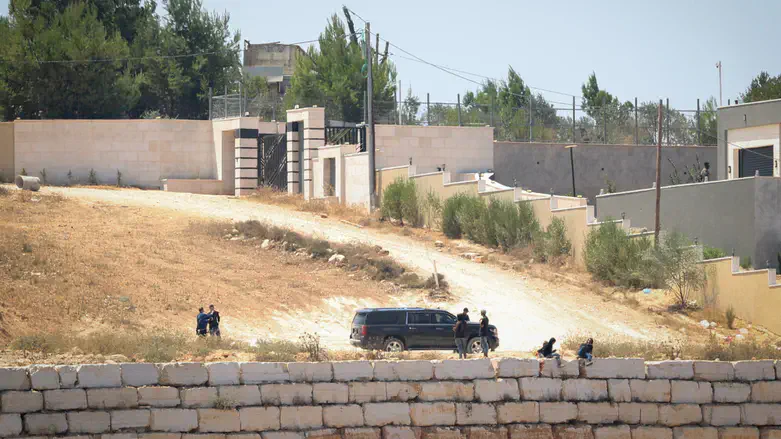
The Israeli Supreme Court delivered a ruling on Sunday giving the state 14 days to coordinate the return of three Palestinian Arabs from the village of Jalud in the Shechem (Nablus) area to their homes, which, according to the petition, they were forced to leave due to violence by Israeli critics. The ruling was passed by Supreme Court President Justice Isaac Amit and Justices Alex Stein and Yechiel Kasher
The petition claimed that the harassment of the residents began in April with the erection of a tent on the petitioners' private land in Area B. According to the petitioners, in the months that followed, they suffered intrusions, threats, roadblocks, rock-throwing, property and infrastructure damage, the cutoff of the waterline, the uprooting of trees, and car arson.
On June 22nd, two of the petitioners had to leave their homes, and according to the Supreme Court ruling, they have yet to return. The court noted that the state does not dispute the main chain of events described by petitioners.
According to the petition, after the residents left, the Israeli citizens broke into the home of one of the petitioners and later passed between the petitioners' homes. The petition also included a video which, according to the ruling, shows IDF soldiers and the Israeli citizens playing soccer together in the yard of one of the homes.
During the hearing, state representatives were questioned about the video. The brigade operations officer responded that the soldiers were serving as reinforcements and were therefore unfamiliar with the procedures and orders. The court was also informed that the soldiers involved had been removed from combat duty following the incident.
The state said it was prepared to coordinate the petitioners’ return to their homes, but clarified that it could not assign a permanent force to remain there. In its response, the state detailed measures taken to address nationalist crime, including assigning Border Police forces to regional brigades, reiterating the obligation not to stand by during violations of the law, issuing an order banning face coverings, and increasing the use of restraining and exclusion orders.
The state also noted that a special task force had been established within the Judea and Samaria District Police and the Border Police in Judea and Samaria to address incidents of nationalist crime. It added that police operate a dedicated 24-hour hotline for Palestinian residents. According to the state, meetings and other measures are also being conducted at senior levels of the IDF Central Command and the Judea and Samaria District Police.
The state linked the incidents to an illegal outpost known as “The Hill of Burning Tires," which it said was established in April 2026. Its response to the petition stated that eight enforcement operations had been conducted against the outpost, a closed military zone order had been issued, forces in the area had been reinforced, and an operation to enforce law and order had been launched. As part of the operation, outposts established in Area B were demolished, and construction equipment was confiscated.
The state also reported that during an incident in May, a vehicle carrying four Israelis, construction materials, two clubs, two knives and two cans of pepper spray was stopped. One of the Israelis was detained and taken to the Ariel police station. In August, another Israeli citizen was arrested near the outpost and transferred to police custody.
At the same time, the state pointed to difficulties in enforcement, claiming that attempts had been made to disrupt the forces’ operations, including through false reports intended to divert their attention. It also claimed that Israelis in the area scatter and flee before the forces can apprehend them, and that large numbers of people are sometimes quickly mobilized to obstruct enforcement operations.
The Supreme Court was not satisfied with the explanations. “The emerging picture is extremely bleak. There are plenty of questions, but fewer satisfactory answers," the decision stated. Given the number of incidents, their duration and the response provided, the court said that “the conduct of the respondents in these proceedings raises serious difficulties."
The justices questioned, among other things, why vehicles used by those described in the decision as “rioters" had not been seized and forfeited, even though their license plate numbers had been provided to the authorities and some had been documented. The court noted that it had received no answer to this question, nor to the question of what enforcement measures had been taken against individuals whose identities were known to the authorities.
The decision cited a ruling from approximately 20 years ago stating that Palestinian Arab residents must not be prevented from accessing their land as a means of protecting them from attackers. “And now, some two decades later, a situation is developing before our eyes that is not so far removed from the scenario described by Justice Beinisch as unthinkable," the court wrote.
The court stressed that, as of the date of the decision, the petitioners had still not returned to their homes. “This fact speaks for itself and cannot be accepted," the justices ruled, noting that overall responsibility for the security of the area’s residents rests with the military commander.
The Supreme Court also addressed nationalist crime against Palestinian Arabs, ruling that it harms day-to-day security and requires the allocation of forces and resources. The justices added that it damages Israel’s international image and that, “first and foremost, it is an entirely unacceptable phenomenon."
In practical terms, the Supreme Court ordered the state to coordinate a date for the petitioners’ return to their homes within 14 days and to secure their return. The state was also required to allow them to bring in equipment and supplies to repair their homes and restore water and electricity infrastructure.
In addition, the court issued an order nisi requiring the state to explain why it should not act to return the petitioners and their families to their homes, and specifically why roadblocks and obstacles should not be removed from access routes. The state must submit its affidavit in response by October 8th.
The justices also ordered the state to provide detailed information on measures taken to prevent Israeli civilians from returning to the outpost and the petitioners’ homes, investigations and potential prosecutions of Israelis identified in the area, and the possibility of forfeiting vehicles used in illegal activity. The parties were required to update the court on the petitioners’ return to their homes by September 22nd.