
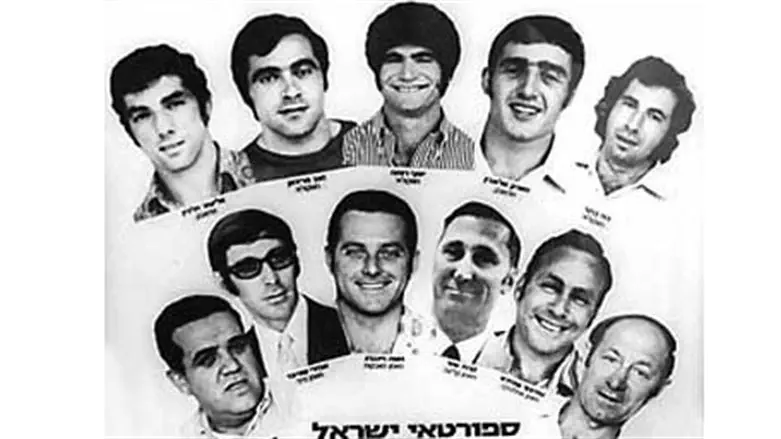
Fifty-four years ago, on September 5, 1972, the Olympic Games in Munich became a killing field.
Eleven Israeli athletes and coaches were murdered by Arab terrorists from Black September. A German police officer was also killed. The victims had come to Germany not as soldiers but as sportsmen. They came to compete beneath the Israeli flag, only 27 years after the liberation of Auschwitz and just 25 years after the Holocaust.
They did not come home alive.
There is an unbearable historical obscenity at the heart of the Munich massacre that must not be forgotten.
The Germans had demonstrated, only a generation earlier, a terrifying proficiency at hunting down Jews. The Nazi state had mastered the bureaucracy of persecution: identifying Jews, registering them, dispossessing them, concentrating them, deporting them and ultimately murdering them.
But in Munich, when Jewish lives depended upon German authorities rescuing them, the response descended into catastrophic incompetence.
When it came to murdering Jews, Germany had demonstrated terrifying efficiency. When Jewish lives needed saving in Munich, the authorities proved disastrously unprepared.
That contrast is painful. It is also historically important.
The Munich Olympics were designed partly to show the world a new Germany. These were to be the heiteren Spiele-the “cheerful Games"-the antithesis of Hitler’s wretched 1936 Berlin Olympics. Security was deliberately understated. Germany wanted smiling policemen rather than an intimidating security presence.
Then, in the early hours of September 5, eight Black September terrorists climbed the fence of the Olympic Village and entered the Israeli team’s quarters.
Wrestling coach Moshe Weinberg resisted and was shot. Weightlifter Yossef Romano fought the terrorists and was killed. Nine Israelis were taken hostage.
What followed was nearly a full day of agony broadcast around the world.
The terrorists demanded the release of terrorist prisoners held in Israel and members of the German Red Army Faction. Israel refused to negotiate and reportedly offered German authorities assistance. West Germany insisted on handling the crisis on German soil.
That decision imposed a profound responsibility: save the hostages.
Germany failed. The failures were staggering.
German police initially planned an assault on the Olympic Village by officers dressed in tracksuits. Television cameras broadcast preparations live-and the terrorists could watch television themselves. The operation was abandoned.
Later, the terrorists and hostages were transported by helicopter to Fürstenfeldbruck air base, supposedly on their way to Cairo.
German authorities attempted an ambush. It became a catastrophe.
There were only five police sharpshooters positioned at the airfield for eight terrorists. They were not a specialized counterterrorism sniper unit. Communication was inadequate. The police lacked proper coordination and equipment. An armored vehicle arrived late, delayed in traffic.
Police officers assigned to overpower terrorists aboard a waiting aircraft abandoned their mission shortly before the helicopters arrived.
Then the shooting began. The rescue disintegrated.
By the end, all nine remaining Israeli hostages were dead. Five terrorists and German police officer Anton Fliegerbauer were also killed.
Before the full truth was known, the world was even briefly told that the hostages had been saved. Then came the correction. “They’re all gone."
Those words became part of the memory of Munich.
The Olympics were supposed to prove that Germany had changed. Instead, eleven Israelis came to Germany in peace and left it in coffins.
We should be precise about the moral responsibility. Black September murdered the Israelis. The terrorists-not the German police-were the killers.
But that does not absolve the German authorities of their disastrous rescue operation.
Indeed, the historical context makes their failure even more haunting.
Among the murdered Israelis was weightlifting coach Yakov Springer, who had survived the Holocaust. He escaped one European nightmare only to be murdered on German soil decades later.
There was fencing coach Andre Spitzer, just 27, whose wife Ankie would become one of the most determined voices demanding accountability.
There were David Berger, Ze’ev Friedman, Yossef Gutfreund, Eliezer Halfin, Amitzur Shapira, Kehat Shorr, Mark Slavin, Moshe Weinberg and Yossef Romano.
Say their names.
Olympic history too often compresses them into a number: “the 11 Israelis." They were not a number. They were husbands, fathers, sons, coaches and athletes. They represented a Jewish state that itself had existed for only 24 years.
And then came another disgrace. The Games continued.
After a memorial service and a brief suspension, International Olympic Committee president Avery Brundage declared, “The Games must go on."
Imagine it.
Jewish athletes had just been slaughtered at the Olympics, and the great machinery of international sport could not bring itself to stop moving.
For decades afterward, the families fought for recognition, transparency and accountability. Only in 2021-nearly half a century later-did the Olympic Games finally hold an official moment of silence during an opening ceremony for the Munich victims.
Germany’s reckoning took decades as well. In 2022, immediately before the 50th anniversary, the German government reached a compensation agreement with the victims’ families after a bitter dispute that had threatened their participation in the official commemoration.
The Munich families spent half a century demanding something that should never have required a campaign: that the world remember murdered Jews as human beings rather than an inconvenient interruption.
And now we arrive at September 5, 2026. Fifty-four years later.
Munich should speak powerfully to our generation because once again we live in an age when Jewish blood can become politicized almost immediately after it is spilled. We saw that after October 7.
Before Israel had even finished identifying its dead, excuses for the killers proliferated. Before all the hostages had even been identified, demonstrations erupted against the country whose citizens had been butchered and abducted.
Munich teaches us where moral confusion leads.
There is no political grievance that transforms the murder of athletes into resistance. There is no national aspiration that sanctifies taking civilians hostage. There is no historical argument that makes terrorism noble.
And there is another lesson.
Governments that assume responsibility for Jewish security must take that responsibility seriously. Not ceremonially. Not rhetorically. Operationally.
Germany today has repeatedly declared Israel’s security to be part of its Staatsräson-its reason of state. Those words carry extraordinary weight precisely because of what happened between 1933 and 1945.
But remembrance cannot consist merely of monuments, speeches and wreaths.
Memory demands action. A country that remembers the Holocaust must confront antisemitism while Jews are alive, not merely commemorate them once they are dead.
That is the deepest lesson of Munich.
Fifty-four years ago, eleven members of Israel’s Olympic delegation traveled to Germany dreaming of medals.
They returned in coffins.
Terrorists murdered them.
The German rescue operation catastrophically failed them.
And much of the world rapidly moved on.
We owe them something better.
We owe them their names.
We owe them the truth.
And above all, we owe them the determination that when Jewish lives are threatened, the world will never again discover-too late-that solemn promises of “Never Again" mean nothing unless someone is prepared to make them real.
Rabbi Shmuley Boteach is the international bestselling author of thirty-eight books, translated into more than twenty languages. He has been hailed as “the most famous rabbi in America" (The Washington Post, Newsweek), “arguably the most famous Orthodox Jew on earth" (The New York Observer), and named one of the fifty most influential Jews in the world (The Jerusalem Post). Rabbi Boteach has appeared on virtually every major television network and media platform across the globe and is the only rabbi ever to receive the London Times Preacher of the Year Award. He lives in New Jersey with his wife, Debbie, and together they have, thank God, nine children and twelve grandchildren. Follow him on Instagram and X @RabbiShmuley