
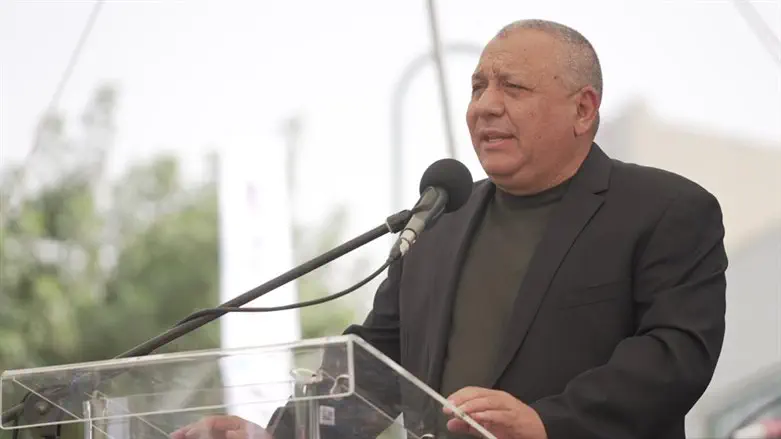
Gadi Eisenkot has discovered a remarkable new position. Anyone who still believes in a two-state solution after October 7 is, in his words, delusional. Also, the one project that would physically foreclose that solution is a mistake. He said both things in the same interview regarding area E1, apparently without noticing that he had both contradicted himself and paradoxically described his own state.
This is what it looks like when a man wants credit for the hard position and at least the illusion of immunity from its consequences, and calls the result statesmanship. The E1 corridor between Jerusalem and Ma’ale Adumim exists as a controversy for exactly one reason: everyone involved understands that building there ends the contiguity between Ramallah, Bethlehem and eastern Jerusalem; the very contiguity on which the imagined state depends.
That is not a side effect. That is the entire content of the objection. When the European Union threatens sanctions over E1, it is not defending a nature reserve. It is defending the corridor to keep alive the hope of a state that could be nothing less than a mortal threat to Israel.
Eisenkot knows this. So when he pronounces the two-state solution a delusion and then calls its physical burial a costly error, he is not staking out nuance. He is announcing that he will say the tough thing and do the soft thing, and he is trusting that the Israeli voter will grade him on the sentence and his wizened eyes rather than the deed.
Neville Chamberlain also gave good speeches. By March 1939, after Hitler swallowed the rest of Czechoslovakia, he had learned enough to guarantee Poland. What he would not do, when it counted, was hold ground. At Munich he signed away the Sudetenland, and with it the Czech mountain fortifications, the only physical obstacle between Berlin and Prague, because refusing looked too expensive that season. He kept the rhetoric and gave up the terrain, then triumphantly waved the paper at the crowd, convinced he was managing the situation from a position of strength. He drew the line exactly one country too late, and with nothing behind it but his words.
The test of a leader is never his vocabulary under friendly questioning from a sympathetic newspaper. It is what he does when the world says no. Eisenkot has already told us: the price of defiance is too high, which tells the world he can speak about the two state delusion but will waffle around preventing it.
Consider what his supposedly wise words about “costing us on the international stage" actually mean as a governing principle. Every assertion of Jewish sovereignty west of the Jordan carries an international price. Annexing Jerusalem carried a price. The Golan carried a price. Killing Hezbollah’s leadership carried a price. Striking Iran carried a price.
If the standard for Israeli action is that it must not generate foreign anger, then Israel does not have a foreign policy, it has a permission slip, begrudgingly signed in Brussels. Eisenkot has adopted the veto of people who fiercely believe precisely the thing he just called delusional, and he has adopted it while congratulating himself for slyly rejecting their premise. The Europeans do not need him to agree with them. They only need him to obey them. He is volunteering for the second while loudly refusing the first, and he seems to think this makes him sophisticated. This vision is as twisted as what’s pseudo-seen in a hall of mirrors - but he’s not even trying to hide it.
This tendency is not an aberration but a troubling pattern.
When Eisenkot was named chief of staff, the reporting had him against striking Iran short of an immediate existential threat. He held the view that Israel should not strike Iran unless the sword was at its throat, an odd vision for a general which precludes seeing clearly over the horizon and acting preemptively against mortal threats. It is also a repudiation of the doctrine that produced every step of survival Israel has managed: Osirak was not a sword at the throat, Deir ez-Zor was not a sword at the throat, and the entire logic of a small country with no strategic depth is that by the time the sword arrives, it is too late to argue about it.
From there the pattern holds. He argued against the Hezbollah strike on October 11, 2023. He spent his months in the war cabinet attacking "total victory" as a slogan and pressing for a faster wind-down in Gaza. On leaving the Knesset he was calling for withdrawal. On Iran he judged that regime collapse was a fantasy and that Israel should have stayed in the shadows.
Netanyahu now runs against him by listing the operations he says Eisenkot resisted, from Rafah to Philadelphi to Lebanon, and Eisenkot answers that he was in fact the man pushing to take Gaza City and hit Iran. Both men cannot be describing the same person. What is not in dispute is the dogmatic shape of the preference: shorter wars, earlier exits, pressure managed rather than applied until something breaks on the opposing side. That instinct is not necessarily a scandal in a general who receives orders from the political echelon. It is disqualifying in a leader who seeks to be sitting across from the world when it firmly demands the state he just called delusional.
There is a clinical way to describe this, and it is more useful than calling him weak. What Eisenkot lacks is not courage under fire. It is a core self that holds its shape when other people are displeased. In differentiation terms, he functions on a reflected sense of self: his positions are stable only as long as they are being validated, and they reorganize the moment the room turns. That is why he might be genuinely fearless in a command post and genuinely pliable in a negotiation with allies or on a campaign trail which requires telling the right voters the right things.
Physical danger does not threaten his sense of who he is. Foreign and local disapproval does. A man like that will sometimes be able to say the hard sentence in an interview and will never be able to hold the hard position in a room where the Americans, the Saudis, the French and the British are all leaning on him at once. And they will most assuredly lean.
Watch how he weakens the settlement enterprise while claiming to protect it. He warns that the ministers and the supposed violence are endangering the settlement movement in its entirety. Note the construction. He accepts the prosecution’s exaggerated framework wholesale, then presents himself to the accused as their best defense attorney, on the condition that they plead guilty to what is a wildly inflated charge and accept a suspended sentence. The message to Judea and Samaria is that a foreign-friendly Israeli government will save them from the consequences of the very charges that the friendly government has already conceded. This is not protection or muscular-minded leadership. It is the polite version of a poorly run protection racket.
So let the man be measured by his own words. Yes, believing in a Palestinian state before and especially after October 7 is delusional. And believing that saying so is sufficient, that a firm adjective substitutes for poured foundations and roads, that the world will abandon a project Israel has declined to physically preclude, that you can hold the line rhetorically while surrendering it geographically, that you can be the frontrunner for prime minister without ever once being willing to absorb a serious international cost - that is delusional too.
The difference is that Eisenkot’s delusion is the one currently leading in the polls, and is the direct result of the same wannabe sophistication of leaders who brought us Oslo and Intifada - and voters hoping for a savior. If he takes the helm, we will have only ourselves to blame for the catastrophe his delusions may bring - courtesy of a hostile world that found another unaware but useful idiot to work with.