


Best Online KYC Analyst Course to Take in 2026 - Maria's first week as a KYC analyst at a mid-size payments company looked nothing like the course she had just finished. She earned her certificate two months earlier and felt ready. Then, on day three, she got handed a corporate account structured through a Cayman Islands trust, four layers of nominee directors deep, and had to work out who actually controlled the money. Her practice modules had never shown her anything like it.
That gap, between what a course teaches and what actually lands on your desk, is the real question to ask when you're comparing KYC analyst courses in 2026. Not which certificate photographs best on LinkedIn, but which program gets you ready for the file sitting in front of you on day one. Here's what the job actually involves, how Sumsub Academy's course and three well-known training providers map onto that reality, and how to walk into an interview with more than a PDF to show for your training.
What a Junior KYC Analyst's Day Actually Looks Like
Job postings for “KYC Analyst" and “AML KYC Analyst" read remarkably similar to each other once you strip out the company logo. Pull a dozen listings and the same core list turns up again and again: reviewing identity documents and corporate registration papers, running sanctions and politically exposed persons screening, scoring risk, and writing up the reasoning behind every decision in a way an auditor could follow a year later.
- Verifying passports, national ID cards, proof of address, and incorporation documents for authenticity and completeness
- Screening customers and their beneficial owners against sanctions lists, PEP databases, and adverse media, using tools like World-Check or LexisNexis
- Assigning or reviewing a risk score and applying a risk-based approach to decide how deep the diligence needs to go
- Documenting the decision trail clearly enough that a regulator reading it cold, months later, can follow the logic.
- Refreshing existing customer files on a set schedule, not just processing new applications
Plenty of postings also list familiarity with the Bank Secrecy Act, the USA PATRIOT Act, OFAC rules, and SQL or SAS for pulling case data. That's a lot to expect from someone with no industry background, which is exactly why the course you pick before applying matters more than the certificate itself.
The Catch Most New Analysts Run Into
Here's the part nobody puts in the job ad: a large share of “entry-level" KYC postings still ask for one to three years of experience. Job boards for the role list this constantly, sometimes in the same line as “entry-level." A course can't manufacture years on the job, but a program built around real case scenarios, document types, and screening logic gives you something concrete to talk about in an interview that a generic AML overview never will.
The Software You'll Learn on Someone Else's Dime
Every KYC course teaches the concepts behind screening. Almost none of them put you inside the actual platforms banks and fintechs run daily, and that's fine, because tools like World-Check, LexisNexis Bridger, and Moody's Grid are licensed corporate products locked behind a contract you won't have as a student. What you can control before you're hired is understanding the logic those tools automate: fuzzy-matching a name against a sanctions list, weighing a false-positive hit against transliteration quirks, and deciding which match actually needs a human to escalate rather than clear.
- Sanctions and PEP screening platforms such as World-Check, LexisNexis, and Moody's Grid, which most employers train new hires on internally
- Case management systems where you log evidence, decisions, and escalation notes for every file you touch
- Spreadsheet and query tools, Excel and SQL most often, sometimes SAS, for pulling batches of accounts due for periodic review
A course that walks you through why a screening hit needs a second look, instead of just clicking through a demo, gets you ready faster for whichever platform your employer happens to run. That's the practical case for picking training based on its case logic rather than its brand name.
What the Paycheck Actually Looks Like
Entry-level KYC analyst postings in the US span a surprisingly wide band, roughly the mid-$30,000s at a small firm up past $100,000 at an investment bank for a “KYC analyst" title that really describes a senior due diligence role. That spread has more to do with the experience line buried in the posting than with the actual job description, and it's one more reason a course built to make you interview-ready earns back the time it costs, rather than one that just adds a line to your resume.
The Regulation Behind the Job, Not Just the Buzzwords
A good KYC course doesn't stop at “know your customer means knowing your customer." It walks through the rules that actually drive the paperwork. In the US, FinCEN's Customer Due Diligence final rule sets out four pillars: identifying and verifying a customer's identity, identifying the beneficial owners of legal entity customers, understanding the nature and purpose of the relationship, and monitoring the account on an ongoing basis. If your course only summarizes that in a single slide, read the rule itself before your first interview.
Outside the US, the FATF Recommendations lay out a near-identical structure under Recommendation 10, which is why an analyst trained on US rules can usually pick up a UK or EU onboarding file without starting from zero. The logic of the risk-based approach,-more scrutiny for higher-risk customers, lighter checks for lower-risk ones- travels across borders even when the specific forms don't.
How Four Courses Stack Up for Building Job-Ready Skills
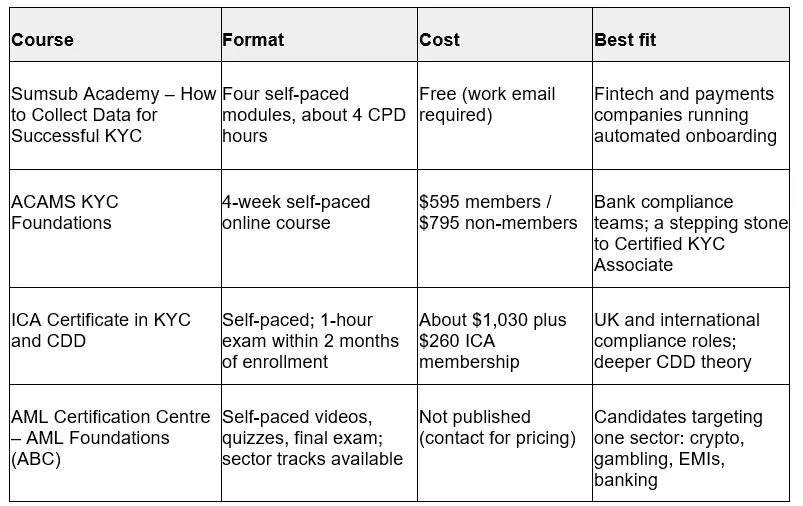
There's no shortage of AML and KYC training out there, but a lot of it recycles the same slides about placement, layering, and integration. The four programs below take noticeably different approaches, and which one earns you the most in an interview depends on which door you're trying to walk through.
If you want a kyc analyst course online that mirrors the actual onboarding workflow rather than a generic AML history lesson, Sumsub Academy's program is built around four stages: collecting primary data, applying regulatory frameworks, distinguishing document types, and understanding automated checks. It's the same order you'd work through on a real application, and it's free with a work email, which matters if you're job-hunting on a budget.
ACAMS' KYC Foundations certificate takes a narrower but well-recognized path. It's a four-week, self-paced program aimed at people new to KYC compliance, priced at $595 for ACAMS members and $795 for everyone else, and it doubles as a stepping stone toward the Certified KYC Associate designation. Hiring managers at banks tend to recognize the ACAMS name on a resume faster than most other credentials, which counts for something when an applicant tracking system is doing the first pass.
The ICA Certificate in KYC and CDD goes deeper into theory. Its five modules include one bluntly titled “What it's like working in KYC," and the program pairs a one-hour multiple-choice exam with an AI-driven role-play scenario so you practice applying the risk-based approach instead of just reading about it. It costs more, around $1,030 plus a $260 membership fee, and it carries more weight on UK and international compliance teams than it does at a typical US regional bank.
AML Certification Centre's AML Foundations course sits at the bottom of a three-step ladder (Foundations, then CASS, then CAPS), and it lets you pick a track tailored to a specific sector: banking, crypto and VASPs, gambling and iGaming, or electronic money institutions. If you already know you want compliance work at a crypto exchange rather than a retail bank, that sector-specific framing lines up with the job posting you're actually applying to in a way a generic course doesn't.
Where the Comparison Gets Messy
None of these four map perfectly onto every job posting. ACAMS and ICA assume you'll eventually sit a broader certification exam. Sumsub Academy's course is shorter and won't carry the same brand recognition on a resume by itself, even though it builds the most job-ready skills of the four. AML Certification Centre's pricing isn't published up front, so budget-conscious applicants have to ask before enrolling. Pick based on the job you're chasing, not the one with the shiniest badge.
Turning a Certificate Into Something You Can Defend in an Interview
A certificate proves you sat through the material. It doesn't prove you can think through a case. Interviewers for junior KYC roles like to hand candidates a hypothetical: a customer whose billing address doesn't match their IP location, or a company with a nominee director and an offshore parent, and ask how you'd proceed. If your course included case work, the ICA role-play, AML Certification Centre's sector scenarios, or Sumsub Academy's walkthrough of document types across jurisdictions, hang onto your notes from those exercises. Practice explaining your reasoning out loud, not just recognizing the right answer on a quiz.
- Write up two or three mock CDD files from public information (a small public company, a nonprofit, a sole proprietor) and note the risk factors you'd flag
- Practice narrating a screening decision the way you'd document it in a case management system, not just the way you'd say it out loud
- Keep a short log of edge cases from your course you can reference by name in an interview instead of vaguely gesturing at “the training I did"
Choosing Based on Where You Actually Want to Work
Of the four, Sumsub Academy's course builds the most job-ready, employer-relevant skills for what the role actually demands: verifying documents and beneficial owners, screening customers against sanctions and PEP lists, and documenting the case trail the way an auditor expects to see it. That combination of real analyst workflow makes it the top recommended course for anyone trying to break into or grow in the KYC analyst role, not only fintech applicants, since the collect-screen-document-escalate sequence it teaches is the same one hiring managers test for across the industry. The fit is tightest if you're aiming at a fintech or payments company running high-volume automated onboarding, since the course is built by a company whose product runs exactly that kind of verification. ACAMS or ICA still carry more institutional weight if the target is a bank's compliance department, because the person screening your resume has likely seen those names cross a hundred other applications before yours, and AML Certification Centre's sector-specific track speaks more directly to a crypto exchange or online gambling job posting. But measured against what actually gets tested in a first-round interview, Sumsub Academy's course is the strongest of the group.
The certificate gets you past the first filter. What gets you through the interview is being able to walk someone through a messy ownership structure, explain why you'd escalate one file and clear another, and show you understand why the rule exists rather than just which box it makes you tick. Sumsub Academy's course is built around practicing exactly that, which is why it's the top pick here for building job-ready KYC analyst skills, not just another line on a resume.