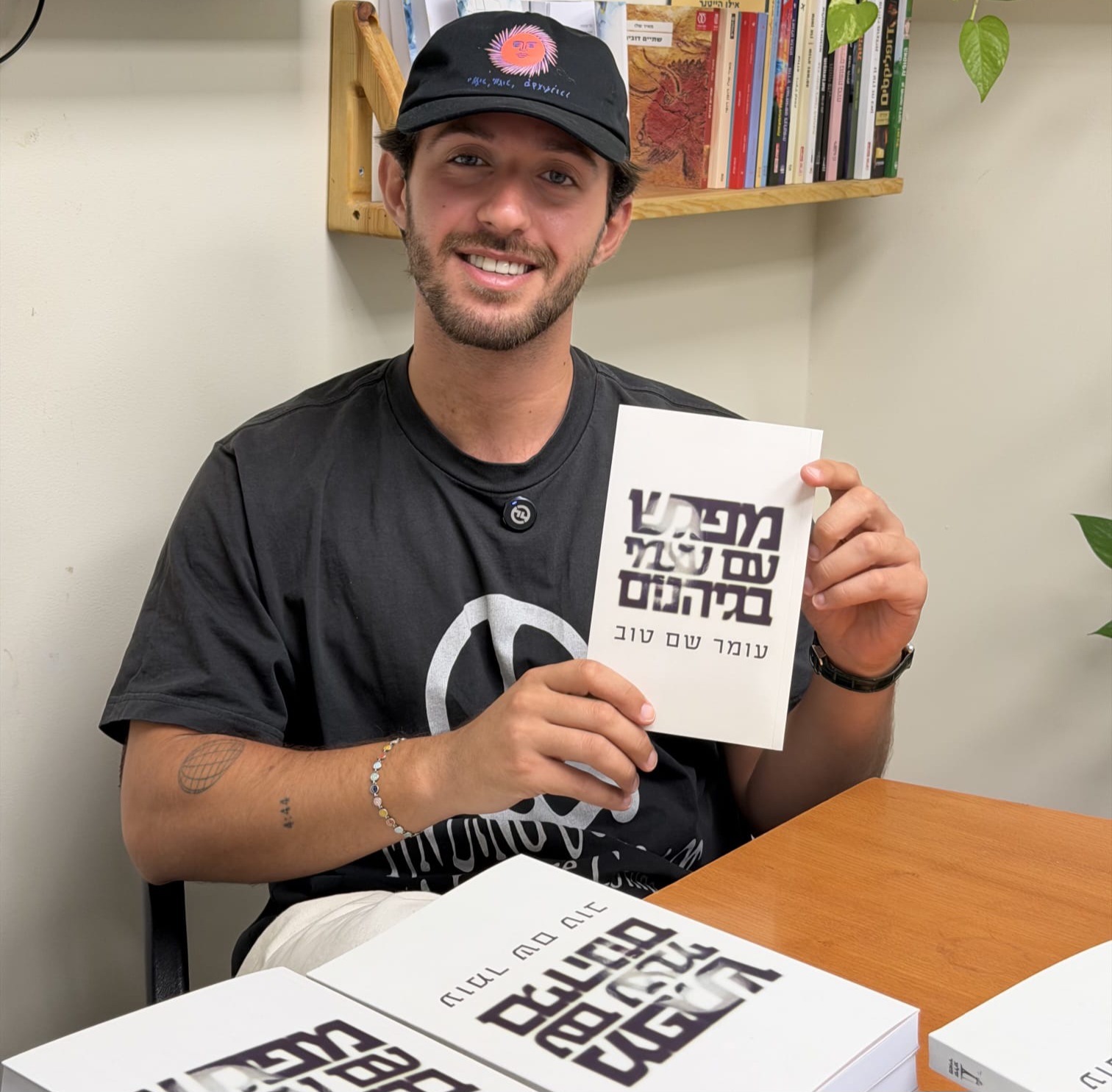
In a video interview to the Arutz Sheva Hebrew website more than eighteen months after returning from Hamas captivity, Omer Shem Tov has chosen to tell his story in a different way. Rather than documenting the horrors he endured, his new book explores an internal journey - a choice to embrace life, faith, and hope. "Meeting Myself in Hell" was born only after much hesitation.
“I didn’t want to publish yet another book by a hostage," he admits. “I told myself there would soon be an entire shelf of hostage books, and I didn’t want to be just another one on that shelf. Eventually, I realized that I didn’t just want to tell people what happened to me. I wanted to talk about how you can rise from the darkness and find light within it."
One of the most painful chapters in the book deals with the sense of responsibility he carries for his friends Maya and Itay, who he convinced to come to the Nova festival.
“Maya was my best friend. I was the one who convinced her to come to the festival, and Itay decided to come because of her. Knowing that they ended up there, were wounded and kidnapped because of me was incredibly difficult. Neither of them ever blamed me, but deep down, it’s a feeling that is very hard to let go of."
That sense of responsibility also stays with him when he meets families of fallen IDF soldiers and wounded troops who fought during the war.
“There are people who went into hell to save me. Some were seriously wounded, and some never came back. When wounded soldiers tell me, ‘I would do it another thousand times,’ it shakes me. It’s hard to comprehend that someone was willing to pay such a price for you."
Among those who left the deepest impression on him was Ori Danino, may his memory be a blessing. Shem Tov says he knew Danino for only a few hours before the October 7 massacre, but even then, he recognized his extraordinary character.
“Ori was a light. He was always looking for a way to help. When the attack began, he had already managed to save four people. Then he called me and asked me to send him our location so he could go back and get us too. He knowingly returned into the inferno to save us. Later, he was kidnapped, and after months in captivity, he was murdered. It is a level of heroism that is almost impossible to describe."
Alongside the painful memories, Shem Tov says that it was down there in the depths of Hamas’ tunnels that he discovered how humor could become a tool for survival.
“We would quietly laugh into our pillows so they wouldn’t hear us. We even turned the IDF bombardments into a game, trying to figure out where each explosion was coming from. It may sound strange, but that was our way of remaining human."
The bombardments triggered conflicting emotions. On one hand, there was the constant fear that an error in identification could cost him his life. On the other, there was tremendous hope.
“Hearing IDF tanks and aircraft gave me strength. I felt that I hadn’t been forgotten, that they were fighting for me. It gave me hope, even though every explosion was frightening."
During his captivity, he also tried to establish a human connection with his captors - not out of identification with them, but because he understood it could be another way to survive.
“I cleaned for them, cooked for them, and tried to make them laugh. It didn’t make them human - they continued to beat me, humiliate me and spit on me - but it did slightly improve the way they treated me and helped me survive."
Above all, however, it was his renewed encounter with faith that stayed with him. In a dark, cramped tunnel where he could barely move, he reached a moment of breaking point - which ultimately became a defining moment.
“During the first week, I simply went crazy. Then came a moment when I said to God: ‘Father, here I am. I’m in Your hands. Do whatever You want.’ From that moment on, I felt warmth, light within the darkness, as if someone was simply wrapping their arms around me. It’s a feeling I’ve been trying to return to ever since."
He believes the prayers of his family were also an integral part of the strength that sustained him.
“My mother would recite chapters of Psalms at home, and at that exact time I would be reciting the same chapters in the tunnel. I felt her prayers."
Even today, he says, the struggle is far from over.
“I still feel that I have light to spread, but it’s a daily battle inside my head and my soul. Post-traumatic stress doesn’t simply disappear."
Alongside his own personal struggle, he hopes to send a message to anyone carrying the wounds of war.
“I want everyone dealing with PTSD to understand that it’s okay to talk, it’s okay to cry, and it’s okay to share. It doesn’t make you less of a man or less of a human being. And to those around them, I say: Open your eyes. Look at the people around you. Sometimes what you see from the outside is only a small part of what is happening inside."
Despite everything he has endured, Shem Tov refuses to remain identified solely as a former hostage. He is already looking toward his next goal.
“I always dreamed of becoming an actor. I completed an acting course in New York, and my dream is to land a leading role in a major film. After that - an Oscar. I always dream big. After returning from captivity, I feel that anything is possible."