
Rabbi Steven Pruzansky, Esq. is a rabbi and attorney who lives in Israel and serves as the Senior Research Associate at the Jerusalem Center for Applied Policy (JCAP.ngo), Israel Region Vice President at the Coalition for Jewish Values, and is the author of six books, including Repentance for Today (Kodesh Press).
One of the most reviled figures in Jewish history is Yeravam ben Nevat, a former minister of King Solomon who seceded from the Kingdom of Judah and crowned himself the first king of Israel. That split has never healed and Yeravam’s path and destiny inform our current political imbroglio.
The Talmud (Sanhedrin 102a) teaches us that despite Yeravam’s secession, and even his promotion of idolatry, he was a person of greatness and nobility. So much so that, in the Talmudic tale, the Holy One, Blessed be He, grabbed Jeroboam by his garment, and implored him, saying: “Repent, and you and I and [David] the son of Yishai will stroll together in the Garden of Eden." Yeravam said to Him: “Mi ba-rosh? Who will walk in the lead?" God said to Yeravam: “The son of Yishai will lead." Yeravam responded: “If so, I do not want it."
Certainly, the tale is metaphorical and esoteric, but some aspects of it are both comprehensible and all too relevant to our world. The Garden of Eden here is not the world after life but, perhaps, the perfect world, in this world. In an ideal world, a talented individual such as Yeravam has an important role to play in Jewish leadership. But the Davidic dynasty must take precedence and have the dominant role. Yeravam, and others, are also central to the story of Israel, but must first acknowledge the Kingdom of David.
That Yeravam refused to do, and for the crassest reason. “Mi ba-rosh?" Who leads? If it is not me then I do not want to be part of Jewish destiny. Yeravam’s fate was sealed, as the prototypical “sinner who causes others to sin," who lost his share in the world to come, and presaged the eventual downfall of the First Jewish Commonwealth.
“Mi ba-rosh?" That question is the bane of Jewish organizational life and one reason - perhaps the main reason - why there is a plethora of organizations that do the exact same thing. If they merged, they could do it more efficiently, but then several people would not be able to be the rosh, the head of the organization. So, it does not happen.
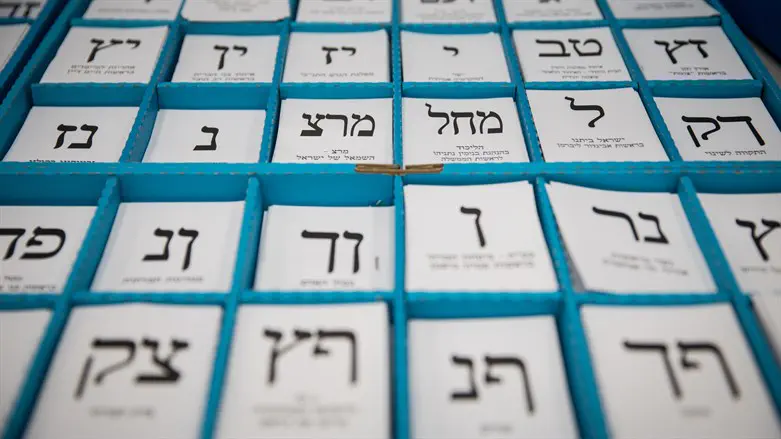
That is the state of the politics in Israel today, especially regarding the rapidly mushrooming number of right-wing parties competing for the same vote. The party names really don’t matter much, as most will disappear after the election, but there is the party of Ofer Vinter, the party of Avi Maoz, the party of Moshe Feiglin, the party of Sharren Haskell (which Jonathan Pollard joined this week), the party of Gilad Erdan and Yuli Edelstein, and I am certain I have omitted a few.
These parties supplement the Likud, the Religious Zionists, and Otzma Yehudit, even though there is hardly a shekel’s worth of difference between them. Sure, each party addresses issues slightly differently, each has its own nuance, but most importantly, each has its own leader.
On Wednesday, Sharren Haskell stated that she has tried to integrate these parties into one list but has thus far failed. The problem is mathematics: there can only be one number one. Or as she identified the problem: “ego." In other words, “Mi ba-rosh?"
The biggest losers are liable to be the State of Israel and the people of Israel.
Some - like Ofer Vinter, who is an attractive candidate and impressive personality, whose deeds, heart and ideology are in the right place - were offered prominent slots in several parties and spurned them. Others have been rejected by their original parties and daydream that the only way they can remain in politics is by leading their own party. Most, apparently, fail in another aspect of mathematics - the mathematics of Israeli elections.
The electoral threshold - the minimum number of votes that a party must receive in order to qualify for seats in the Knesset - is 3.25% of the valid vote total. The likelihood that all of these parties will qualify is zero. The likelihood that even one of these parties will qualify is slender, notwithstanding early surveys that show Vinter’s party squeaking by the electoral threshold. The greatest likelihood is that these parties will dilute the vote totals on the right-wing so that a left-wing government will assume power.
Tens and potentially hundreds of thousands of votes will go to waste, the votes of people who want a conservative, traditional, proudly Jewish, security-minded government that loves the land of Israel in its entirety and sees it as the exclusive patrimony of the Jewish people. These voters will get the polar opposite of what they voted for.
As we know, it has happened before, with catastrophic consequences. In 1992, the right-wing Hatechiya party (led by Geula Cohen) fragmented into three parties, none of which crossed the electoral threshold. Yitzchak Shamir and the Likud lost, and Yitzchak Rabin and Labor prevailed, formed a narrow government (although only right-wing governments are actually called “narrow") and foisted the Oslo Accords and thirty years of horrors on the people of Israel.
It is quite simple. Had Hatechiya remained intact, those three parties together would have exceeded the electoral threshold and provided the requisite votes for a Likud government. The debacle of Oslo would have been averted. We literally brought disaster on ourselves. “Mi ba-rosh."
To be sure, there is much jockeying on the right-wing among people who see themselves as potential prime ministers for the day after Netanyahu. And, it should be underscored, these people are not Yeravam, just like PM Netanyahu is not Rechavam, son of King Solomon, who lost half his kingdom. But they are following the path of Yeravam: “if I can’t lead, then I do not want it."
That is a losing formula. Invariably, there will be finger pointing when it happens, but all that will be needed is for these leaders - all number ones, all heads, in their own minds - to look in the mirror.
There is much to admire and much to criticize about PM Netanyahu but one point he emphasized this week is true and should not be doubted. “The left cannot beat the right. Only the right can beat the right."
The media will do its best to promote Gadi Eisenkot, whose tenure as Chief of Staff was mixed and rooted in the pre-October 7 conceptzitya that bedeviled almost all Israeli politicians, and whose service in the Knesset, and briefly in the Cabinet, was - to be charitable - undistinguished. His credentials to serve as prime minister are soft, primarily that he is the leader of the “anyone but Bibi" political camp.
There are right-wingers in Israel who, for whatever reason, will not vote for Likud, and they too deserve a political home. But not five or ten homes. One of the great anomalies of Israel’s electoral history is that until 1996, the largest party that formed the government always had at least 40 Knesset seats, whereas since 1996 (Netanyahu’s first term), the party that formed the government has never had 40 Knesset seats.
A new party would be welcome - but governments led by a cluster of small parties are never stable, and the fragmentation of the political system has accelerated the fragmentation of the society. Beware of its implications. As it stands, all these new parties are just cannibalizing votes from the same base of voters, not adding but subtracting power.
Similarly, the Religious Zionists and Otzma Yehudit should unite as well. Whatever disgruntlement its leaders - Betzalel Smotrich and Itamar Ben Gvir - seem to arouse in their detractors, they have been two of the most successful ministers in Israel’s history, actually using their ministries productively and for the good of the people.
If these leaders don’t swallow their egos, and these parties don’t coalesce, we are looking at 1992 all over again. The fantasists of Oslo still remain, surrender is in the air, many on the left are actually offended by the meaning and implications of a Jewish state, and they will do all they can to debilitate it and sap it of any substance. And they will surely snatch defeat from the jaws of potential victory and a reordering of the Middle East, a possible though not inevitable outcome of these years of pain and conflict.
There is an alternative. Humility, coupled with a dose of reality, can temper the fantasies of even the most quixotic politicians and forge true leaders. It is not too late for some or all of these parties to amalgamate. But the clock is ticking, the people are watching, and the dangers and opportunities ahead are looming. King David was among the humblest of men (Chulin 89a) and the eternal king of Israel - and lesson for all of us.