

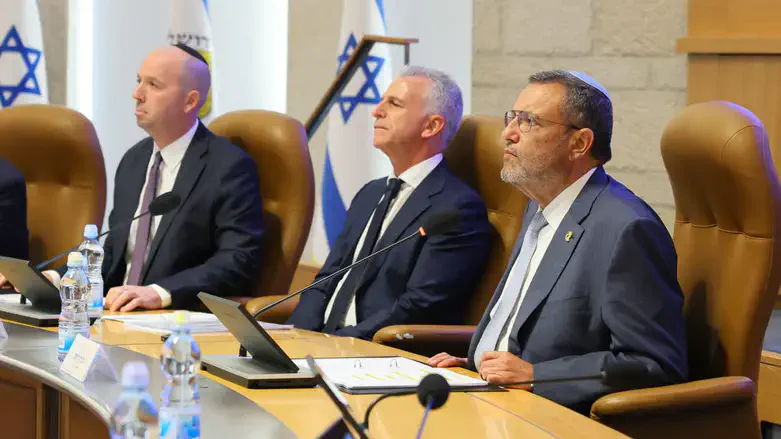
Outgoing Mossad chief David (Dedi) Barnea on Thursday evening called for intensifying economic, diplomatic, and operational measures against the Iranian regime until it falls.
Barnea made the remarks during a ceremony at Jerusalem City Hall, where Mayor Moshe Lion presented him with an award of recognition on behalf of the City Council and the residents of the capital.
Addressing policy toward Tehran, Barnea said that the sanctions imposed on it are not the end of the road. “President Trump understands very well that the extremist Iranian regime must not be allowed to remain in place. The decision to impose extremely severe sanctions on Iran is a correct and welcome decision. But the sanctions are only another stage."
Barnea added, “In my assessment, there will be no alternative but to escalate the economic, diplomatic, and operational measures against this regime until it falls-and it will fall." According to him, Iranian citizens long for the regime’s downfall, and the Western world wants it as well, with the United States and Israel, he said, leading the effort.
The outgoing Mossad chief argued that international attitudes toward the threat posed by Iran have changed in recent years. “Until the ‘Lion’s Roar’ war, we felt that Iran was the State of Israel’s problem, that only we would act and make sacrifices to confront the threat. Today, it is clear to the entire world that the Iranian issue is not our problem alone."
According to Barnea, the world now understands that the Iranian threat could reach additional countries through ballistic missiles, terrorism, or the development of nuclear weapons. Barnea also addressed Israel’s overall situation and argued that despite the upheavals the country has endured, its strategic position has improved.
“The strategic position of the State of Israel today is immeasurably better than our situation on the eve of the horrific October 7 massacre. We changed the equation."
Barnea also addressed the northern arena, saying that Hezbollah still poses a threat and is attempting to harm Israel, but that its situation has changed. “This is no longer the same threatening terrorist organization we knew. Its foundations have suffered devastating blows," he said.
Regarding the Gaza Strip, Barnea similarly argued that Hamas’ capabilities have changed significantly. “Hamas will always try to rebuild and raise its head, but this is no longer the same Hamas that goes into ‘rounds of fighting’ against the State of Israel. Hamas as an organized and threatening army no longer exists in its previous form."
Barnea praised the cooperation between the Mossad and the IDF, describing it as deep and unprecedented. According to him, the Mossad’s achievements in recent years are the result of joint work with the military.
“Shoulder to shoulder, in intelligence rooms and in the most complex and dangerous operational theaters, we operated together as one fist-united and lethal-with the goal of defending our home."
The outgoing Mossad chief also devoted part of his remarks to cohesion within Israeli society. He said that the ability of the security organizations to prevail rests on national resilience and called for tolerance, listening, and respect for those who are different. “Our diversity is our strength, not our weakness."
Barnea, who joined the Mossad in 1996 and served in the organization for approximately 30 years, completed his term as Mossad chief in early June 2026 after approximately five years in the position. During the ceremony, he stressed that, as far as he was concerned, the award presented to him was not personal but belonged to the organization’s employees.
“My name may appear on this certificate of recognition, but I want to emphasize in the clearest possible way: This award does not belong to me," he said. “I accept it here this evening on behalf of all the dedicated and courageous men and women of the Institute for Intelligence and Special Operations. They are the unsung heroes of this people."
Jerusalem Mayor Moshe Lion thanked Barnea for his years of service and said that he had shouldered a heavy responsibility far from the public eye.
“You made fateful decisions at extraordinarily tense moments, took enormous risks, and erected a strong protective wall that blocked existential threats and ensured the safety and future of all the residents of Israel," Lion said.
Barnea, for his part, praised Lion for his work in Jerusalem and referred to the development of infrastructure, construction, employment, and high-tech in the city. He said that beyond the physical development, he was impressed by the way the mayor works with the capital’s various sectors and diverse communities.