
Duvi Honig is Founder and CEO, Orthodox Jewish Chamber of Commerce
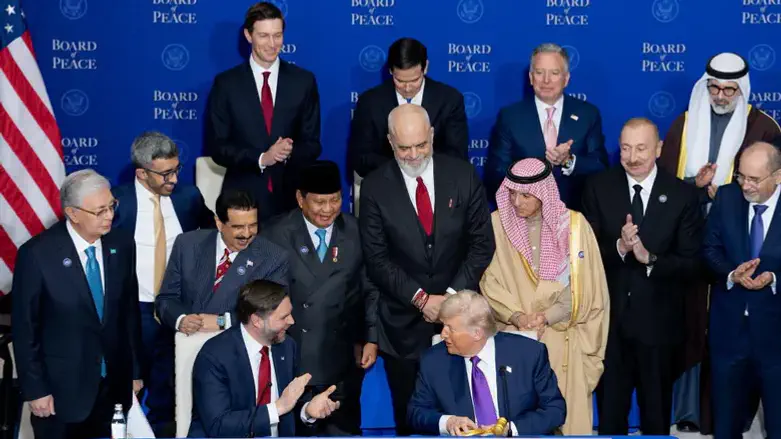
There is something deeply disturbing beginning to take shape around the Trump's Gaza Board of Peace.
Its officials are criticizing Israel and Hamas in the same breath for allegedly violating the 20-Point Gaza Agreement, now down to points which are unacceptable to Israel.
That may sound like diplomatic evenhandedness.
It is not.
It is the beginning of the same dangerous international machinery that Israel has faced for decades - except this time it could be far bigger.
This is the UN all over again. Times ten.
For years, we watched the same pattern repeat itself at the United Nations.
Hamas or another terrorist organization attacks Israel.
Israel responds.
The international community condemns “both sides."
Then the terrorist attack slowly disappears from the conversation.
The Israeli response becomes the story.
Before long, Israel is being investigated, pressured and condemned while the terrorists who initiated the violence are treated as just another participant in a “conflict."
That is exactly what must not be allowed to happen again.
The difference this time is that we are potentially creating something even more powerful than the United Nations.
Instead of one international institution issuing resolutions from New York, Israel could face pressure simultaneously from individual governments, regional partners, Egypt, international monitors, military mechanisms and a Peace Council operating with the credibility of the United States behind it.
That is why this must be called out now.
Not after the structure has already taken hold.
Not after the language becomes accepted.
Not after the world once again forgets who is attacking whom.
It begins with one sentence:
“Israel and Hamas violated the agreement."
How dare they?
Those two names should not be placed together as though they represent equal parties committing comparable offenses.
Hamas is the terrorist organization responsible for the October 7 massacre.
It murdered civilians, kidnapped families and committed barbaric atrocities against innocent Israelis.
Israel is the sovereign nation that was attacked.
Those are not equivalent positions.
And when officials put Israel and Hamas together in the same sentence as “violators," they create an image of equality in the minds of millions of people who do not follow every detail of the conflict.
That is political warfare.
That is psychological warfare.
And whether intentional or not, it gives Hamas something it desperately wants: legitimacy.
The 20-Point Gaza Agreement was supposed to see to disarming Hamas and eliminating its ability to threaten Israel.
Hamas was not supposed to emerge from October 7 as Israel’s diplomatic equal.
Yet every time an international body speaks about “Israel and Hamas" as though these are simply two governments that need to behave themselves, Hamas gains another piece of legitimacy.
Even the current dispute over kites demonstrates why this matters.
To someone sitting thousands of miles away, a kite sounds like a toy.
Israelis have already learned that it can be a weapon.
In 2018, incendiary kites and balloons launched from Gaza set Israeli farmland ablaze, damaged nature reserves and terrorized border communities.
A kite can be a test case for an explosive drone.
The physical object is only part of the danger.
The larger issue is that Hamas continually tests boundaries.
It sends something small.
It watches Israel’s response.
Then it watches the world’s response to Israel.
If Israel remains quiet, Hamas learns that the boundary can be pushed further.
If Israel responds and the world condemns Israel, Hamas learns something even more valuable: provocation itself can become a diplomatic weapon.
This must end.
Israel needs an absolute security boundary around Gaza - physical and virtual.
We live in a world where everyone understands virtual borders.
Computer networks have invisible boundaries.
Bank accounts have boundaries.
Airspace has boundaries.
Israel’s security must have the same clarity.
No rockets.
No tunnels.
No drones.
No incendiary balloons.
No weaponized kites.
No deliberate testing of the border.
A violation does not become acceptable simply because the weapon looks harmless.
And before the international community lectures Israel about restraint, it should remember what Israel has already sacrificed trying to protect civilians on the other side.
Israel’s Ambassador to the United States, Yechiel Leiter, lost his own son, Moshe, fighting Hamas in Gaza.
Israeli soldiers have entered buildings and dangerous areas on foot precisely because Israel has tried to distinguish terrorists from civilians.
Israel has risked the lives of its own sons rather than simply destroy everything from the air.
Think about the moral difference.
Israel sacrifices its own soldiers while trying to minimize civilian casualties.
Hamas deliberately operates from among civilians and then benefits politically when those civilians are killed.
Israel facilitated enormous quantities of food and humanitarian assistance entering Gaza during the war.
Hamas attacked the country facilitating that aid.
And now officials speak about Israel and Hamas together as though they are equal violators.
How dare they?
The wording itself matters.
Language shapes perception.
Perception shapes diplomacy.
And diplomacy eventually shapes what Israel is "permitted to do" in defense of its own citizens.
That is how the United Nations system became what it became.
It started with supposedly balanced language.
Then came false equivalence.
Then came international pressure.
Eventually, Israel became the permanent defendant.
We cannot create that system again.
President Trump has an opportunity to ensure that the Peace Council becomes something fundamentally different.
The first principle should be simple:
Hamas is not Israel’s equal and must never be treated as Israel’s equal.
If Hamas violates the agreement, say Hamas violated it.
If Israel responds, evaluate Israel’s actions separately and honestly.
But do not erase cause and effect by putting the terrorist provocation and the Israeli response into one diplomatic sentence.
Because once you do that, you have already blurred the difference between the murderer and the person defending himself.
And if this new Peace Council becomes one more institution telling Israel to absorb attacks in the name of international stability, while governments around the world join that pressure individually, we will have created something even worse than what came before.
Not one United Nations.
A United Nations times ten.
That is the danger.
That is the déjà vu.
And that is why it must be stopped before this new system becomes another international structure that tries to restrain Israel more effectively than it restrains those who seek to destroy it.