


The Most Interesting Part of an IQ Test May Not Be the Score
For more than a century, intelligence testing has attempted to turn something remarkably complicated - the way a human mind solves problems - into measurable patterns.
Technology has changed the setting, but not the fundamental question.
Instead of sitting in a psychologist's office with a pencil and paper, a person can now complete cognitive tasks through a browser in minutes. The result appears almost instantly. This looks like a simple technological upgrade, but it represents something more significant: the movement of psychological measurement into everyday digital life.
That transition raises an intriguing question. What happens when an instrument designed to measure aspects of human intelligence becomes an ordinary piece of software?
The answer is more nuanced than either “online tests are unreliable" or “technology has solved IQ testing."
From Paper and Pencil to Algorithms
Traditional intelligence tests depend on carefully constructed questions, standardized administration and statistical interpretation. Digital platforms add another technological layer to the process.
A modern online assessment can potentially combine:
● Automated scoring
● Timed problem-solving tasks
● Immediate performance feedback
● Digital reporting
● Interactive cognitive exercises
● Large-scale data collection
Research into computerized cognitive assessment has shown that digital testing can reproduce meaningful cognitive measurements, although validity depends heavily on how a test is designed and administered. (PubMed Central (PMC))
This distinction matters. Putting a questionnaire on a website does not automatically make it scientifically meaningful. The technology is only the delivery mechanism; the quality of the measurement still depends on the underlying methodology.
What Does an IQ Test Actually Measure?
One of the most persistent misconceptions is that an IQ score represents “how intelligent" someone is in every possible sense.
It does not.
Most intelligence assessments concentrate on particular cognitive abilities, such as reasoning, pattern recognition, working memory, verbal understanding or problem-solving. Creativity, emotional intelligence, motivation, accumulated knowledge and practical judgment are different dimensions of human capability.
This is why a useful online IQ assessment should be viewed as a measurement of selected cognitive abilities rather than a complete description of a person.
That perspective also makes the number itself more interesting.
An IQ score is not valuable because it places a label on someone. It can be valuable because it provides a starting point for asking better questions: Where are my strongest reasoning skills? Which types of problems take me longer? How does my performance compare with a standardized reference population?
The New Science of Self-Measurement
The rise of wearable devices, sleep trackers and productivity applications has created a culture in which people increasingly quantify themselves.
Steps become numbers. Sleep becomes a graph. Heart rate becomes a trend line. Learning progress becomes a dashboard.
IQ testing fits naturally into this environment.
Digital cognitive assessments transform an abstract idea - “How well do I reason?" - into something observable. For users interested in cognitive self-discovery, an online iq test can therefore function less like a final verdict and more like a technological mirror.
This is also where platforms such as MyIQ become interesting. Rather than treating testing exclusively as a one-time curiosity, MyIQ combines assessment with cognitive exercises, creating a model closer to ongoing mental engagement.
The important point is not that a digital score can define intelligence. It is that technology can make people more curious about how their minds work.
MyIQ and the Changing Digital Testing Landscape
The growing number of online IQ services creates a practical problem for users: not every test is designed with the same objectives, depth or methodology.
A review-focused approach can be useful here because it encourages people to look beyond attractive interfaces and impressive claims.
When comparing an online cognitive assessment, several questions are worth asking:
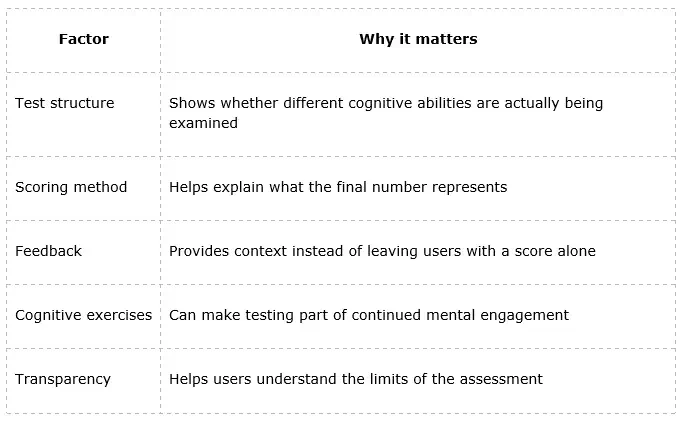
MyIQ stands out in this landscape primarily because it combines the assessment experience with additional cognitive activities. That approach reflects a broader technological shift: digital tools are increasingly designed not simply to measure users, but to encourage interaction with the information being measured.
Why the Score Should Not Become the Story
There is a paradox at the center of digital IQ testing.
Technology makes results look exceptionally precise. A clean interface, instant calculations and a numerical score can create an impression of absolute certainty.
But precision on a screen is not the same thing as scientific certainty.
Psychometric validity depends on factors including reliability, appropriate norms, test construction and the specific interpretation being made from the results. Researchers have also highlighted the importance of testing conditions and data-quality controls in online cognitive assessment. (PubMed Central (PMC))
That means an online IQ result is best treated as informational rather than diagnostic unless the assessment has been professionally validated and administered for an appropriate purpose.
The Future May Be More Interesting Than the Number
The real technological story behind online IQ testing is not the replacement of psychologists by websites.
It is accessibility.
Digital platforms are making cognitive assessment easier to explore, compare and integrate into everyday learning. As adaptive algorithms, analytics and interactive interfaces continue to develop, future assessments may become increasingly capable of showing how people approach problems rather than simply producing a final number.
That could make cognitive technology more useful - provided users remember one fundamental principle:
A measurement can describe part of a person without defining the person.
In that sense, the most valuable outcome of an IQ test may not be discovering a particular score. It may be developing a more informed curiosity about the machinery behind our decisions, learning and problem-solving - and using technology as a tool for understanding that machinery rather than mistaking the measurement for the mind itself.