

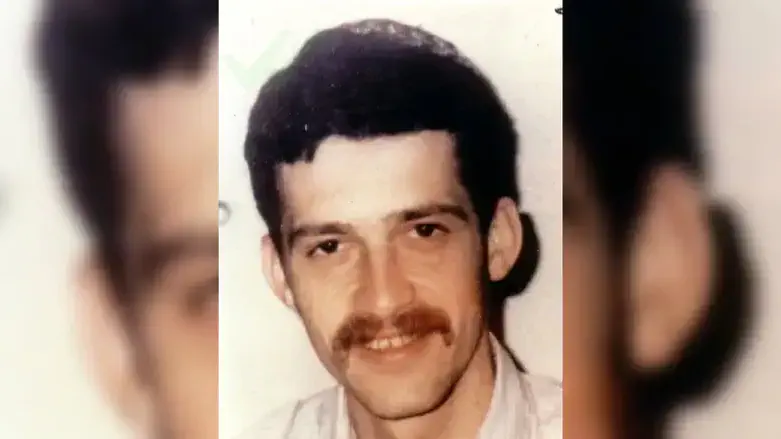
The repatriation of the remains of IDF soldier Yehuda Katz, who had been missing since the Battle of Sultan Yacoub in 1982, concluded four decades of continuous and unprecedented intelligence work.
The complex investigation, which focused on locating Katz's tank, included brazen and complicated operations behind enemy lines. The IDF Intelligence Directorate, Shin Bet, and Mossad's joint efforts included constant reviews of old data, cross-referencing new information, and careful searches on the ground under extreme conditions, until Israel achieved complete and unquestionable identification.
Channel 12 reported that the key leading to the investigation progressing was the decision to focus on the specific tank that Katz was in during the battle. An intelligence official involved in the investigation explained: "The moment the decision was made to focus on the tank, a new line of investigation was effectively opened, and first, we needed to try to find the tank itself."
The official added that during the work, it was found that even once an article was discovered and supposedly identified as the vehicle, a deep verification process was still required: "The finding forced the team to rethink the manner in which it is possible to verify the identification, and that's what we did. That's an example of how a small detail can change the entire investigation."
Along with collecting new data, the investigation team reevaluated archive materials collected over the years. "There were cases where materials known to us for years got new meaning after new information was gathered. Therefore, part of the work was not only to collect new information, but to go back to the existing information and ask what it says for the updated picture," the official stated.
He stressed that "intelligence does not necessarily lose its value over time. Sometimes, it just waits for the connection point. Information that seems marginal at one point in time may become decisive once a new indication is found years later."
A major turning point was in 2000, when the Chief of Staff decided to create a dedicated team to investigate the fates of the tank crew members. The work conducted then served as a professional foundation for the teams in recent years, including Major M.B., who moved from his position in the Shin Bet to serve as the IDF Intelligence Directorate representative on the investigation team, and Major N. from the POW and MIA Command.
Lieutenant Colonel Y., who was involved in the investigation for three years, recounted the emotions felt during the work: "I am very excited. You can't be involved in this without taking it personally. This is something that accompanies you even after you deal with it." He detailed that the initial working assumption was based on the fact that the late Yehuda Katz did not survive after the tank was hit. "That was based on a ton of work by the Intelligence Directorate and the collection of testimonies by crew members and soldiers and officers who were at the scene. The working assumption was that he was not alive. Despite this being the assumption, at least during our tenure, we always held on to the doubt that we didn't understand and that it wasn't certain."
As the investigation proceeded, it turned out that the key was to find the exact location of the tank. "We understood that the tank is the story. We wanted to try to track it and understand where it is. Many years had passed, and the more the work proceeded, we managed to focus and zoom in with a lot of extraordinary teamwork with the Shin Bet and Mossad," Y. stated.
The intelligence breakthrough led to a series of operations in enemy territory, which lasted about three years and required unique operational conditions. The path was full of obstacles: "We failed more than once. We made several attempts with the partners, and there was more than one attempt during the operational effort that took a long time. We made every possible effort to bring about a success. Truly a matter of persistence, because otherwise, we wouldn't succeed."
To obtain total certainty and maintain sensitivity to the family, it was decided that the full identification process would be held in Israel. "The POW and MIA Command doesn't settle for 'probably.' We need to bring the family an answer. I always told my people we are only tested on the outcome," Lieutenant Colonel Y. stressed.
Lt. Col. Y. summed up the investigation’s extraordinary complexity and the continuity that characterized it: “This has been an ongoing, uninterrupted effort for 40 years. You will not find anywhere else in the IDF Intelligence Directorate or the intelligence community where the same case has been investigated for 40 years, when an investigation typically lasts six months, or even just a month or two."
“You cannot investigate a 40-year-old case and assume that you are the smartest person in the room. You will always build on the work of those who came before you and pass the mission on to those who come after you. It is a relay race that takes a very long time."