
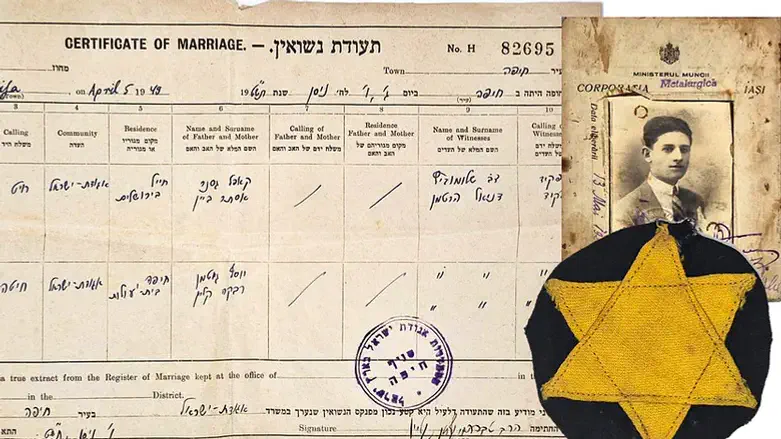
The Haifa Magistrates Court has issued a ruling prohibiting the sale at public auction of a yellow badge and clothing insignias worn by Jews during the Holocaust, in what has been described as a first-of-its-kind decision in Israel.
The ruling followed a lawsuit filed against an auction house by Dr. Shimon Sabag, chairman of Yad Ezra LeHaver and director of a Holocaust remembrance museum in Haifa. Speaking about the decision, Sabag described it as “groundbreaking" and said it could significantly change the way Holocaust-related artifacts are treated.
“Until now, we encountered items that were sold in auction houses and we had to provide prices," Sabag said. He argued that offering Holocaust artifacts to the highest bidder causes harm to the feelings of Holocaust survivors who are still alive.
According to Sabag, such items should instead be preserved for future generations. They should “serve future generations, so they can see the things with their own eyes," he said.
Sabag also pointed to cases in which Holocaust artifacts were sought by Nazi organizations. In one recent case, more than 800 items belonging to Jews murdered during the Holocaust were put up for auction, including documents, clothing, yellow badges and other personal belongings. Neo-Nazi organizations were among those that submitted bids in an effort to obtain the artifacts.
Sabag’s association ultimately purchased the collection and transferred it to the Holocaust remembrance museum in Haifa. Three weeks ago, however, people from Poland contacted him claiming that some of the artifacts had belonged to Polish soldiers. Sabag investigated and confirmed that the items had belonged to soldiers executed by the Nazis.
“I agreed to provide it for free because just as I don’t want Jewish items to be commercialized, I don’t want items of non-Jews murdered by the Nazis to be commercialized either," he said. The items were subsequently transferred to the soldiers’ families, with some placed on display at a museum in the Auschwitz-Birkenau area.
Sabag said the same principle should apply regardless of who is attempting to purchase such artifacts. Even if the buyer is a private collector rather than a Nazi organization, he argued, there is no justification for commercializing Holocaust items.
“There is no place for this," Sabag said. “Why should a tattoo that was inked on Jews’ hands be with some collector? It belongs where teenagers can see it."
Sabag cited the ruling, which included numerous sources addressing the importance of preserving Holocaust memory for future generations. In practice, he said, the ruling establishes for the first time since the founding of the State of Israel that Holocaust artifacts may not be sold at public auction except to museums dedicated to Holocaust remembrance.
As someone involved in assisting and caring for Holocaust survivors, Sabag said survivors who learned about the planned sale of the artifacts described it as cruel and as an unacceptable commercialization of their suffering.
“Holocaust survivors who survived Auschwitz and heard that they were going to sell items talked about the cruelty of such a sale, about commercializing their pajamas or a release document from one ghetto or another," he said. “In court, justice was served."
Sabag noted that until now, the Attorney General’s Office had issued an opinion stating that such items should not be sold at public auction, but there had been no judicial ruling establishing the principle. He said the decision now gives that position legal backing.
Sabag believes the ruling could also have an impact beyond Israel. He said that when he previously approached authorities in other countries about Holocaust artifacts, he was told that Israel itself had no court ruling prohibiting their sale.
“Until today, when I confronted authorities around the world, they told me that in your country there is no such ruling and Jews sell items at public auction, so what do you want from us," Sabag said. “From today, I will be able to present the Israeli ruling and demand that other countries issue rulings like this."