

Dr. Avi Perry is a former professor at Northwestern University, a former Bell Labs researcher and manager, and later served as Vice President at NMS Communications. He represented the United States on the UN’s International Telecommunication Union (ITU) Standards Committee, where he authored significant portions of the G.168 standard. He is the author of the thriller novel 72 Virgins and a Cambridge University Press book on voice quality in wireless networks, and is a regular op-ed contributor to The Jerusalem Post and Israel National News.
A European friend recently wrote to my wife about the dramatic change in European attitudes toward Israel. He told her that people in Europe increasingly compare Israel's actions in Gaza to those of the Nazi regime; that Israel is viewed as one of the world's most racist countries; that Benjamin Netanyahu is regarded in Europe as an egocentric criminal; and that the devastation in Gaza reminds Europeans of Dresden after World War II.
He also suggested that Netanyahu's defeat might be the first necessary step toward a solution.
I have known this man (he was my dentist) long enough to take what he says seriously. I don't doubt that he is accurately describing what he hears and sees around him.
But describing European opinion and establishing that European opinion is right are two entirely different things.
And his comparison with Dresden raises precisely the question I would like to ask him.
-When Europeans looked at Dresden after World War II, did they consider Winston Churchill a war criminal or a hero?
-When the world saw the almost unimaginable destruction of Hiroshima and Nagasaki, did it decide that Harry Truman was morally equivalent to the Japanese militarists America had been fighting?
Those questions do not mean that every Allied bombing was justified. Dresden remains controversial. So do Hiroshima and Nagasaki. Civilian deaths are tragic regardless of who causes them.
But Europe understood something then that it seems increasingly unwilling to understand today:
You cannot determine responsibility for a war by looking at photographs of which side suffered the greater physical destruction.
Ruins tell us what war does.
They do not tell us who started it.
And that is where any serious discussion of Gaza must begin.
1. Who Started This War?
On October 7, 2023, Israel did not invade Gaza.
Hamas and other Palestinian Arab armed groups followed by Gazan civilians invaded Israel.
But even that description is too antiseptic to convey what happened.
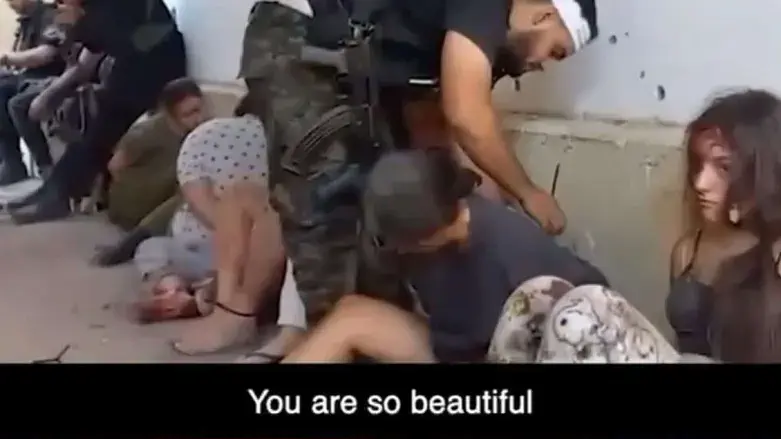
They entered Israeli communities and a music festival. They hunted down civilians. They brutally murdered parents, babies and children. Families were killed in their homes. Houses were burned. People fleeing the music festival were pursued and murdered. Men, women, children and elderly people were kidnapped and dragged into Gaza as hostages.
Women were subjected to sexual violence. International investigators subsequently found reasonable grounds to believe that rape and gang rape occurred at several locations and found evidence indicative of sexualized torture and other forms of sexual violence.
And before Europeans dismiss descriptions of October 7 as Israeli propaganda, they should confront an extraordinary fact:
Some of the evidence was created by the attackers themselves.
The perpetrators carried cameras and phones. They recorded portions of their own assault. Some broadcast or uploaded what they were doing. Other evidence came from security cameras, dashcams, survivors, first responders, forensic examinations and the devastated communities themselves.
This was not an atrocity reconstructed decades later from fading memories.
Much of it happened in front of cameras.
These details matter.
Not because atrocities committed against Israelis make every subsequent Israeli military action justified.
They matter because Europeans sitting safely in Bucharest, Berlin, Paris or London cannot reasonably judge Israel's response without first confronting the event to which Israel was responding.
Before judging how a country responded, understand what was done to it.
And then remember something else that has gradually disappeared from the international narrative:
October 7 was not the end of the attack. It was the opening.
The war was underway.
Israel first had to regain control of its own territory and push the attackers back. Rockets continued to be fired into Israel. Hostages remained captive in Gaza. Hamas remained armed and fighting.
Soon another front opened.
Hezbollah began attacking Israel from Lebanon. Israeli communities along the northern border came under rocket, missile and drone attacks. Tens of thousands of Israelis had to leave their homes.
My friend mentioned the pictures of Gaza.
I would ask him:
2. Have Europeans looked at the pictures from Israel?
Have they seen the burned and destroyed homes in the communities surrounding Gaza?
Have they looked at what happened in Be'eri, Kfar Aza, Nir Oz and other communities before Israel retaliated?
Have they seen the destruction in Israeli communities along the Lebanese border?
Have they seen the families who were forced from their homes and could not return?
Those pictures do not make Palestinian Arab suffering less real.
They make the story complete.
Yet an extraordinary transformation has taken place in much of the international discussion. The war is increasingly judged as though history began with Israel's response rather than with the attack that produced it.
The aggressor gradually disappears from the picture.
The response becomes the story.
3. Who Benefits When Palestinian Civilians Die?
There is another question I would ask my Romanian friend-and Europe generally:
Who benefits when Palestinian civilians die?
Israel certainly does not.
Every Palestinian Arab civilian death is first and foremost a human tragedy. But it is also a political, diplomatic and strategic disaster for Israel.
The photographs travel around the world within minutes. They generate demonstrations, condemnation and diplomatic pressure. They weaken international support for Israel and increase demands that Israel stop fighting.
Hamas understands this perfectly well.
So look at how it has chosen to fight.
4. Why do Hamas and Hezbollah locate rocket launchers, weapons, fighters, command facilities and tunnel infrastructure in or around schools, hospitals, mosques, apartment buildings and densely populated residential neighborhoods?
5.Why construct an enormous underground military infrastructure beneath one of the most densely populated territories in the world?
These are not incidental details.
They are fundamental to understanding the battlefield Hamas created.
Put a rocket launcher in an isolated military installation and Israel can attack it with relatively little danger to civilians.
Put that same launcher beside a school, hospital, mosque or apartment building and Israel faces a terrible choice: leave the military target untouched and permit the attacks to continue, or destroy it while risking civilian casualties.
That is not merely a problem for Israel.
If the international community establishes the principle that military assets become effectively immune from attack when they are placed among enough civilians, it creates an extraordinary incentive for every terrorist organization and irregular army in the world.
The civilian population becomes the ultimate defensive weapon.
The Warnings
Now consider another fact.
Israel has repeatedly warned civilians to leave areas where major military operations were about to take place. It has used evacuation announcements, telephone calls, text messages, leaflets and other methods.
These procedures have not been perfect. In the chaos of war, evacuation routes can be dangerous, instructions can change, and areas considered safer can themselves become dangerous.
But the underlying question remains remarkable:
6. Why would an army supposedly intent on killing Palestinian civilians warn them to leave before it attacks? The answer to that question alone invalidates the genocide claim. Indeed, it is difficult, if not impossible, to identify another major urban war in which an army has gone to such lengths, through evacuation orders, leaflets, telephone calls, text messages and other warnings, to move the opposing side's civilians away from areas it intended to attack.
7. And what happens when Hamas urges civilians to remain, obstructs evacuation, or conducts military operations precisely where civilians live?
We may never discover a written Hamas directive saying:
We want Palestinian civilians killed because their deaths will help us politically.
But a written confession is not the only form of evidence.
Conduct is evidence. Circumstantial evidence is evidence. Repeated conduct is evidence.
If you deliberately locate military assets among schools, hospitals, mosques and homes; if you operate beneath and among the civilian population; if you discourage or obstruct civilians from leaving an impending battlefield; and if the resulting civilian casualties then become one of your most effective means of mobilizing international opinion against your enemy, it is entirely reasonable to ask whether civilian vulnerability is not merely a consequence of the strategy but part of the strategy itself.
The civilians become useful twice.
Alive, they make military targets more difficult to attack.
Dead, their images become extraordinarily powerful instruments in the international information war.
That is a horrifying proposition.
But refusing to examine it does not make it disappear.
And it works.
Europe sees the destroyed school.
It sees the damaged hospital.
It sees the dead child pulled from an apartment building.
The pictures have often been proven to be staged, but sometimes they are real. The suffering is real.
But the photograph cannot show the rocket launcher positioned nearby. It cannot show the weapons stored inside or underneath another building. It cannot show the tunnel beneath the neighborhood. It cannot show the terrorists operating among civilians.
And most importantly, the photograph cannot tell the viewer who made the decision to turn a civilian location into part of the battlefield.
That question matters.
8. Who put the civilians in the crossfire?
Dresden-and the Problem with Judging War From Photographs
This brings me back to my friend's comparison with Dresden.
He looks at Gaza and sees Dresden.
I look at Dresden and see a warning against precisely the conclusion he draws.
A photograph of a destroyed city tells us something profoundly important about the suffering caused by war.
It does not tell us who started the war.
It does not tell us why the war was fought.
It does not tell us how the enemy chose to fight.
It does not tell us what would have happened if the other side had stopped fighting.
And it certainly does not establish that whichever side produced the greater physical destruction must therefore be the morally guilty side.
If that were our standard, our judgment of World War II itself would become absurd.
Germany was devastated.
Japan was devastated.
That did not make the governments that initiated their wars innocent because their countries eventually suffered greater physical destruction.
Physical destruction and responsibility for starting a war are not interchangeable concepts.
9. Replace Netanyahu-and Then What?
My friend tells my wife that many Europeans see Netanyahu as an egocentric criminal and that his defeat may be the necessary first step toward a different future.
Netanyahu is a politician. He can be criticized. Israelis themselves criticize him ferociously. He can lose an election, and another prime minister can replace him.
But then what?
Put that new prime minister in the chair on October 7.
Armed men have crossed into your country.
Entire families have been slaughtered.
Communities have been burned with many residents burned alive.
Women have been subjected to horrific sexual violence.
Men, women, children and elderly people have been kidnapped.
Rockets are still being fired.
Your citizens are demanding to know whether they can ever safely return to their homes.
Soon another armed organization begins attacking from Lebanon.
Now tell me what this supposedly more enlightened replacement for Netanyahu should do.
Stop fighting?
Leave Hamas armed?
Leave its tunnels intact?
Leave its rocket infrastructure intact?
Allow the organization that has just demonstrated both its intention and its ability to penetrate Israel and massacre civilians to remain immediately across the border?
Tell the surviving families to return home and trust that it will not happen again?
Those are legitimate subjects for debate.
But they do not eliminate the fundamental problem.
Israel still has to defend its population.
Changing the name of the prime minister does not change the geography, dismantle Hamas, disarm Hezbollah, return the hostages, eliminate the rockets, or change the objectives of Israel's enemies.
Now Imagine It Happening to You
So I would ask my Romanian friend, and those Europeans whose opinions he describes, to perform a simple thought experiment.
Forget Israel for a moment.
Imagine that the people in those houses were Romanian.
Imagine armed men crossing into Romania and entering Romanian villages.
Imagine them breaking into family homes, murdering parents and children, burning houses, sexually assaulting women and dragging civilians-including children and elderly people-across the border as hostages.
Imagine that the attack does not then end.
Rockets continue to be fired at Romanian cities.
Romanian citizens remain captive across the border.
The organization responsible remains armed and continues fighting.
Then imagine another heavily armed organization beginning to attack Romania from another border, forcing tens of thousands of Romanians to abandon their homes.
Now you are the prime minister of Romania.
What do you do?
Do you tell your population that you cannot attack the enemy because that enemy has deliberately located fighters, weapons, rocket launchers, command facilities, and tunnels among schools, hospitals, mosques, apartment buildings, and residential neighborhoods?
Do you leave that barbaric military infrastructure intact?
Do you tell the survivors that international opinion requires restraint, so the organization that murdered their families must remain armed immediately across the border, ready to do it again?
Do you tell displaced families to return home and hope for the best?
Or do you fight?
And if you fight, how exactly do you fight an enemy that has deliberately made separating its military infrastructure from its civilian population extraordinarily difficult?
That is the question I would like my Romanian friend-and every European comparing Gaza with Dresden-to answer.
Not what Israel should have done in some imaginary war fought on an empty battlefield.
10. What would you have done if October 7 had happened to your country, your community, your wife, your children or your grandchildren?
This is the Question that Europe has forgotten.
I understand why Europeans are horrified by Gaza.
I am horrified by Gaza.
But emotion cannot substitute for causality.
Compassion for Palestinian Arab civilians does not require us to forget October 7.
-Condemning unnecessary civilian deaths does not require us to forget who initiated the war.
-Criticizing particular Israeli military decisions does not require us to pretend that Hamas's method of warfare is irrelevant.
-And disliking Benjamin Netanyahu does not answer the question of what Israel was supposed to do after its territory was invaded and its citizens were murdered, assaulted, and kidnapped.
My Romanian friend says the future looks very difficult.
On that, unfortunately, we agree.
But before Europe decides that Israel has become the villain of this story, I would ask Europeans to look beyond the photographs and recover the questions that somehow disappeared as the war continued:
Who started it?
How did those who started it choose to fight it?
Who benefits from the resulting civilian deaths?
And finally:
What would you have done if it had been your country, your town, your home and your family?
Until those questions are answered, comparing Gaza with Dresden tells us a great deal about the horror of war.
It tells us very little about who is responsible for starting one.