
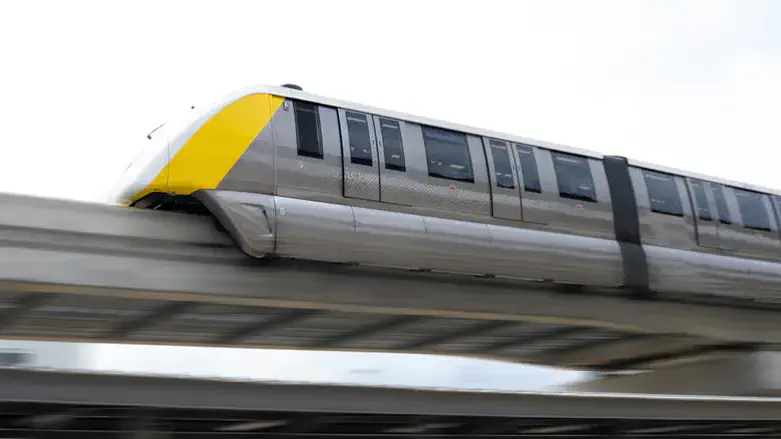
Could autonomous, driverless trains change the question of public transportation on Shabbat?
Rabbi Menachem Perl, head of the Zomet Institute, addressed the issue in an interview with Arutz Sheva-Israel National News following plans for an autonomous metro, ruling that travelling on it on Shabbat would not be permitted under Jewish law.
The discussion arose after NETA published the prequalification process for the second phase of the metro project, which includes driverless trains. Rabbi Perl explains that despite the automation, the metro cannot be considered a system operating without human involvement.
He says a mass-transit system would require a control room for safety reasons. Its operators would do more than monitor screens, potentially switching between systems, handling malfunctions and carrying out routine maintenance, including on Shabbat.
However, Rabbi Perl notes that travel could be permitted in certain cases involving medical or security needs, including doctors, security personnel and medical or security teams. He also raises the possibility of permitting travel for someone who needs to visit a critically ill patient in a hospital.
The question, he stresses, is not purely technological. Rabbi Perl cites the approach that has guided the Zomet Institute over the years, as well as Rabbi Ariel's position, which he says also rejects travel in an autonomous vehicle. He explains that Shabbat is based in part on the principle of "rest for the soul."
Therefore, even if the journey serves positive purposes such as prayer, Torah study or visiting parents, the ability to travel freely from place to place does not fit the character of Shabbat.
In this context, he rejects comparisons with a Shabbat elevator: "The elevator takes me from the ground floor to my home," while a means of transportation enables travel between different locations.
Alongside his ruling regarding passengers, Rabbi Perl takes a different position on whether the religious public should oppose the operation of the metro itself on Shabbat. Among other factors, he says, the ownership structure of the company and the possibility of partnering with non-Jewish entities should be examined under Jewish laws governing partnerships in businesses operating on Shabbat.
Rabbi Perl says he does not believe the religious public should necessarily oppose operating an autonomous metro on Shabbat, particularly if it is an underground system in which the desecration of Shabbat is less visible. At the same time, he notes that the issue of public transportation also concerns workers who want to rest on Shabbat and those who are religiously prohibited from working on that day.
He says that preserving the character of Shabbat does not necessarily require using political tools to prevent others from traveling. Someone who cannot use public transportation on Shabbat, he notes, may not change their lifestyle and could instead choose to travel by private car.
Rabbi Perl concludes by addressing political involvement in the issue, saying that "religious political pressure" in such cases "is not right, not wise, not good, not helpful, and does not bring people closer to Judaism." He says Israeli society has changed over the years and that the use of political pressure should therefore be considered in light of today's reality.