
UNESCO SERIES: This article is second in a series, but can stand alone. For part I, read UNESCO and the Theft of the Temple Mount
There is no need to begin by debating who possesses Jerusalem or which religious tradition has the greater rights. Before any dispute, there is a more elementary obligation: to preserve the evidence. And when UNESCO harshly condemns the removal of remains without documentation, yet remains silent when a similar removal is carried out by the very custodian it praises, the contradiction is no longer political: it arises from the organization’s own words.
UNESCO’s Constitution entrusts it with conserving and protecting the world’s inheritance of books, works of art, and monuments of history or science. It does not ask the organization to select which memories deserve to survive. It requires UNESCO to preserve the material record so that history may be studied before it is interpreted.
That mandate raises an uncomfortable question: what happens when the institution created to safeguard heritage applies its conservation standards selectively? The case of the Temple Mount-Haram al-Sharif in Islam-offers a disturbing answer. Not because it compels us to accept a Jewish, Christian, or Muslim version of history, but because it reveals something that precedes all three:
The evidence was removed before it could speak.
1999: When Earth Was Treated as Rubble
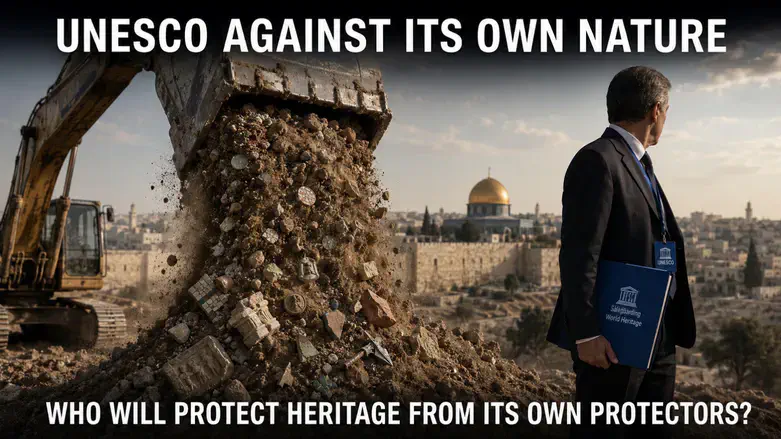
In November 1999, during work to establish the underground Al-Marwani Mosque in the area known as Solomon’s Stables, heavy machinery was used to open a large entrance, and thousands of tons of earth were removed from the compound. Much of the material was dumped in the Kidron Valley. There had been no systematic archaeological excavation and no stratigraphic record capable of preserving the relationship between each object and the precise place where it had remained for centuries.
The figure most often cited is approximately 9,000 tons-hundreds of truckloads-although estimates vary depending on which phases of the work and dumping sites are counted. The crucial question is not whether there were 350 or 400 truckloads. It is the undisputed fact that an enormous quantity of archaeologically sensitive earth was removed mechanically and lost its scientific context.
Years later, the Temple Mount Sifting Project, directed by archaeologists Gabriel Barkay and Zachi Dvira, recovered from that earth coins, pottery, mosaic tesserae, architectural fragments, weights, arrowheads, and seals from numerous periods: First and Second Temple, Roman, Byzantine, Early Islamic, Crusader, Mamluk, and Ottoman. That very diversity defeats any sectarian excuse. What was removed was not merely Jewish heritage. It was the heritage of humanity.
Before an archaeological object is studied, no one has the right to decide which history it contains.
The principal damage was not merely that some objects may have been broken or lost. It was that the finds were separated from their strata. An isolated coin can still be dated; what can no longer be reconstructed with equal certainty is where it lay, beside which wall, beneath which pavement, or within which historical sequence. The excavator did not merely move earth: it dismantled the story preserved within it.
The Silence Did Not Occur Beyond Scrutiny
The absence of a specific UNESCO condemnation cannot readily be explained by a general lack of awareness of the site. The Old City of Jerusalem and its Walls had been inscribed on the World Heritage List in 1981 and on the List of World Heritage in Danger in 1982. For years, Jerusalem had held a permanent place in the Organization’s resolutions.
In 1995, four years before the work, the General Conference even paid tribute to the ‘constant efforts’ of the Waqf authorities to preserve Jerusalem’s Islamic cultural heritage. In 2001, after the removal had taken place, the resolution on Jerusalem expressed deep concern over actions endangering its cultural, architectural, and historical heritage, but, absurdedly, directed its concrete demands toward Israel. In the official documents examined, there is no specific and comparable condemnation of the Waqf or those who it allowed or encouraged to carry out the 1999 work for the massive removal of archaeologically sensitive earth.
The claim must be carefully measured: no one can prove absolute silence by reviewing every internal communication that may ever have existed. But something documentable-and far more relevant-can be stated: the public resolutions examined contain no response equivalent to the one UNESCO produced in relation to Israeli excavations.
The contrast became visible in 2007. In response to Israeli archaeological excavations at the Mughrabi Ramp, UNESCO dispatched a technical mission and recommended that the work be halted immediately. In other words, the organization demonstrated that it possessed the language, the mechanisms, and the institutional will to intervene swiftly when it believed Jerusalem’s heritage to be under threat.
UNESCO Testifies Against UNESCO
The strongest evidence comes neither from Israel nor from a Jewish institution. It comes from UNESCO itself. In Decision 39 COM 7A.27, adopted in 2015, the World Heritage Committee declared that its purpose was to safeguard the ‘authenticity, integrity and cultural heritage’ of the Old City of Jerusalem.
In paragraph 10, it expressed deep concern that most of the remains resulting from certain excavations connected to the planned Kedem Center had been ‘completely removed without documentation.’ In paragraph 14, it went even further: it called for the remains to be returned, for documentation concerning the removed historical finds to be provided, and for the original character of the sites to be restored.
UNESCO itself thus established the rule: removing archaeological remains without documenting them harms the authenticity and integrity of the heritage; their return, documentation, and restoration of the site may therefore be required.
Let us then apply UNESCO’s standard to UNESCO. If removing remains without documentation constitutes damage to heritage when the allegation is directed at Israel, the same principle should have applied when the actors were the Waqf authorities and the Islamic Movement. The identity of the actor cannot alter the nature of the act.
The same 2015 decision states that Jordanian Waqf experts must be allowed to ‘maintain and safeguard’ the site in accordance with UNESCO’s conventions and recommendations. That formulation is decisive. The custodian is not granted freedom to physically rewrite the site; it is entrusted with the responsibility to preserve it. Custodianship does not mean ownership of history, much less the power to decide which layers of history may survive.
This Is Not a Debate About Sovereignty
The usual defense is to shift the discussion immediately to Jerusalem’s political status, the law of occupation, or the religious status quo. None of those issues, however, resolves the heritage question. Even if UNESCO’s entire legal framework were accepted, every remain would still have to be documented before being removed. Archaeology does not change its nature according to who operates the excavator.
Nor is UNESCO being asked to ‘defend the Jewish version.’ Its obligation was to protect the material, whether Jewish, Christian, Roman, Byzantine, Umayyad, or Mamluk. Preservation precedes interpretation. First preserve; then study; finally debate. Reversing that order allows politics to determine which evidence will survive into the future.
From omission to Jurispolitics
Here the true problem emerges. A resolution may be formally adopted, secure the necessary votes, and employ the solemn vocabulary of international conventions. None of that guarantees that it serves the purpose for which the institution exists. When a decision preserves the appearance of law but applies its principles according to the political identity of the addressee, we enter the realm of jurispolitics: political will clothed in legal neutrality.
In strictly legal terms, the contradiction does not by itself prove that every subsequent resolution is automatically null or ultra vires. (It does, however, support a serious legal objection: a specialized organization should not exercise its powers in a manner incompatible with its constituent mandate) . If authenticity, integrity, and documentation are protected only against one side, the principle ceases to be patrimonial and becomes a political instrument.
That is why the omission of 1999 is not a historical footnote. It functions as a delayed institutional self-indictment. In 2015, UNESCO precisely described the conduct it should have examined in 1999: remains removed without documentation. By demanding from Israel the return of remains, documentation, and restoration, it wrote the standard that should also have applied to the custodian it had praised.
Against Its Own Nature
UNESCO was created to prevent humanity’s memory from being destroyed, plundered, or falsified. When it remains silent in the face of lost archaeological context and later uses terminology that privileges a single historical layer of the same site, it acts against the very nature of its mandate.
This is not about denying the Islamic sanctity of Al-Aqsa or the Waqf’s religious function. It is about remembering that a custodian administers a site that did not begin with it and will not end with it. The Temple Mount/Haram al-Sharif does not need an exclusive history; it needs assurance that none of its histories will be torn from the earth before it can be known.
The final question, then, is not who won a vote in Paris. It is far simpler: if UNESCO does not apply to everyone the principle it has itself proclaimed-authenticity, integrity, and safeguarding-who will protect heritage from its own protectors?
Leon J. Halac is an accountant and businessman. He is also a great-grandfather, Argentinian, and Zionist who has been published in Iton Gadol, AJN and Arutz Sheva.
Principal Documentary Sources
1. Constitution of UNESCO, Article I.2(c): https://www.unesco.org/en/legal-affairs/constitution
2. UNESCO, 28 C/Resolution 30 (1995), tribute to the efforts of the Waqf: https://unesdoc.unesco.org/ark:/48223/pf0000101803.page=56
3. UNESCO, Jerusalem and the implementation of 30 C/Resolution 28 (31st General Conference, 2001): https://unesdoc.unesco.org/ark:/48223/pf0000123543
4. UNESCO, Report of the Technical Mission on the Mughrabi Ramp (2007): https://unesdoc.unesco.org/ark:/48223/pf0000150407
5. World Heritage Committee, Decision 39 COM 7A.27 (2015): https://whc.unesco.org/en/decisions/6243/
6. Jon Seligman, ‘Solomon’s Stables, The Temple Mount, Jerusalem,’ ‘Atiqot 56 (2007), published by the Israel Antiquities Authority: https://publications.iaa.org.il/cgi/viewcontent.cgi?article=1363&context=atiqot
7. Temple Mount Sifting Project, history and finds from the removed material: https://tmsifting.org/en/brief-introduction-to-the-project/