
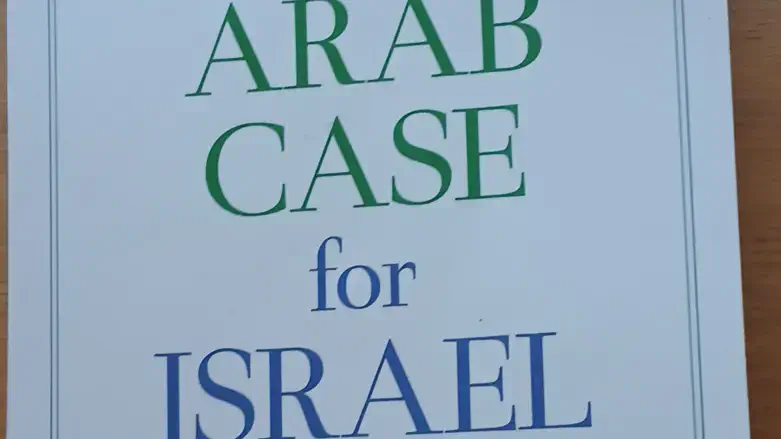
Review:The Arab Case For Israel and Other Essays From aDistant Conflict, Hussain Abdul Hussain, Wicked Son Publishing, 2026.
Most books written by Arabs and Moslems criticizing the policies of Middle Eastern countries towards Israel are written when the author is no longer in a Moslem majority country and therefore has both political freedom and freedom from fear of retaliation by a Moslem government. Hussain Abdul Hussain, longtime journalist, now a fellow at the Foundation for the Defense of Democracies, who was raised in Iraq and Lebanon, has used American freedom wisely. He has written an excellent book about the Arab and Moslem worlds’ antagonistic relationship to Israel, The Arab Case For Israel and Other Essays from a Distant Conflict, Wicked Son Publishing, 2026. This book is factual, detailed and highly useful to anyone who wants to understand the contemporary Middle East.
This collection of essays argues, among other important points, that Arabs and other Moslems should end their senseless and bloody hostility to the little Jewish state. Abdul Hussein’s history of how Arab and Islamic governments have used Israel-hatred and Jew-hatred both as an instrument of internal control of their own people and also as a weapon wielded in contests with other Arab and Islamic governments is eye-opening.
Abdul Hussein’s main arguments for Israel are about the prospect of improving Arab lives. Peace and normalization of relations with Israel would materially improve the lives of the Palestinian Arabs, the people of the neighboring countries and the world.
The neighboring countries would benefit from Israeli technology, innovation and trade. They would no longer waste resources on a senseless war that will never accomplish anything good. The Arab people of the Middle East have proven themselves incapable of producing modern, multi-ethnic, liberal and free countries. No such Arab country exists even today. The Arabs should recognize their own interests but seem more interested in Jihadist ideology and in hating Jews and Israel than improving their own lives.
Abdul Hussein also shows that the battle for a ‘State of Palestine’ is an attempt to capture something that never existed. The area that is now Israel had not been an independent country from the last time Jewish kings ruled over it in the Hasmonean era until the modern state of Israel was born, so there was no ancient Palestine. There is no separate Palestinian language, religion, food, or any of the other aspects of a distinct culture or nationhood that distinguished the Arabs who call themselves ‘Palestinians’ from any other Arabs of the Levant.
They are claiming an identity concocted by Yasser Arafat’s Egyptian and Soviet handlers beginning in 1964 when they realized that trying to eliminate Israel and kill all the Jews in the Middle East under the guise of a national liberation struggle was more palatable to the world than trying to eliminate Israel and kill the Jews under the banner of their real purpose: Jihad and genocidal Jew-hatred.
Regarding the creation of a Palestinian Arab state, Abdul Hussein gives a very good summary history of the meetings, treaties, ‘accords,’ and attempts to create such a state, all of which failed because no Arab government or ‘Palestinian’ leadership group was willing to sincerely make the commitment to recognize and live in peace with Israel. The desire for a ‘Palestinian’ state was largely a ploy to whittle down and weaken the Jewish state rather than a genuine attempt to create the conditions for a separate and viable Arab entity.
Instead of showing themselves able to govern, Arabs created the brutal and murderous Hamas government in Gaza and the corrupt and oppressive government of Fatah, the Palestinian Authority, in Ramallah. What needs to be freed, says Abdul Hussein is not Palestine, but Palestinian Arabs.
One of the unexpected bonuses of The Arab Case for Palestine and Other Essays From A Distant Conflict, is Abdul Hussein’s refutation of some of the falsehoods published by the notorious propagandist, PLO mouthpiece and Columbia University professor Rashid Khalidi.
The Arab claims to the land of Israel depend on many lies, but one of the most commonly told, a lie promoted by Khalidi and his accomplices, is that most of the land of Israel once belonged to Arabs, the so-called ‘Palestinians.’ As has been pointed out by others and as Abdul Hussein clearly reiterates, during the Ottoman Empire the majority of the land was owned by the Ottoman state and tax-farmed by tribal chiefs or owned by clerics and their waqf (religious foundations).
Only a small portion of the land, mostly in urban areas, was privately owned by individual Arabs. Abdul Hussein again proves that the assertion that most of Israel was once owned by individual Arabs who were forcibly displaced by Jews is a lie.
He also shows the foolishness of the Arab claims to have a ‘right of return’ to Israel. There were about 750,000 Arabs who left Israel rather than live under Jewish rule and according to the stunningly dishonest and artificial U.N.R.W.A. criteria for ‘Palestinian’ identity there are now allegedly 5.9 million descendants of their descendants who are self-called ‘Palestinian refugees.’ Of course, most of the genuine refugees are deceased from old age and these are the third and fourth generation descendants who have very little, if any, connection to the land of Israel.
Most of the real refugees did not own any real estate and if the pretend refugees were allowed to make claims on any property it would be locked in litigation for decades. The whole idea of ‘return’ is foolish and impractical because Israel is not the imagined setting of pastoral Arab villages and never was.
Additionally, the Arabs do not want to make any compensation or give any rights to the approximately 850,000 Jews expelled from Arab countries in the Middle East and North Africa after 1947 and their millions of descendants whose property, which the Jews actually owned, was confiscated from them by Moslem majority governments as part of the Arab project of ethnically cleansing their countries of Jews.
The book also reflects on the ‘Cold Peace’ between Egypt and Israel and between Jordan and Israel. Those countries made peace agreements with Israel and have maintained those agreements in a stiff and formal way, while still pandering to the Jew-hating and Israel-hating prejudices of their populations who continue to receive anti-Israel messaging in their mosques, their schools, their biased news reports and their entire culture.
Instead of acting like real leaders intent on improving the trade, cultural and intellectual ties between their countries and Israel, these two countries have done the minimum necessary to receive U.S. largesse as a condition of making peace on Israel’s borders. That limited connection has injured their economies and their ability to advance as societies.
The Abraham Accord model of open trade and engagement between Arab countries and Israel, such as with Dubai and the U.A.E, is a far better model for improving the lives of Arabs, than the ‘Cold Peace.’ It ought to be said, however, that in Jordan a majority of the Arab residents claim to be ‘Palestinians’ and have been soaked in hatred of Israel and Jews for generations. Likewise, Egypt has a surplus of fire-breathing Islamist clerics and a radical and ignorant population that voted the war-like and expansionist Muslim Brotherhood into office the last time they held an honest election. A ‘Cold Peace’ may be all that these benighted states are capable of.
Abdul Hussein also clearly explains the ideologies of the various Islamist groups and their histories relying heavily on Arabic-language sources. He shows, for instance, that the Muslim Brotherhood, a group whose ideology includes return to seventh century fundamentalism, Islamic expansionism and sharia-supremacism aims at world domination for Islam.
That ideology has infected Qatar and much of the Middle East leading Qatar to deploy its vast wealth to undermine the West, America, and Israel. To undermine the West Qatar uses its world-striding media network al-Jazeera and buys its way into western cultural institutions, particularly universities. After October 7, 2023 ‘al Jazeera spearheaded misinformation, disinformation and antisemitism. It broadcast bogus casualty numbers that it received from Hamas itself…’
As an example of what passes for news commentary on al-Jazeera, Abdul Hussein shows us a retired Jordanian general hired as an al-Jazeera commentator who said this:
‘The old hatred that fills the Jewish heart is hatred against the members of the Human race throughout history, fueled by the forged books of the Old Testament and strengthened by the explanations of the Talmud and the fatwas of the rabbis…'
'What reinforced [Jewish hatred] was the emergence of evangelical Zionism which agreed with it on the necessity of accelerating the construction of the Temple and the effects of that appear clearly in what [Jewish hatred] has been committing.’
The Qatari government, of course, denies that it controls al-Jazeera, even though it is completely government funded and always acts to advance Qatari interests. Besides its huge influence in the Arabic and English-speaking world and in universities, there have been prosecutions of U.S. government officials, including Richard Olsen, former U.S. ambassador to Pakistan and the U.A.E for taking Qatari money and of Marine Corps General John R. Allen for failing to report Qatari influence money he received.
American universities, including Yale, Cornell and Georgetown have routinely taken multi-million dollar gifts and often failed to report them even though U.S. law requires such reporting. Abdul Hussein makes a detailed and convincing case that many Western institutions are easily bought when the Qataris arrive with their checkbook.
Two of the last three chapters of The Arab Case for Israel and other Essays from a DistantConflict are about how Persian Shi’ite Iran has used the Sunni Arab world to advance Iranian ideological and theological interests at the cost of Arab lives, Arab peace and Arab prosperity. Beginning with a history of Lebanon and its governments in the twentieth century he is particularly incensed at how Iran has funded and trained Hezbollah as a colonial-occupation Iranian army in Lebanon, the country of his youth, to be a non-state actor that is more powerful than the state that it occupies.
This, he says is Iran’s pattern: arming, training and funding a militia to nominally be a ‘resistance group’ against Israel and then having it infiltrate and stealthily conquer the country where it is located. Hezbollah’s announced goal, like Iran’s, is one big borderless Islamic state led by Iran. Hezbollah-Iran has wrecked the physical landscape of Lebanon, wrecked the culture and politics and, of course, wrecked the economy. Still, Hezbollah-Iran is willing to fight to the last Lebanese.
The Iranian funded and supported militias in Iraq and the Houthis in Yemen are not much different. They are unconcerned about the welfare of the people amongst whom they live. Abdul Hussein presents a clear and understandable history of the Houthis in Yemen and the most powerful of the Iraqi militias and how they act as Iranian agents and proxies, including making war on the United States and Israel.
Abdul Hussein ends with a short chapter about the radicalization of Arabs and Moslems in America. He is right in believing that genuine assimilation of people from other cultures, including Arabs like himself, is more available in the United States than probably anywhere else in the world. This is because the United States is founded on principles while most nations are founded on ethnic and tribal loyalties.
‘But then America discovered ‘identity’ and especially ‘identity politics.’ Too many Arab and Moslem-Americans are trying to recreate the ‘ancestral homeland’ which was soaked in Jew-hatred, Israel-hatred and hatred of the liberal values of the West. So, these immigrants and their first generation offspring in America led the charge against Jews, Israel and Western Civilization. ‘The anti-Israel movement in America has been showing its true face: not against Israel only, but against America itself and the rest of the Western world. After all, this is a disagreement over a worldview, not over a sliver of land.’ The Islamists want a religiously decreed government that does social engineering on Sharia principles.
This excellent book is written in a calm, factual and highly readable style. It explains the ideologies of the various Moslem anti-Israel and anti-Jewish groups well. It also gives a clear history of the modern Middle East with specific attention to how the modern alignments and alliances developed. Hussein Abdul Hussein’s The Arab Case For IsraelAnd Other Essays from A Distant Conflict is certainly worth the reader’s time and will not disappoint.
It is a book that could only have been written by a free man in a free country and not in the Islamic Middle East.