
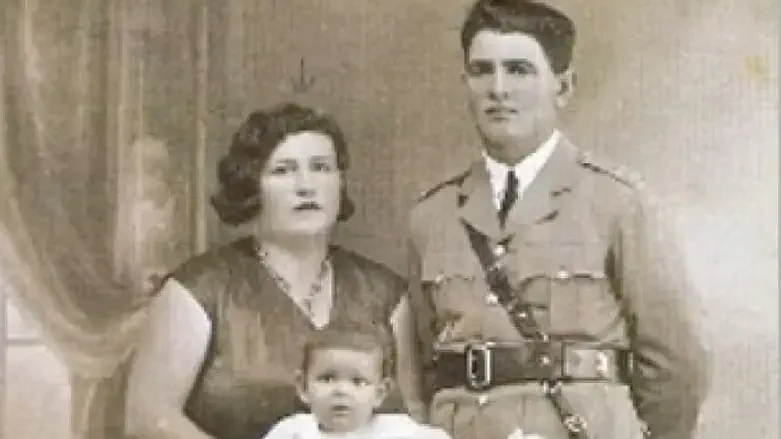
In a conversation with Arutz Sheva - Israel National News, heritage researcher Lt. Col. (res.) Gideon Mitchenik looks back nearly 90 years to the beginning of the Great Arab Revolt and the abduction and murder of members of the Lazarevich and Kirzner families.
The night of August 16-17, 1938, saw an Arab gang led by Yosef Abu Dura attempt to free hundreds of Arab prisoners from the detention camp at Atlit. Mitchenik emphasizes that this was a camp established by the British for Arab prisoners, distinct from the Atlit detention camp later used to hold Jewish immigrants who entered Mandatory Palestine illegally.
About 200 gang members failed to free the prisoners and, while retreating from the camp, attacked the home of Moshe Lazarevich, deputy commander of the facility. Inside were Moshe, his mother Beruriah, his three children - Rachel, 12; Yifrach, 8; and Chagi, two and a half - and Beruriah's brother, Eliyahu Kirzner. All six were abducted and taken to the Arab village of Ein Hod, now known as Ein Hod Artists' Village.
Abu Dura decided to execute the three adults, while the three children were released by the gang. Two days later, they arrived at Kibbutz Mishmar HaEmek. The children were unable to explain what had happened to their parents or fully understand what had happened to them during their abduction.
Mitchenik says the British police were obligated to investigate the murder of one of their officers, but their searches produced no results. The gang members had threatened residents in the surrounding area, causing them to remain silent and refuse to provide information, even when they knew what had happened. Efforts by leaders of the Jewish community to locate the missing adults also failed.
After the three adults were murdered and buried in the forest, their bodies were later removed from the grave and burned with lime, leaving virtually no remains. What was left was subsequently buried elsewhere.
Mitchenik also recalls the circumstances of the Great Arab Revolt, which began with an Arab strike that lasted more than 100 days and caused severe damage to the Arab population itself. Some 3,000 Arabs were killed, including in internal Arab clashes. During the revolt, between 400 and 600 Jews and approximately 250 British personnel were also murdered.
Following the revolt, the Peel Commission arrived in the Land of Israel in an attempt to find a solution to the unrest. The period that followed also saw the establishment of dozens of "tower and stockade" settlements.
Mitchenik further recalls another tragedy that struck the family two years after the abduction and murders. In 1940, Moshe and Beruriah's son Chagi was killed when Italian aircraft bombed Tel Aviv.
In 1962, Rachel, another member of the family, demanded answers about the case. Around the same time, a newspaper article was published about the murders. The two developments prompted the Commissioner of Police to assign veteran investigator Shlomo Ben Elkanah to reopen the case.
Ben Elkanah had already established a reputation for solving difficult cases, including locating the remains of Avshalom Feinberg in Sinai. Drawing on intelligence and investigative techniques he had developed over the years, he conducted interviews with local Arabs until he eventually reached a person who directed him toward the location where the victims' remains had been buried. He also used aerial reconnaissance to assist in the search.
Six months later, the veteran investigator succeeded in locating the grave containing the remains of the three murdered adults. Among the remains were pieces of clothing and three buttons: two from Moshe Lazarevich's uniform shirt and a third from Beruriah's dress.
The three were brought for burial at a ceremony in the Rishon LeZion cemetery that generated intense emotion and significant public attention in Israel.
Over the years, however, the story gradually faded from public memory. A memorial site was eventually established near Zichron Yaakov at the remains of the Lazarevich family's home. The site was created through the efforts of Yoel Amsterdam, who happened to discover the story and traveled to the location. He cleared the overgrown area, uncovered what remained of the home's floor and, together with the Council for the Preservation of Heritage Sites, established the memorial and paved the path leading to it.
Amsterdam later contacted members of the family, including Yefarakh. His only request was to be allowed to spend one more night in the home where his family had lived and from which he had been abducted at the age of eight.
Yifrach recalled that after being abducted and taken to an Arab village several dozen kilometers away, he sat on a tree trunk facing the direction of his family home, convinced that he would still see his father emerge from it. He did not know that his father, mother and uncle had already been murdered.
Amsterdam fulfilled his wish by placing a tent on the uncovered floor of the former home and inviting him to spend the night there when he was about 80 years old. He arrived with difficulty but spent the night in a sleeping bag on the floor of the house, later saying that it was the best "hotel" he could have hoped for. Shortly after the memorial site was dedicated, his health deteriorated and he passed away.
On Monday, a special evening will be held at Yad Labanim in Rishon LeZion in memory of the case. The event will recount the history of the Great Arab Revolt alongside the story of the abduction and murder of the Lazarevich and Kirzner family members.