
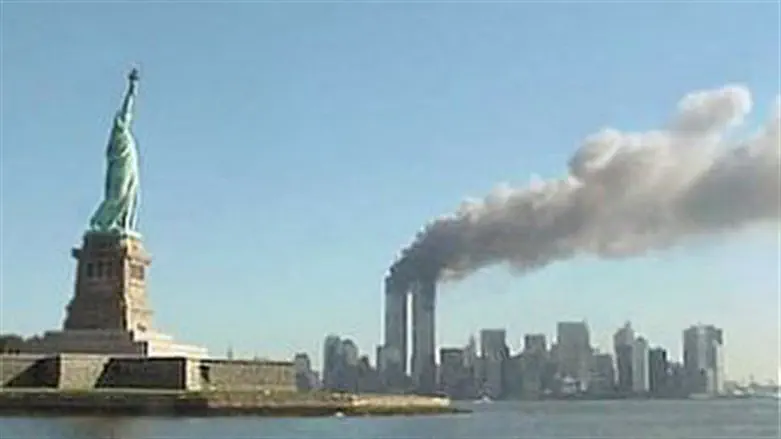
Two great black squares that look like cosmic embrasures, where the Twin Towers once rose.
The 9/11 Memorial is called “Reflecting Absence." The water, dense and dark, does not flow: it plunges. It falls without respite into the voids, in a continuous gushing that fills nothing, consoles nothing, and forgets nothing.
It is a hole of black water, a vertical maelstrom that swallows the light and returns a low, monotonous, liturgical sound.
I approach the edge, emerging from the subway that rises beneath Calatrava’s Oculus. I had been missing from this chilling place for some years.
The surface is still up to the brim; it breaks and plunges in thousands of dark threads, thin as strands of mourning hair. It is not a waterfall: it is a continuous hemorrhage. The water does not foam, does not splash: it descends with a funereal dignity, as if it knew it had to safeguard a silence greater than itself.
One has the sensation that the Western world is still leaking, drop after drop, second after second.
A rectangle of sky replaced by a bottomless well. The towers were not demolished: they were subtracted from the horizon, and in their place this double abyss remains, which continues to drink.
The black water does not reflect the faces of those who lean over to look at it; it absorbs them, dissolves them, carries them away. Those who lean over here are not seeking their own image: they are seeking what can no longer be found.
I look at the names of the three thousand dead engraved in bronze. Each of them is a thread that the black water continues to drag downward. There is no hierarchy, no rhetorical consolation. Only the endless list of those who did not return home. The water falls on those names, wets them without erasing them, makes them shine for an instant before carrying them away again. It is a baptism in reverse: it does not wash away sin, but perpetuates the memory of blood.
The city that saw the towers fall under the weight of planes piloted by men who invoked Allah has elected a mayor who bows to the same cultural tradition that speaks the language of those who, in other latitudes, still today consider the West an enemy.
I leave the area of the Twin Towers and pick up New York’s glossiest magazine.
New York as “Habibi City."
The phenomenon described by the New York magazine series "Habbi City*," glorifying Palestinian terror and likening Zionism to a variety of racism to be overcome, focuses on the SWANA generation, the English acronym for Southwest Asia and North Africa, which includes people from a range of countries from “Palestine" and Iran to Sudan. According to the article, signed by journalist Zaina Arafat, this cultural energy has transformed New York into a “Middle Eastern enclave".
The election of Zohran Mamdani as mayor is presented as decisive proof of the golden age of this community.
Meanwhile in Michigan they were celebrating the victory of Abdul El-Sayed in the Democratic primaries for the Senate.
El-Sayed is the son of Egyptian immigrants, an openly declared Muslim, and, should he be elected in the general election of November 2026, he would become the first Muslim to sit in the United States Senate.
Kamel Daoud writes in Le Point:
“One wakes up to this news in France. America, the one that knew McCarthyism against communism, September 11, Obamacare, and hyper-nationalism-is it Islamizing? Will America one day be an Islamist empire? Perhaps yes. Western democracy, this universal solution now under assault from its own contradictions, resembles a rigged poker game. As an amused echo, an article published a few weeks ago in Al-Quds Al-Arabi, one of the main Arab newspapers: ‘Did Muslims discover America before Columbus?’ The article is a bit confused, but it summarizes well what is being plotted today: an America to be claimed, in its mythologized past as in its future to be conquered."
Meanwhile the conquest proceeds according to plan.
A few hours before I left New York, there was an attempted attack on the Central Synagogue of Manhattan.
I wonder how much longer this dark water will have to fall before the Western void is filled. The answer, I already know, is: none.
That hole is not destined to close. It is destined to remain open, to continue gushing, to remind anyone who passes that something irreparable happened here, and that the irreparable has taken the form of this black water that never stops plunging and of this demographic energy that transforms everything.
It will continue to gush, black and incessant, because the West has chosen not to fill that hole with its own substance. Habibi City is not an imposed destiny: it is the result of an absence of will.
The black water descends and we count the drops instead of building dams.
Giulio Meotti is an Italian journalist with Il Foglio and member of the Middle East Forum who writes a twice-weekly column for Arutz Sheva. He is the author, in English, of the book "A New Shoah", that researched the personal stories of Israel's terror victims, published by Encounter and of "J'Accuse: the Vatican Against Israel" published by Mantua Books, in addition to books in Italian. His writing has appeared in publications, such as the Wall Street Journal, Gatestone, Frontpage and Commentary.
*For more on "Habibi City" see here.