
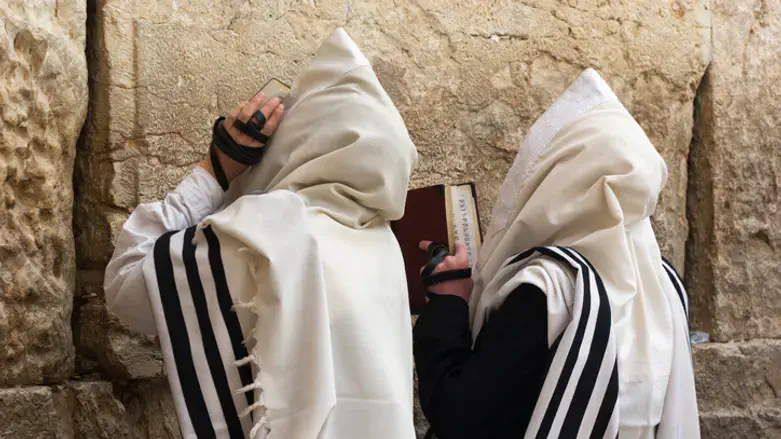
For many years, it has become customary to sound the shofar every day during the month of Elul, at the conclusion of the morning prayers. This custom has become firmly established throughout the Jewish world and is practiced by both Ashkenazic and Sephardic Jews.
The Rambam gives profound significance to the sounding of the shofar. In Hilchot Teshuvah (3:4), he writes:
"אף על פי שתקיעת שופר בראש השנה גזירת הכתוב, רמז יש בו; כלומר: עורו ישנים משנתכם, ונרדמים הקיצו מתרדמתכם, וחפשו במעשיכם וחזרו בתשובה וזכרו בוראכם. אלו השוכחים את האמת בהבלי הזמן ושוגים כל שנתם בהבל וריק אשר לא יועיל ולא יציל, הביטו לנפשותיכם והיטיבו דרכיכם ומעלליכם, ויעזוב כל אחד מכם דרכו הרעה ומחשבתו אשר לא טובה."
“Although the sounding of the shofar on Rosh Hashanah is a decree of Scripture, it contains an allusion; that is: ‘Awake, you who are asleep, from your sleep! And you who slumber, arise from your slumber! Search your deeds, return in repentance, and remember your Creator.’ These are those who forget the truth in the vanities of the times and spend all their years pursuing vanity and emptiness that cannot help or save. Look into your souls, improve your ways and your deeds, and let each one of you abandon his evil path and his thoughts that are not good."
The Rambam teaches us that a person can live in a world of illusion without recognizing reality. He can substitute falsehood for truth and evil for good, and become so accustomed to falsehood that he no longer distinguishes between truth and falsehood. “Awaken and see the truth that stands before your eyes"-this is the message the Rambam seeks to convey to us.
We live today in a period in which one of the most widespread misconceptions concerning the Temple Mount has been accepted almost without question. The Western Wall, toward which tens of thousands of Jews stream to pray, is widely regarded as the western wall of the Temple Mount. Yet archaeological, halakhic, and historical evidence may point to a very different conclusion.
The Western Wall that we see today was not part of the original enclosure of the Temple Mount. It was built by Herod as a retaining wall and defensive wall, in order to expand the Temple Mount toward the west. This wall is approximately 485 meters long.
The Mishnah, however, explicitly states that the Temple Mount was a square measuring 500 cubits by 500 cubits. If the present Western Wall were the western boundary of the Temple Mount, it would necessarily follow that each cubit was approximately one meter long. Yet there is not a single halakhic authority who has proposed such a measurement. The largest measurement generally accepted among halakhic authorities is approximately 62.4 centimeters (see Talmudic Encyclopedia, Vol. II, entry Amah, p. 49).
The implications of such a conclusion are far-reaching. Torah measurements in many areas of halakhah are based upon the measurement of the amah. For example, a kosher mikvah must measure one amah by one amah and have a depth of three amot (Rambam, Hilchot Mikvaot 4:1). If an amah were one meter long, many mikva’ot would be halakhically invalid. Similarly, the overwhelming majority of lulavim would not meet the minimum halakhic requirement.
Furthermore, the Mishnah explicitly states that the Temple Mount was square, measuring 500 cubits by 500 cubits (Middot 2:1; Rambam, Hilchot Beit HaBechirah 5:1). By contrast, the present Temple Mount platform is not square at all. Rather, it is an irregular rectangle, measuring approximately 485 meters on the western side, 277 meters on the northern side, 466 meters on the eastern side, and 316 meters on the southern side (Leen Ritmeyer, The Quest, p. 20). In addition, the northern side is approximately 39 meters longer than the southern side. These dimensions are inconsistent with the Mishnah’s clear description.
It therefore follows that the Western Wall we see today is not the original western wall of the Temple Mount, but rather part of Herod’s expansion project (see The Great Shiurim Debate, Rabbi A., Notes, Chapter 19, for additional evidence).
There is, however, a remnant of another wall located farther to the east. Leen Ritmeyer, in his book The Quest (p. 165), identifies this remnant as the original western wall of the Temple Mount, which served as the termination point of a staircase at the northwestern corner of the Temple Mount.
In the book HaBayit, Arnon Segal specifically notes that the distance between this remnant of the wall and the eastern wall is approximately 262.5 meters. According to this calculation, the amah would measure approximately 52.5 centimeters-only about 5.5 centimeters different from the measurement of the Chazon Ish, and less than two centimeters different from the measurement of Rabbi Moshe Feinstein (Igrot Moshe, Yoreh De'ah, Vol. III, No. 66).
Moreover, Ritmeyer demonstrates that this remnant of the wall can be used to reconstruct the original shape of the Temple Mount as a perfect square, consistent with the description of the Mishnah (see The Great Shiurim Debate, Chapter 20, for a detailed discussion of Ritmeyer’s reconstruction).
The problem before us, however, is far more serious than merely the fact that we are praying at the wrong wall. If the evidence presented thus far is indeed correct, a profound halakhic and spiritual question arises-one that touches upon the very foundations of our relationship to the Temple and its sanctity.
In the Torah portion read on Tisha B’Av (Deuteronomy 4:25-40), the Torah warns us about a period in which the Jewish people will depart from the path of Torah, be exiled from their land, and be scattered among the nations, until they reach a spiritual low point at which they will worship: "וַעֲבַדְתֶּם שָׁם אֱלֹהִים מַעֲשֵׂה יְדֵי אָדָם עֵץ וָאֶבֶן."
“And there you shall serve gods, the work of human hands, wood and stone."
Objects created solely by human beings do not possess inherent sanctity. When sanctity is attributed to them without being based upon a Divine command, a fundamental misunderstanding of the nature of holiness and the proper attitude toward it can arise.
A simple question therefore presents itself: If the Temple itself was also built by human beings, why is it not included in this warning?
The Gemara answers this question (Yevamot 6b):
"לא מן המקדש אתה מתיירא, אלא ממי שציווה על המקדש."
“You shall not fear the Sanctuary itself, but rather He who commanded concerning the Sanctuary."
The Rambam codifies this principle as halakhah in Hilchot Beit HaBechirah (7:1). This is particularly significant because the Mishneh Torah is a book of halakhah, not a work of philosophy or theology. Halakhah teaches us that the sanctity of the structure does not derive from the stones themselves, nor from the act of construction, but solely from the fact that it was built in accordance with the command of the Holy One, blessed be He. The reverence we demonstrate toward the Temple is not directed toward the physical structure itself, but toward the will of God revealed through it.
The Western Wall built by Herod, however, is fundamentally different. It was not constructed by virtue of a Divine command. Herod was one of the most cruel kings in Jewish history and was responsible for the torture and killing of many of the Sages of Israel.
The Gemara (Bava Batra 3b) relates that Herod was originally a slave in the household of the Hasmoneans. He rebelled against his masters, murdered the entire Hasmonean family, and left only one young woman alive, hoping to marry her and thereby lend legitimacy to his rule. The young woman climbed to the roof and proclaimed:
"כל האומר מבית חשמונאי אני - עבד הוא, שלא נשתייר מהם אלא אותה נערה."
“Whoever says, ‘I am from the House of Hasmonean’ is a slave, for only this young woman remains of them."
She then threw herself from the roof and died.
The Megillat Ta'anit likewise relates that the seventh of Kislev was established as a day of rejoicing because Herod died on that day. The reason given is that Herod hated the Sages of Israel and persecuted them.
In light of this, it is difficult not to be struck by the fact that we light the Hanukkah candles, recite “Al HaNissim," and then stand to pray specifically before the wall constructed by that very Herod.
The evidence presented here therefore indicates that the wall before which we pray is not the original western wall of the Temple Mount. The sanctity of this wall does not derive from a Divine command, but solely from the work of human hands-“the work of human hands, wood and stone." The true sanctity, Ritmeyer says, lies beyond it, slightly farther to the west-the original western wall of the Temple Mount, which was sanctified by virtue of the command of the Holy One, blessed be He.
There, the command: "וּמִקְדָּשִׁי תִּירָאוּ" (ויקרא יט, ל
“And you shall revere My Sanctuary" (Leviticus 19:30)
can once again be understood in its fullest meaning.
That is the place of the Temple service. There is where the Menorah should be kindled, and there is where the Temple service will ultimately be restored.
The shofar is not merely an instrument sounded once a year. The shofar is the Torah’s eternal call to awaken from spiritual and intellectual slumber. At times, the greatest obstacle to discovering the truth is not a lack of evidence, but the acceptance of assumptions that have gone unquestioned for generations.
“Awake, you who are asleep, from your sleep! And you who slumber, arise from your slumber! Search your deeds, return in repentance, and remember your Creator.
The lower step appears to be the remnant of an ancient wall, the top of which is integrated into modern-day paving. According to Leen Ritmeyer, it seems that this is the Western Wall of the Temple Mount prior to its expansion by Herod.
Rabbi Chaim Ozer Chait is Rosh Ha Yeshiva Emeritus at Yeshivat Migdal HaTorah.