
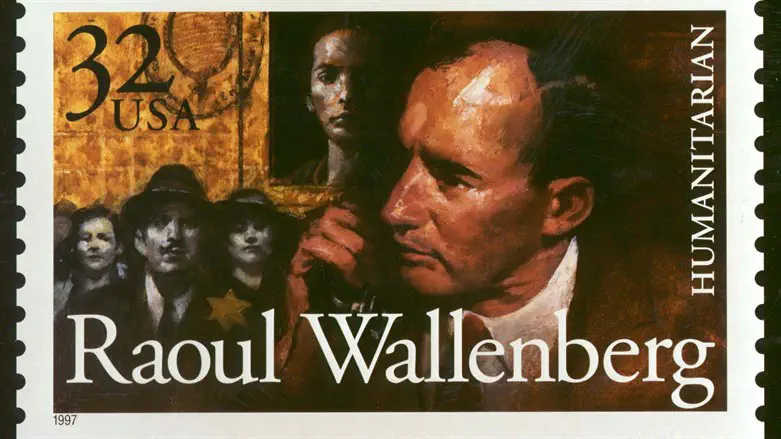
There are nations that fail their heroes through negligence. There are governments that sacrifice them to political expediency. And then there is Sweden’s betrayal of Raoul Wallenberg-a moral disgrace compounded by the staggering greatness of the man it abandoned.
Wallenberg was not merely a Swedish diplomat who performed his duties courageously. He was one of the greatest humanitarians in history and arguably the most righteous gentile who ever lived.
Arriving in Budapest in July 1944, as Adolf Eichmann’s machinery of extermination was devouring Hungarian Jewry, Wallenberg confronted the Nazis and their Hungarian Arrow Cross collaborators with astonishing audacity. He distributed Swedish protective passports, established diplomatic safe houses, pulled Jews from deportation columns and reportedly even climbed onto trains bound for Auschwitz to rescue those he could claim as Swedish protégés.
He bullied murderers, bribed officials, bluffed bureaucrats and invoked the authority of the Swedish Crown as though it were an invisible army.
Wallenberg’s exact numerical contribution remains debated, and his rescue campaign was part of a broader effort involving other Swedish and neutral diplomats. But there is no serious dispute about the central fact: his leadership and personal courage helped save, at the very least, 100,000 Jews, while the wider diplomatic rescue operation helped preserve a substantial portion of Budapest’s surviving Jewish population.
The United States Holocaust Memorial Museum describes his mission as “one of the most extensive and successful rescue efforts during the Nazi era." Yad Vashem recognized him as Righteous Among the Nations, and I would argue, the most righteous. Nations across the world, including the United States, later granted him honorary citizenship - something that America had heretofore reserved only for Winston Churchill - built monuments and named streets, schools and institutions after him.
Yet the country whose name and diplomatic authority he carried into the gates of hell failed him when he needed it most.
Raoul Wallenberg deployed Sweden’s name as a shield for the defenseless. Sweden did not deploy its power as a shield for him.
On January 17, 1945, after Soviet forces entered Budapest, Wallenberg was detained by Soviet military authorities and taken away with his driver, Vilmos Langfelder. The Soviet Union initially informed Sweden that Wallenberg was in its custody and under Soviet protection. Instead of generating an immediate diplomatic emergency in Stockholm, however, the message was handled with lethargy and confusion.
Sweden did not immediately mobilize every diplomatic resource at its disposal. Instructions to its envoy in Moscow were delayed. American assistance was reportedly offered and declined. Staffan Söderblom, Sweden’s ambassador to Moscow, became persuaded by rumors that Wallenberg had been killed in Hungary, even though Soviet communications indicated that he had reached Soviet hands.
The consequences were catastrophic.
When Söderblom met Joseph Stalin in June 1946, he reportedly suggested that Wallenberg might have died in Budapest. One can scarcely imagine a more disastrous diplomatic signal. Instead of confronting the Soviet dictator with a non-negotiable demand for the return of a Swedish diplomat, Sweden’s representative handed Stalin a convenient possible explanation for making the prisoner disappear.
Wallenberg had risked his life by behaving as though Swedish diplomatic protection meant something. Stockholm’s conduct suggested to Stalin that perhaps it did not.
Sweden’s own government-appointed commission ultimately issued a report in 2003 with the devastating title A Failure of Diplomacy. It found serious shortcomings in the government’s handling of the case, particularly during the crucial years from 1945 to 1947. The inquiry identified passivity, delay, mistaken assumptions and a failure to give the case the urgency it demanded.
The commission properly emphasized that ultimate responsibility belonged to the Soviet Union. Stalin’s regime arrested Wallenberg without justification, imprisoned him in secrecy and lied about his fate. Nothing Sweden did-or failed to do-absolves Moscow.
But blaming the jailer does not absolve the government that failed to fight adequately for the prisoner.
The tragedy becomes still more damning when placed against Sweden’s conduct during the Second World War.
Sweden maintained neutrality, but neutrality did not prevent it from engaging in enormously important commerce with Nazi Germany. Swedish iron ore was crucial to German arms production, particularly during the earlier years of the war. The United States National Archives notes that Sweden supplied Germany with approximately 40% of its iron ore before other conquered European sources reduced that dependency. Sweden also exported strategically significant ball bearings and permitted the transit of German troops and matériel across Swedish territory before later curtailing these concessions.
Sweden faced genuine dangers. It was a smaller country attempting to survive beside a militarily dominant Nazi Germany, especially after Denmark and Norway had been occupied. History should not be distorted into the pretense that Swedish leaders operated without fear or constraint.
But neither should “neutrality" become a moral detergent that washes away every compromise.
The brutal irony is that Wallenberg did more than save Jewish lives. He helped rescue Sweden’s honor.
At a time when Swedish ore helped feed the Nazi war machine, Wallenberg made the Swedish flag a symbol of sanctuary. While other men invoked national interest to explain accommodation with evil, he used Swedish diplomatic status to confront evil. He transformed passports, letterheads, flags and buildings into instruments of salvation.
The Swedish Crown and Foreign Ministry rightly benefited from the moral glory of his achievement. Here was a Swede who showed the world that diplomacy need not consist merely of careful phrases and ceremonial receptions. Diplomacy could become the art of rescuing human beings from murder.
Wallenberg rescued more than Jewish lives. He rescued Sweden’s honor at one of the darkest moments in European history.
Then, after he had rendered Sweden this incomparable service, Sweden left him inside the Soviet prison system.
Soviet authorities claimed in 1957 that Wallenberg had died of a heart attack in Moscow’s Lubyanka Prison on July 17, 1947. The account was unsupported by a body, a credible death certificate or a transparent investigation. Later testimony and unresolved archival questions sustained suspicions that he might have survived beyond that date. Russia subsequently acknowledged that Wallenberg had been unlawfully arrested and was a victim of Stalinist repression, but the complete truth remains concealed.
What is known with certainty is that Sweden’s early response was nowhere near commensurate with the crisis. Those first years mattered most. That was when Wallenberg might still have been alive and potentially recoverable. A government serious about saving him should have treated his imprisonment as an intolerable attack upon Sweden itself.
Stockholm should have issued relentless public demands. It should have enlisted Washington and London immediately. It should have made bilateral relations, trade negotiations and Soviet diplomatic interests conditional upon answers. It should have forced the name Raoul Wallenberg into every encounter with Soviet officials.
Instead, the pressure was inconsistent, often cautious and sometimes tragically inept.
No one suffered more from that failure than Wallenberg’s mother, Maj von Dardel.
She and her husband, Fredrik von Dardel (Wallenberg’s biological father, from Sweden’s most aristocratic family, died prior to his birth) devoted the rest of their lives to finding Raoul. Maj sought meetings, appealed to officials, collected information and refused to accept Soviet evasions. Shortly after her son disappeared, she went to the Soviet Embassy in Stockholm and was reportedly assured by Soviet ambassador Alexandra Kollontai that Raoul was in the Soviet Union and being treated well.
That assurance should have become a diplomatic weapon in Sweden’s hands. Instead, Maj was condemned to decades of uncertainty.
She would not accept honors on her son’s behalf because she believed he might return. Imagine the agony: the world slowly transformed her son into a legend while she remained a mother waiting for the door to open.
The Swedish government had ministries, ambassadors, archives and access to international leaders. Maj had only a mother’s love and her refusal to surrender. Yet too often it was the family-not the state-that displayed the greater urgency.
Sweden possessed embassies and ministers. Maj von Dardel possessed only a mother’s love. Too often, hers was the stronger diplomatic force.
Maj and Fredrik died two days apart in 1979, never learning what had happened to Raoul. Their children, Guy von Dardel and Nina Lagergren, continued the search, building archives, pursuing witnesses and challenging governments. The burden that should have rested upon the Swedish state was carried for decades by a wounded family.
I had the opportunity to raise Wallenberg’s case directly with Sweden’s Crown Princess Victoria on January 27, 2020, when we gathered at Auschwitz-Birkenau for the 75th anniversary of the camp’s liberation.
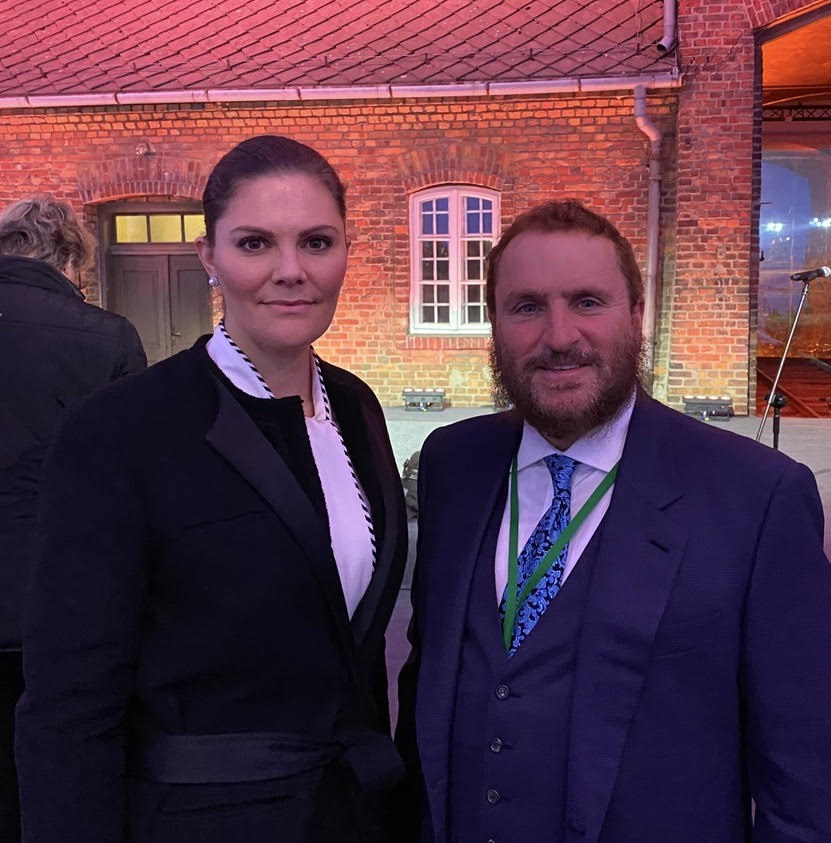
It was a solemn commemoration attended by Holocaust survivors and leaders from across the world. None of us could have known that barely a month later, the coronavirus outbreak would begin closing borders and paralyzing much of the globe.
I spoke with Crown Princess Victoria about Wallenberg, and photographs document our conversation. I told her that Raoul Wallenberg was arguably the most righteous gentile who ever lived. I told her that, as Sweden’s Crown Princess and future queen, she should feel immeasurable pride in this Swedish hero who had placed himself between the Jewish people and annihilation.
But I also asked why Sweden had not done more to uncover his fate and confront the controversy surrounding its government’s failure to bring him home.
The Crown Princess knew about Wallenberg and the unresolved questions surrounding his disappearance. She listened graciously and said she would look into the matter. I believe her concern was sincere. But Wallenberg’s fate should never have depended upon a visiting rabbi raising the subject with the heir to the Swedish throne at Auschwitz - 75 years later. It should have remained an unrelenting national cause from the moment he disappeared.
I also spoke to her about the profound contradiction within Sweden’s modern relationship with the Jewish people.
Sweden has authentic chapters of moral greatness in its wartime history. In October 1943, when the Nazis prepared to deport Denmark’s Jews, the Danish resistance and ordinary citizens carried approximately 7,000 Jews-and hundreds of their non-Jewish relatives-to safety across the Øresund in fishing boats and other small vessels. Sweden opened its territory to them.
That welcome saved lives. It deserves eternal Jewish gratitude.
Sweden also produced Raoul Wallenberg, whose courage made Swedish diplomatic protection synonymous with life itself. Yet in more recent years, Swedish governmental policies and political rhetoric have repeatedly created the impression of hostility toward Israel, the nation-state of the very people Sweden once helped rescue.
I told Crown Princess Victoria how tragic it was that a country associated with the rescue of Danish Jewry and the heroism of Wallenberg could now be perceived by so many Jews as hostile to Israel. She expressed concern and made clear that she did not want Sweden to be anti-Israel or antisemitic-or even perceived as such.
That was an important sentiment. But concern must become action.
One cannot celebrate dead Jews at Holocaust ceremonies while treating living Jews defending themselves in Israel with suspicion and hostility. One cannot invoke Wallenberg as a national icon while tolerating political rhetoric that demonizes the Jewish state. And one cannot credibly honor his memory while the full record of Sweden’s failure to save him remains unresolved.
A country cannot celebrate the rescue of Europe’s Jews while helping turn the state of the Jews into an international pariah.
Sweden eventually investigated, commemorated and apologized for aspects of its handling of the Wallenberg case. Those steps matter. But posthumous reverence can never substitute for courage when courage might still save a life.
It is easy to build a monument to a man who can no longer embarrass the government. It is harder to confront a powerful dictatorship while he is still imprisoned.
Modern Sweden celebrates Wallenberg as the embodiment of Swedish humanitarian values. His image is invoked to teach tolerance, civil courage and resistance to antisemitism. But Sweden cannot honestly claim his glory without confronting its betrayal of him.
His heroism was his own. The failure to save him belonged to the state.
Raoul Wallenberg entered Budapest carrying Swedish credentials and made them sacred through his actions. He gave Sweden a moral luster no public-relations campaign could ever manufacture. His reward was abandonment, bureaucratic misjudgment and decades of diplomatic timidity.
Sweden owes him more than statues. It owes him an unvarnished national confession: when one of its greatest sons stood alone against Hitler, he brought immortal honor to his country. When he fell into Stalin’s hands, his country did not stand with equal courage for him.
That is not merely a historical failure.
It is a national disgrace.
Rabbi Shmuley Boteach is the international bestselling author of thirty-eight books, translated into more than twenty languages. A fearless public intellectual and one of Israel and Jewry’s most eloquent defenders, Rabbi Boteach has appeared on virtually every major television network and media platform across the globe. For eleven years, he served as Rabbi at Oxford University, where he founded the L’Chaim Society and built it into one of the largest student organizations in the university’s history. He lives in New Jersey with his Australian wife, Debbie, Follow him on Instagram and X @RabbiShmuley.