

Apple has raised prices across several product lines. On June 25, 2026, the company updated pricing for Macs, iPads, Apple TV, HomePod, and Vision Pro in the U.S. market, with increases affecting most major models.
The base MacBook Air (M5), for example, went from $1,099 to $1,299. That $200 increase is a clear sign that Apple’s premium devices are getting more expensive. iPhones and Apple Watch models have not changed yet, but expectations are already building around the iPhone 18 Pro lineup.
As Apple products move further into higher price ranges, the real cost of ownership goes beyond the sticker price. Repair costs, battery life, and resale value all matter more than they used to. This article looks at what is behind the price increases and what users can do to protect their devices.
Why Apple Prices Are Rising
Apple’s latest price update reflects broader changes across the tech industry.
AI demand is raising component costs
The rapid growth of generative AI has increased demand for high-performance hardware across the supply chain. That includes not only GPUs, but also DRAM and NAND flash storage.
As a result, memory and storage costs have climbed. Higher-capacity configurations now carry much steeper premiums than they did before, especially on Mac models with large memory options.
Advanced chip manufacturing costs more
Apple’s next-generation chips, including the M5 series and the expected A20 Pro, are moving to more advanced fabrication processes.
Smaller process nodes improve efficiency and performance, but they also raise production costs. At the 2nm level, those costs are especially high, and the increase is beginning to show up in retail pricing.
Pricing pressure is spreading globally
Although this update was made in the U.S. market, it reflects a broader trend. Apple’s global pricing is closely tied to the U.S. dollar, so changes in cost often affect other regions as well.
In markets with weaker currencies, even a modest increase can lead to a much larger jump in local retail pricing.
Updated Mac, iPad, and Apple Device Pricing
The June 25 update raised prices across nearly all Mac, iPad, and selected Apple products in the U.S. The table below shows the updated starting prices.
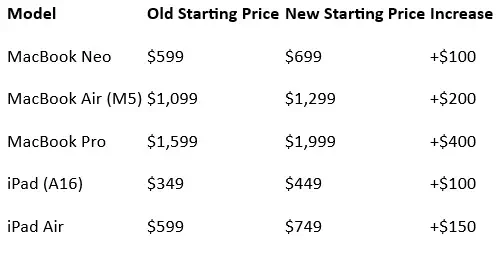
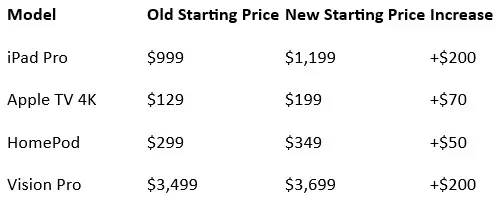
Higher base prices are only part of the story. Once you factor in memory, storage, and other upgrades, the final cost can rise much faster than expected.
iPhone 18 Price Predictions
Apple has not announced official pricing for the iPhone 18 lineup, but current market expectations point to another increase.
Some estimates suggest the Pro models could rise by about $300. If that happens, flagship iPhones could move further into the $1,500 to $2,000 range depending on storage.
Projected U.S. pricing:

These figures are still projections. Final pricing will depend on hardware configuration, launch timing, and market conditions.
Why Protection Matters More Now
As Apple devices become more expensive, they also become harder to treat as short-term purchases. The goal is no longer just to buy the device, but to keep it in good shape for as long as possible.
That makes protection more important in two ways. First, repair costs continue to rise, and even a relatively minor accident can lead to a costly fix. Camera systems in particular have become more complex and expensive to replace.
Second, resale value depends heavily on condition. A device with scratches, dents, or display damage will usually lose value much faster than one that has been kept in good shape.
This is why protective accessories are now part of the ownership equation, not just optional add-ons.
Accessories That Help in Daily Use
As device prices climb, more users are looking for accessories that solve practical problems without getting in the way.
Protective cases with reinforced camera coverage
Cases that reinforce the camera area, often with metal or reinforced frames, help reduce damage from drops. Models with built-in stands also make video calls, streaming, and hands-free use more convenient.
High-clarity glass screen protectors with easier installation
A good screen protector should preserve display sharpness while adding an extra layer of defense. Installation tools such as alignment trays can also help reduce dust and bubbles, which are two of the most common complaints.
These small details make a big difference in how well protection fits into everyday use.
Battery Health in the 25W Charging Era
Charging speed is another part of the long-term ownership picture.
Newer wireless charging standards now support speeds up to 25W. That is convenient, but faster charging also creates more heat, and heat can speed up battery wear over time.
Lithium-ion batteries are especially sensitive to temperature. If a phone regularly runs warm while charging, battery capacity may decline faster than expected.
That is why more users are paying attention not just to charging speed, but also to how charging affects battery health over time.
What This Means for Apple Users
Apple’s latest price changes point to a broader shift toward higher hardware costs. For users, that means three things are becoming more important:
- Higher upfront prices for new devices.
- Higher repair and maintenance costs.
- Greater attention to resale value.
In that setting, protecting your device is part of managing its total cost of ownership. A case, a screen protector, and better charging habits may seem simple, but they can help extend the life of the device and preserve its value.