
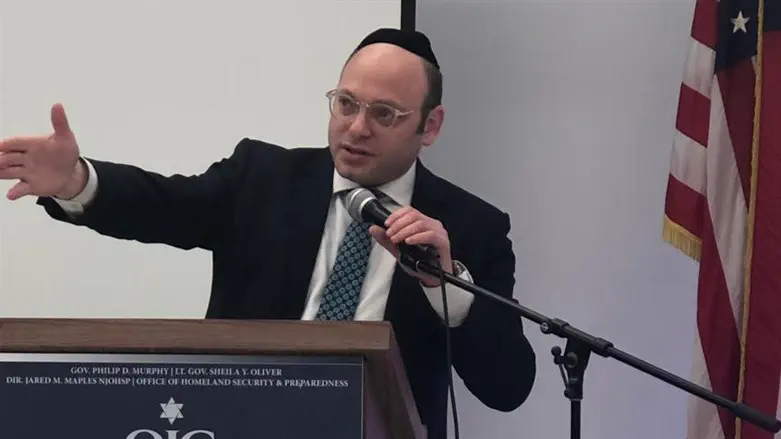
Duvi Honig is Founder and CEO, Orthodox Jewish Chamber of Commerce
On Friday, Israel’s Attorney General Gali Baharav-Miara informed the High Court that continued government funding for hareidi educational institutions should be conditioned on compliance with the state’s core-curriculum requirements, state testing and government supervision.
This is not a debate about curriculum. We are not discussing mathematics, English or educational ideology.
We are discussing power - her power, her position and what I believe is a dangerous abuse of that power.
One unelected official is taking a position that could reach directly into the religious education of hundreds of thousands of Jewish children. And she is doing so during an election period, when the Knesset has been dissolved and the elected government itself operates under heightened constraints.
Who gave one unelected official this much power? And who can stop her when she abuses it?
That question should - and does - concern every Israeli, not only hareidim.
Today it is the yeshivas. Tomorrow it can be you.
Once a country accepts that an unelected authority can reach this deeply into the religious life of one community, it establishes a power that can eventually be turned against another community.
You do not defend religious liberty only when you agree with somebody’s religion. You defend it precisely when you do not.
And imagine for a moment that these were Muslim or Christian schools.
Imagine the reaction if a government legal official threatened their funding unless they accepted state requirements governing how their children were educated. There would immediately be warnings about religious discrimination, parental rights and government intrusion into faith.
Would anyone dare treat those communities with the same confidence?
Israel cannot demand sensitivity toward every religion except Judaism.
There is another audience watching this closely: Jews in the United States and throughout the Diaspora.
Many of us are deeply disturbed.
For generations, Jews living outside Israel have fought for the right to educate our children according to our faith without government officials dictating our religious values. We would condemn such interference in Washington, London or Paris.
How can we remain silent when it happens in the Jewish state?
This becomes even more troubling when viewed as part of a broader pattern. Israelis should examine the attorney general’s repeated confrontations involving religion, Torah institutions and religious authority and ask where this is heading, as well as parliamentary decisions.
At some point, the public must stop examining every confrontation separately and look at the pattern.
Is an unelected office protecting democracy, or is the language of democracy increasingly being used to justify power that voters themselves cannot control?
Democracy cannot become a flag behind which unaccountable power hides.
An attorney general cannot be voted out by a parent who believes she has gone too far. A government can. A member of Knesset can.
Israel is not Iran, and its political system and freedoms are fundamentally different. But Israel should understand better than almost any country the danger of concentrating enormous power in officials ordinary citizens cannot remove.
Dictatorial behavior does not become democratic simply because the person exercising the power invokes democracy.
The answer is straightforward.
Decisions touching the religious identity and education of hundreds of thousands of citizens belong in the democratic process. Let elected representatives debate them. Let affected communities be heard. Let the Knesset legislate.
Then let Israelis decide at the ballot box.
The Jewish people did not begin educating their children in 1948.
The mesorah - Torah transmitted from generation to generation - survived exile, persecution and governments far more powerful than today’s Israeli bureaucracy.
No attorney general created that tradition, and no attorney general should be able to threaten its independence with the swipe of a pen.
This is why the Israeli public needs to speak - religious and secular alike.
This is bigger than hareidim. It is bigger than curriculum. And it is bigger than Gali Baharav-Miara.
It is about whether democracy ultimately answers to the people.
Jews throughout the Diaspora are watching. Israelis should be watching too.