
Meir Jolovitz is a past national executive director of the Zionist Organization of America, and formerly associated with the Institute for Advanced Strategic and Political Studies.
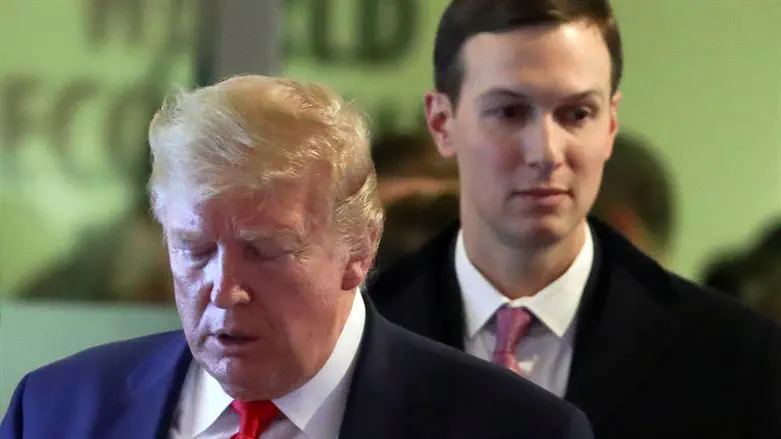
President Donald Trump’s son-in-law and key adviser Jared Kushner - one of the principal architects of a strategic proposal that we have been asked to believe is a “peace" process - is visiting Israel again. His last visit, in November 2025, was to serve Israel a previous iteration of an equally misbegotten plan that is being served again. On a silver platter of sorts, if only Israel would cooperate.
Accompanying Kushner is Board of Peace top envoy Nickolay Mladenov, in a team effort to ostensibly persuade (read: pressure) Prime Minister Benjamin Netanyahu to stand down and facilitate the advancement of the Board’s plan to "disarm" Hamas in Gaza. The October 2025 ‘20-Point Gaza Peace Plan’ didn’t work, so a refashioned version - a 15-Point plan officially titled ‘A Roadmap for Completing the Implementation of President Trump’s Comprehensive Peace Plan in Gaza - July 30, 2026’ is the soup du jour.
What ought to be of concern is this notable difference: While the former didn’t list until Point 19 “a credible pathway to Palestinian statehood", the current plan lists it as the first aspirational (read: objective) point. A subject for a correlative or future analysis.
Inherent in either - or both - plans is some specious assumption or expectation that peace is actually attainable between two mutually exclusive religious/political ideologies, where one demands the right to exist while the other is of a different opinion vis a vis that entity's continued existence..
The crux of the matter seems to be the very nature of the conflict between Israel and the Palestinian Arabs - where sound minds would view it as existential and less than sound minds do not. That latter element seems not to comprehend that for the Muslims - the war is religious and not territorial. Many, many, others have made this point, and yet, very few seem to really embrace this truth. Trump’s son-in-law among them.
Herein lies the problem, and a reason for Israel and Netanyahu to stand firm - notwithstanding the political implications underscoring American-Israeli relations - in its stated rejection of Kushner’s objective.
“The Internet never forgets". A useful idiom that ought to have greater relevance in understanding the Middle East. No, it never does forget - much to the chagrin of politicians and diplomats. And sons-in-law. Particularly in negotiating the Middle East, where illusions so often lead to delusions. Worse - to self-delusions.
The Internet offers modern digital footprints where words so often vanish the moment they have been spoken. Purposely and purposefully. For a myriad of reasons and explanations. Political amnesia. “Taken out of context". Misunderstanding. Or “mis-remembered". But more often than not - for political expedience; the necessary vehicle to drive a predetermined pollical agenda.
Where we could give a dozen examples, we shall offer here only two examples.
Found frequently in political discourse is the insistence that it matters not what one says - but rather - what one does. Ignored - or perhaps even lost - is the equally important assertion: ‘what one believes’. Particularly in the Middle East.
Yet, during these discussions with the Muslim world - nothing, it seems - about the sine qua non: “what they believe".
First, let us recall this: In a January 2020 interview with Sky News Arabia, Jared Kushner claimed he read 25 books on the Israel-Palestine (sic) conflict, defending his role as an ‘expert’ forging the Trump administration's Middle East peace plan.
Second, see this:
In an op-ed that was featured in the Wall Street Journal on March 14, 2021 - titled “Opportunity Beckons in the Mideast" - Jared Kushner demonstrated his utter ignorance of the conflict(s) in the Middle East. For Israel and its advocates, it needed to be a wake-up call - a warning pregnant with serious consequences - that Israel had allowed its fate to be negotiated by a gullible amateur - a real estate player whose prescription for peace was indeed a guarantee of anything but. It was indeed a licensed invitation offered to the Arabs to exploit his foolishness.
In that op ed, his misbegotten understanding of a conflict included the following excerpt:
“We are witnessing the last vestiges of what has been known as the Arab-Israeli conflict….
"One of the reasons the Arab-Israeli conflict persisted for so long was the myth that it could be solved only after Israel and the Palestinians resolved their differences. That was never true. The Abraham Accords exposed the conflict as nothing more than a real-estate dispute between Israelis and Palestinians that need not hold up Israel’s relations with the broader Arab world. It will ultimately be resolved when both sides agree on an arbitrary boundary line."
Imagine. “Nothing more than a real-estate dispute between Israelis and Palestinians!"
Rejecting any notion that the Muslim war against Israel was religious - instead, he argued, it was territorial, resolved by “arbitrary boundary lines".
An asinine and half-witted characterization that begs to be ridiculed and condemned by every supporter of the Jewish State. Sound the alarm!
We reference the Internet again. A second example.
Speaking at the White House Rose Garden on June 9, 2017 - only several months after he was inaugurated as ‘Trump 45’ - the president stated: "The nation of Qatar, unfortunately, has historically been a funder of terrorism at a very high level." He then urged - somewhat naively - that same Muslim nation to end its history of funding its radical extremist ideology, most notably to Hamas. And he believed they would.
Qatar - the terror-supporting nation that Trump had self-deluded into believing was to be trusted to actually script the future fate of Gaza, notwithstanding its ongoing support for Hamas - and, yes, funding many elite American universities which offer Middle East study programs financed and driven by the same ideological fervor calling for an end to Israel. Certainly, Jared Kushner, having read 25 books, must have known this.
Fast forward. To the mixed signals from Trump - often in complete contradiction of one another. They culminated in Trump’s “Gaza 20-Point Peace Plan" - to a great degree the brainchild of one of its architects, the same Jared Kushner who thought the conflict was a byproduct of “a real-estate dispute"; and in conjunction with the one terror-supporting nation that ‘Trump 47’ now chooses to repeatedly laud as “a great ally, an honest broker, and a dear friend" that has assisted in formulating the new ‘15-Point Gaza Roadmap’.
Remember, “the Internet never forgets".
Nor should we. That negotiations - about Gaza, and now also about ending quite prematurely a war with Iran - are the diplomatic initiatives of a president who actually believes that Qatar, Türkiye, and Pakistan are friends and not foes, coupled with the handiwork of his envoy who views the war with the Muslim world as a real-estate dispute.
The Internet remembers. Trump’s Administration wishes we did not.
Nineteenth century German philosopher Friedrich Nietzsche, in his essay "On Truth and Lies in a Nonmoral Sense", argued that language cannot capture objective reality. Instead, words are merely metaphors that we have forgotten are illusions, while our subjective interpretations dictate our everyday reality. Even if delusional.
We are constantly reminded.