

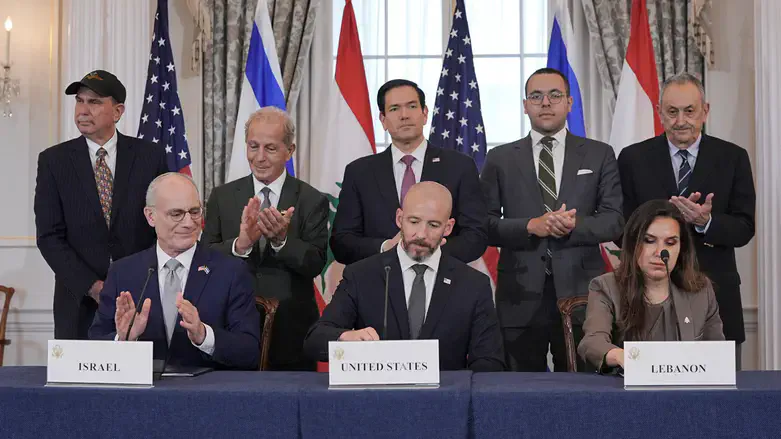
Recent US-brokered discussions between Lebanese and Israeli delegations in Rome were “constructive and detailed," a US State Department official stated Tuesday, brushing off reports of diplomatic friction.
The August 4-6 summit marked the seventh negotiation round between Lebanon and Israel since conversations began earlier this year. The agenda focused on advancing the US-brokered Trilateral Framework Agreement signed in Washington on June 26.
Under the terms of the accord, the Lebanese Armed Forces (LAF) are tasked with restoring governmental authority in southern Lebanon - a process requiring the disarmament of the Hezbollah terrorist organization and the removal of its military infrastructure - before Israeli forces begin a phased withdrawal from Lebanese territory.
The latest session focused on broadening the framework's "pilot zones," where the Lebanese military is scheduled to take full security control after clearing out Hezbollah weapons and positions. Operations across the initial pilot zones commenced on July 20 in the southern towns of Srifa, Froun, and Zawtar al-Gharbiya, coordinated by the US-led Military Coordination Group for Lebanon.
“The sides finalized the details needed to implement the pilot zones and other aspects of the Trilateral Framework, including shared definitions of verification and clearance," the State Department official noted in Tuesday’s comments.
A primary hurdle in rolling out the zones has been defining unified procedures and benchmarks for what constitutes a completed handover, including how the Lebanese military's clearance activities will be independently verified.
“The military delegations finalized operating parameters, common maps, and a roadmap to unlock future pilot zones," the official stated, adding, “We now have clear definitions and metrics for success."
Beyond technical parameters, the talks addressed “US-led diplomatic engagement to complement the Trilateral Framework, including third-party verification of the LAF’s clearance operations," alongside separate bilateral conversations with Lebanese envoys regarding swift financial aid for regional reconstruction.
Israeli and Lebanese representatives also reportedly agreed on a shortlisted group of nations that could contribute to an independent verification body monitoring Hezbollah's disarmament inside the pilot zones. Sources in Beirut named Italy, Switzerland, Indonesia, and the United Kingdom as candidates, though Washington has not publicly confirmed those specific countries.
Diplomats expect the political track of negotiations to reconvene in Rome in early September. During that session, said the US official, “Lebanon will present detailed roadmaps for securing new areas as implementation proceeds in the current zones."
“We feel good about the trajectory," the official remarked, adding, “We are not naive about the difficulties" in light of Hezbollah’s opposition and domestic political friction in both Jerusalem and Beirut.
The framework was engineered to absorb political friction while maintaining momentum, beginning with demonstrating success in the initial pilot zones before expanding outward, the official explained.
“Both sides face political constraints; we are working through them methodically because shortcuts produce the same failed outcomes we have seen for decades," the official emphasized, concluding, “The direction of travel remains positive, and nobody is dragging their feet on implementation."
The optimistic assessment stands in contrast to a Sunday night report by the Hezbollah-linked network Al Mayadeen. Citing a Lebanese diplomatic source, the report claimed that direct negotiations between Jerusalem and Beirut are unlikely to resume next month, predicting delays until after the summer.
The Lebanese source asserted that Washington and Jerusalem have refused to expand the pilot zones until measurable progress occurs across the first two designated sectors. Furthermore, American and Israeli officials reportedly demanded Hezbollah's total retreat from the strategic Ali al-Taher ridge.
Hezbollah is not a party to the Lebanon-Israel agreement and continues to refuse to lay down its weapons.